
























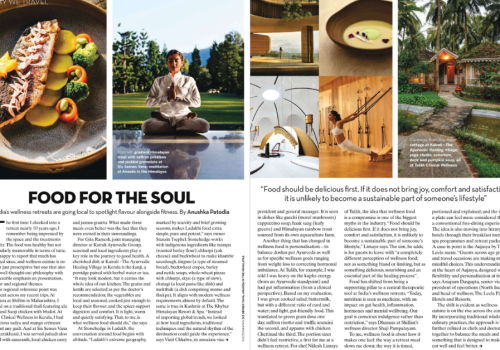




In September 2009, Hindustan Times published a travel piece by Kushalrani Gulab after she spent three days at Kairali’s Ayurvedic property in Palakkad.
Its headline was simple: “Fatigued? Rejuvenate yourself.”
What makes the article interesting more than a decade later is not the language of rejuvenation. It is the writer’s description of returning to work after the trip and feeling strangely disconnected from her normal pace.
She had been away for only a few days. Yet the slower rhythm of the stay made ordinary Monday morning life feel unexpectedly unfamiliar.
That observation feels even more relevant now.
We have become very good at taking holidays without necessarily resting.
A holiday is not always the same as rest
Modern travel can be exhausting in its own way.
There are flights to catch, restaurants to book, places to photograph and itineraries to complete. Even when we are technically “off”, phones remain close at hand. Emails arrive. Social media continues. Work follows us more easily than it did when Gulab wrote her article in 2009.
A residential Ayurvedic stay works differently.
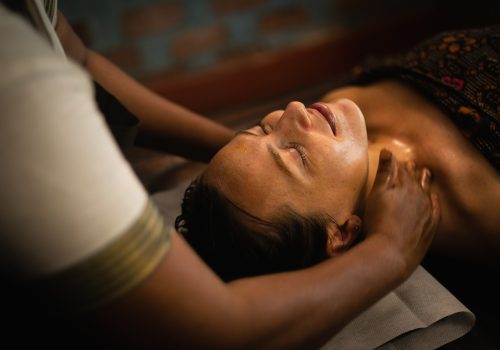
The day is usually more structured. Meals happen at regular times. Therapies are scheduled. There is time for rest, walking, yoga or quiet activity. The pace is deliberately slower than ordinary urban life.
This does not mean that a retreat somehow switches off stress.
It means that the environment removes some of the habits that keep us continuously stimulated.
That distinction matters.
What Gulab noticed at Kairali
In her Hindustan Times account, Gulab wrote about arriving in Palakkad from Mumbai and quickly adjusting to the quieter environment.
She described reading, walking, yoga, Ayurvedic treatments and the simple fact that there was less to do than in the city. Rather than finding the slower pace frustrating, she found herself settling into it.
There is something useful in that description.
Rest is often imagined as an activity we add to an already crowded schedule: a massage at 5 pm, meditation before bed, a weekend away every few months.
Ayurveda tends to look at the structure of the day more broadly.
Sleep, food, activity, digestion and routine are considered together. The question is not only whether someone has rested for an hour, but whether their daily pattern allows adequate recovery in the first place.
That is a less glamorous idea than a wellness treatment.
It may also be the more important one.
Why environment can change behaviour
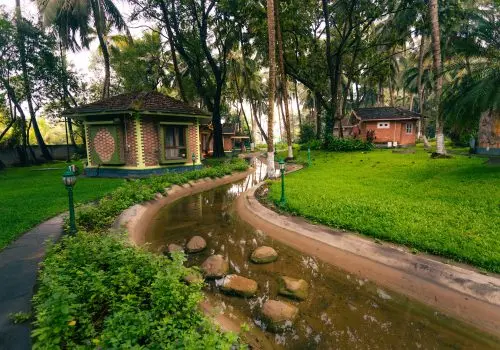
The setting of an Ayurvedic retreat is sometimes described in exaggerated terms, as though trees, silence or fresh air have healing powers of their own.
There is no need to make that claim.
Environment matters because it changes what we do.
In a quieter residential setting, there may be fewer late dinners, fewer meetings, less commuting and fewer opportunities to remain online until midnight.
Meals can become more predictable. Bedtimes may become earlier. Walking becomes easier to fit into the day.
Research on exposure to green spaces has also found associations with psychological restoration and lower perceived stress, although the evidence varies considerably between studies and should not be interpreted as proof that a retreat treats stress-related illness.
The surroundings create conditions that may make rest easier.
They are not a treatment in themselves.
Ayurveda’s interest in regularity
One of Ayurveda’s practical ideas is dinacaryā, or daily routine.
The principle is straightforward: the timing of waking, eating, activity and sleep forms part of health rather than sitting outside it.
A residential Ayurvedic programme makes this particularly visible.
Instead of meals changing according to meetings or travel, they occur at defined times. Therapies fit within a schedule. Rest is not squeezed into whatever remains of the day.
Modern sleep research approaches this through a different framework, but there is increasing interest in the importance of regular sleep timing as well as total sleep duration. Systematic reviews and large observational studies have associated greater sleep regularity with better health outcomes, though those findings do not mean that simply following a retreat timetable produces those outcomes.
What both perspectives make easier to appreciate is that consistency matters.
The difficult first stage of slowing down
There is another side to rest that wellness marketing rarely discusses.
Slowing down can initially feel uncomfortable.
Someone accustomed to constant activity may feel bored when there is nothing urgent to do. Without notifications and deadlines, mental restlessness can become much more noticeable.
That does not need to be interpreted through mystical language or treated as evidence that the body is “detoxing”.
Sometimes it simply means that the pace has changed.
Gulab’s article captures that transition well. Her stay was striking partly because the environment was so different from her working life in Mumbai.
A quieter schedule gives people an opportunity to notice habits that are usually hidden by activity.
How tired am I when I stop pushing through the day?
Do I actually sleep enough?
How often do I eat in a hurry?
Can I sit with a book without checking my phone?
These are ordinary questions. They can also be revealing ones.
More than massage
The 2009 Hindustan Times article reflects the wellness language of its time. It describes Kairali partly as a place people visited for specific health complaints and uses stronger treatment language than WhyAyurveda would use today.
That is worth acknowledging rather than repeating.
Kairali, The Ayurvedic Healing Village today operates as an NABH-accredited Ayurvedic hospital in Kodumbu, Palakkad. Physician assessment forms the basis of its residential programmes.
That clinical structure distinguishes Ayurvedic residential care from simply booking a sequence of massages.
An Ayurvedic physician may consider health history, constitution, digestion, sleep and current concerns before deciding whether therapies are appropriate.
The programme may also include meals, yoga, movement and rest.
The useful point is not that every element independently “heals”.
It is that they are organised as part of the same daily environment.
What modern rest should not promise
Wellness travel often makes restoration sound almost instantaneous.
Arrive exhausted on Friday. Leave transformed on Sunday.
Real life is less tidy.
Three quiet days may feel restorative, as Gulab’s account suggests. They are not enough to resolve chronic stress, burnout, insomnia or another medical or psychological condition.
Mindfulness and relaxation programmes have shown modest benefits for perceived stress in research settings, but they are not substitutes for appropriate medical or mental-health care when that is needed.
A retreat should therefore be careful about what it promises.
The most credible benefit of a short stay may simply be the chance to experience a different routine and notice which parts of it are worth carrying home.
The difficult part begins after the retreat
There is an irony in Gulab’s story.
The clearest sign that the weekend had changed her pace appeared when she returned to the office.
That is also where every retreat eventually meets reality.
Regular meals are relatively easy when someone else prepares them.
An early bedtime is easier when there is no commute.
A quiet walk is easier when it is already built into the day.
The harder question is what survives after returning home.
Perhaps one earlier dinner.
A more consistent sleep time.
Half an hour without a screen.
A regular walk.
Enough space in the day to notice fatigue before it becomes exhaustion.
A retreat cannot permanently create those conditions for us.
It can make their absence easier to see.
What that 2009 weekend still gets right
Much has changed in wellness travel since Kushalrani Gulab visited Kairali.
The language has changed. The industry has grown. Consumers are more sceptical of broad therapeutic promises, and rightly so.
But one observation in her article has aged particularly well.
Rest feels different when the structure of the day changes.
Ayurveda has long treated routine, food, sleep and environment as relevant to how a person feels. Modern research is examining some of those same areas through very different scientific frameworks.
Neither perspective supports the idea that a weekend away can cure chronic stress.
They do suggest something more practical.
Rest is not simply stopping work.
It is giving the body and attention enough consistency, quiet and time to recover from the pace at which they have been operating.
For many people, the hardest part may not be finding somewhere to rest.
It may be remembering how.