



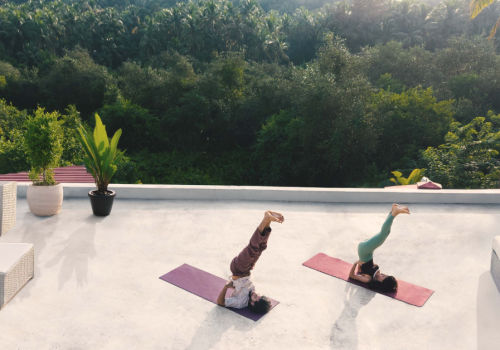


















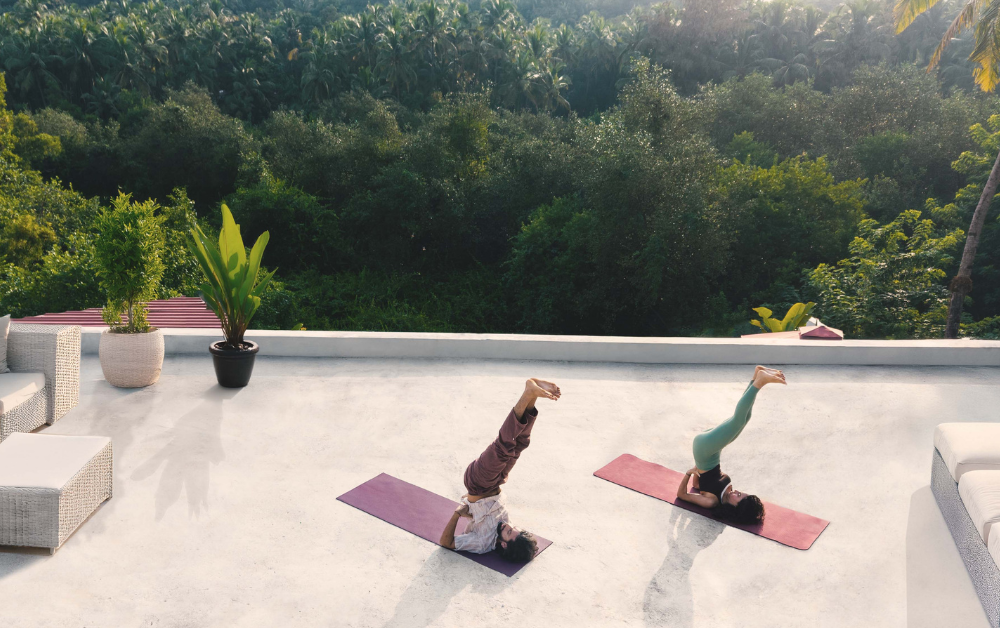

When guests arrive at Villa Raag in Goa, many already roll out their mats with confident habits and a “regular practice.”
Their bodies tell a softer, truer story. Stiff side ribs. Tired lower backs. A quiet disappointment that yoga “should feel better by now.”
This usually has very little to do with discipline or dedication. More often, it’s a few subtle sequencing habits that slowly pull the system out of balance, week after week, class after class — the kind of drift you only notice when you suddenly realise you’re waking up sore every morning.
As an Ayurvedic physician who’s spent years working alongside yoga teachers at Kairali – The Ayurvedic Healing Village, and now shaping programmes for Villa Raag, I see practice through both anatomy and an Ayurveda lens. One of the early surprises in my clinical work was how often a guest’s sleep, digestion, and emotional state improved simply by adjusting how their classes were structured, even before adding herbs or treatments.
What follows are the sequencing gaps I see most often — and how we gently recalibrate them in a retreat setting, without breaking anyone’s spirit or love for the mat.
How Ayurveda sees yoga sequencing mistakes
Ayurveda, the traditional science of life and health, starts from the idea that each person has a unique Prakriti (constitution).
That constitution is described through three Doshas (functional principles): Vata (movement and air), Pitta (heat and transformation), and Kapha (stability and earth).
When a sequence leans too heavily in one direction, it tends to push a Dosha out of its comfortable zone. A class strung together from nonstop fast vinyasas can easily overstimulate Vata — breath gets shallow, thoughts speed up, and the body feels slightly “ahead” of itself.
In peak Goan summer, strong, aggressive backbends are more likely to aggravate Pitta — more heat in the face, irritation rising quickly, difficulty cooling down even after a shower.
Long, heavy holds with almost no warmth or circulation can increase Kapha, leaving you slow, dull, and hard to get moving again, even if you technically “did your practice.”
At Villa Raag, I often ask teachers one basic question when we review class plans: “After this sequence, what do you want the student’s nervous system to feel like?”
Their answer quickly shows which Dosha they’re unconsciously feeding — and whether the arc of the class will support or quietly strain the body underneath the visible effort.
Mistake 1: Chasing a peak pose instead of a balanced class
Many guests arrive with clear, heartfelt goals.
“I want to finally get into wheel.” “I’d like to master a deep backbend by the end of the week.” These aims can be healthy and inspiring.
The difficulty begins when the entire class revolves around one dramatic posture, while the rest of the spine and major muscle groups are treated as extras. A backbend‑heavy practice that never really lets the spine flex forward can leave the lower back gripping, the front body overworked, and the nervous system slightly on edge.
When this becomes a weekly pattern over months, I often see it showing up as disturbed sleep, tightness in the neck and jaw, and a jumpy, scattered mind — all classic signs of Vata disturbance hiding under the appearance of strength. At Kairali’s clinic in Palakkad, a number of long‑term practitioners have come to us with chronic neck pain that softened significantly once their home routine included simple forward bends and gentle flexion after years of only “heart‑opening” work.
The Villa Raag fix: A 6–4–2 style check‑in
Instead of counting how many poses they can fit into 60 minutes, our teachers use a quiet checklist before each class:
- Six directions of the spine: forward bend, backbend, side‑bend right and left, twist right and left
- Four “lines” of the legs: front (quads, hip flexors), back (hamstrings, calves), inner (adductors), outer (abductors/IT band)
- Two core actions: active engagement and an intentional softening/release
This isn’t a rigid template.
It’s more like a safety net under creativity. When each area is at least touched, the practice tends to feel rounded, with fewer “forgotten” territories in the body.
Guests often explain the difference in simple words: “I feel worked, but not wiped out.” On the treatment side, when someone walks into the consultation room after such a class, the breath usually feels even, the skin temperature more steady, and the eyes less restless. That’s usually a good sign that Agni (digestive and metabolic fire) has been supported instead of drained, and that the sequence is building resilience rather than slowly depleting it.
For a broader look at how sound structure supports safety, this overview of what authentic Ayurveda focuses on in a retreat setting offers more context and examples from clinical practice.
Mistake 2: Ignoring side body and inner legs
Among regular studio practitioners, I often notice the same combination.
Strong fronts of the thighs, fair hamstring length — but very quiet inner legs and side ribs that feel almost armoured. Over time, the loss of lateral softness and width can disturb both Vata and Pitta.
Classes filled with forward folds and the usual “hip openers” for the outer hips rarely wake up the adductors or the intercostal muscles.
Someone might slide easily into a forward fold and touch their toes, yet still feel compressed and narrow across the waist and chest, as if there’s no sideways space.
In consultations, this often correlates with shallow, upper‑chest breathing and a sense of “mental tightness” — difficulty taking a full, satisfying breath even when lung capacity is normal. One software engineer who works remotely from Bangalore described it to me as “breathing through a straw in my upper ribs.”
The Villa Raag fix: Side‑bending as a daily vitamin
In Goa’s humid summer, we treat side‑bends and gentle twists a bit like your daily mineral tablet. Skipping them for too long usually shows up somewhere.
They support the ribcage’s natural breath movement and help soften sharp Pitta edges, while giving Vata some grounded length and orientation.
We use simple shapes: a supported side stretch draped over a bolster, or a deliberate, even lateral bend in standing poses, layered into nearly every class. One of our teachers has a favourite line: “I don’t mind how far you go — I care where you feel it.”
The goal isn’t depth or a photo‑worthy shape; it’s sensation spread like a thin ribbon along the whole side body, instead of a single stabbing point at the waist or shoulder.
Over a week, guests often describe a quiet shift — less pressure under the bra line, easier breathing when climbing the stairs to their villa, and a general sense of more “room” around the heart area.
Mistake 3: Overusing “flow” and underusing rest
Many high‑performing guests — CEOs, parents, caregivers, people used to holding things together — arrive with an unspoken rule in their heads. A “good” practice should leave them drenched in sweat and pleasantly exhausted.
Sequencing then becomes an almost unbroken chain of vinyasas, crested by a short rest at the very end, if there’s any time left.
Viewed through Ayurveda, this drains Ojas (vital reserve or resilience) surprisingly quickly and can easily irritate Vata.
When months go by like this, sleep often gets lighter, moods swing more readily, digestion loses regularity. The person often describes feeling simultaneously tired and wired — craving rest, but overstimulated when they try. Several women I see for perimenopausal symptoms arrive with this pattern: restless nights, hot flushes, and a strong attachment to only fast, high‑intensity classes.
The Villa Raag fix: Pacing that respects Ojas
We absolutely still use flow in our classes.
We just interrupt it on purpose. After a heating or effortful sequence, we insert simpler, ground‑level shapes, supported forward bends, or a brief, clear period of watching the breath. These pauses aren’t treats tacked onto the ending; they’re load‑bearing columns inside the structure of the class.
This rhythm echoes how we design Panchakarma (structured cleansing and rejuvenation protocols) at Kairali. As we explain in our Palakkad retreat walk‑through, each strong therapy is counterbalanced with quiet time and nourishment.
The nervous system is asked to stretch into something new and then is consciously led back to safety, instead of being left suspended in effort.
In practice, this might look like three or four rounds of sun salutations, followed by a few breaths in child’s pose and a supported kneeling lunge, before moving into standing work again. Guests often notice that with this pacing, they fall asleep more easily at night, even though the total “work” of the class is similar.
Mistake 4: Same sequence, every day
Repeating the exact same class each day can feel comforting. There’s predictability, no need to think, and progress is easy to measure.
Meanwhile, the body is in an ongoing conversation with whatever’s happening outside and inside: climate, menstrual cycle, workload, emotional waves, sleep depth, even what you ate for dinner.
A fixed sequence that never listens to those changes can become a quiet, background stressor. During hot Goan afternoons in Grishma (summer), a strong midday power class with long arm balances may send a Pitta‑dominant student away flushed, impatient, and overheated.
The very same class could feel perfectly energising for them on a clear, dry December morning.
The Villa Raag fix: Seasonal and daily tweaks
At check‑in, we look at each guest’s Prakriti and current Dosha balance. But the adjustments don’t stop with that initial assessment.
We also look closely at the immediate context. If the night was unusually humid and people slept poorly, the morning class often shifts toward more floor work, gentler pacing, and less additional heat. On cooler, lighter days, we may bring in longer standing sequences, balances, or slightly stronger holds.
On one particularly heavy monsoon morning, for example, we replaced planned arm balances with slow supine twists and supported bridge variations. The class looked “easier” on paper, yet post‑class pulses were steadier, and several guests reported better appetite and a clearer head through the afternoon.
This way of thinking follows guidance from classical Ayurvedic texts like the Ashtanga Hridaya, which repeatedly emphasise syncing activity and intensity with the season and the person’s available strength, rather than clinging to one permanent routine.[^1]
Practically, it can be as simple as asking at the start of class: “Heavy, light, or somewhere in between today?” and quietly letting that answer reshape the arc.
[^1]: Vaghbhata, Ashtanga Hridaya, Sutrasthana – sections on seasonal regimens.
Mistake 5: Forgetting the nervous system
The subtlest, and probably most important, sequencing mistake is overlooking how the class actually lands on the nervous system. On paper, a sequence can tick every box: all directions of the spine, strength and stretch, rest and effort.
Yet in the lived experience, it may still leave someone agitated and buzzy, or flat and dulled, if the opening and closing don’t meet their mental state where it is.
When we review classes at Villa Raag, I ask teachers to describe the first five minutes and last five minutes almost pose by pose. Are we asking students to jump into demanding standing shapes before their breath has even been noticed?
Are we spinning them out of a strong inversion straight into breakfast, phones, and emails, with no time to come down?
The Villa Raag fix: Clear opening and closing rituals
Every class starts with a simple, repeated opening. Just a few minutes of sitting or lying quietly, noticing natural breath, and scanning for physical sensation without judgment.
That small ritual settles Vata and gives the mind a neutral “starting picture” before anything moves.
We close with an unhurried Shavasana and at least one small grounding action: maybe a short seated practice, deliberate contact of the hands with the floor, or a slow walk back to the villa instead of rushing off.
In the first week of our soft launch at Villa Raag, one guest shared that this final pause changed how she entered her work calls afterwards — “less like I’m jumping on a moving train, more like I’m choosing to step in.” Many guests later tell me that these bookends are what they replicate at home when they design their own practice — more lasting in their memory than any complicated arm balance.
Bringing it home: questions to ask your own practice
You may not have a teacher checking every sequence you do at home.
Still, you can bring this way of looking at things to your own mat. Before or after you practice, you might gently ask yourself:
- Did I move my spine in all six directions today, even briefly?
- Did my legs work in a balanced way — front, back, inner, and outer lines?
- Where, in the flow of the sequence, did I genuinely feel rested? Where did I feel hurried?
- How does my mind feel two hours after practice, not only in the first few minutes afterward?
If you’re curious how a retreat environment can reset some of these ingrained patterns, our team at Kairali has written more about the contrast between trend‑driven wellness breaks and structured, therapeutic stays in this comparison of Ayurveda retreats in Kerala.
At Villa Raag, my intention stays simple and steady: to let yoga sequencing work with your body, instead of quietly against it, so that you leave Goa with a practice that feels steady, spacious, and realistically sustainable in the life you’re returning to.
Website: www.villaraag.com
Call: +91-9555156156





Leave a Reply