


















Travel is usually described in terms of what we receive.
A quieter morning.
A better meal.
A beautiful view.
Time away from work.
A chance to rest, move, swim, walk, or simply be somewhere different.
There is nothing wrong with that. Travel is often valuable precisely because it gives us distance from familiar routines.
But there is another question worth asking.
What do we give back to the places we visit?
That question sits at the heart of Leave Only Footprints – A Mindful Agonda Walk, part of World Wellness Weekend at Villa Raag.
The activity begins with a simple idea: wellness does not have to remain personal.
It can extend to the places that hold us.
Wellness does not end with the individual
Much of modern wellness is centred on the self.
How do I feel?
How do I sleep?
How do I move?
How do I become calmer, stronger or more balanced?
These are useful questions.
But wellbeing also depends on the environments around us.
The quality of the air.
The spaces we walk through.
The landscapes we enjoy.
The beaches, forests, villages and neighbourhoods that become part of our experience of a destination.
A wellness retreat may begin with the body, but it does not need to stop there.
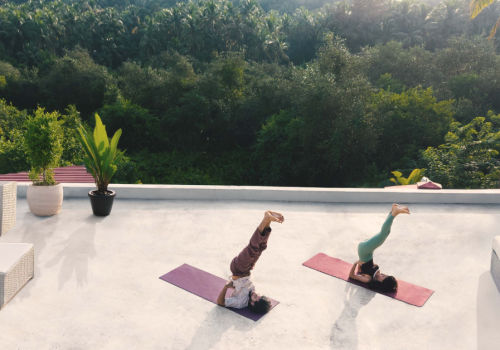
Wellness doesn’t stop at the edge of the yoga mat.
Mindfulness can move outward
Mindfulness is often understood as paying attention to the present moment.
But attention can be directed outward as well as inward.
You can notice the sound of the sea.
The condition of a walking path.
The plants growing at the edge of a road.
The way people use a public space.
The small signs that a place is being cared for.
You can also begin to notice your own presence within that environment.
What you carry.
What you leave behind.
What you disturb.
What you choose not to disturb.
This is where mindful travel begins to overlap with responsible travel.
Not through grand gestures, but through greater awareness of how we move through a place.
Responsible travel can be very small
Sustainable travel is often discussed at a large scale.
Flights.
Infrastructure.
Energy use.
Waste systems.
Tourism policy.
These questions matter, but they can also make individual travellers feel that their own actions are too small to count.
Responsible tourism can begin much closer to the ground.
Carrying a reusable bottle.
Avoiding unnecessary single-use items.
Staying on designated paths.
Respecting local wildlife.
Leaving natural objects where they are.
Being thoughtful about noise.
Disposing of waste carefully.
Picking up something that has been left behind when it is safe and appropriate to do so.
None of these actions solve the environmental pressures associated with tourism.
But they do change the relationship between traveller and destination.
The traveller is no longer only a consumer of the place.
They become a temporary participant in its care.
Why coastal environments deserve attention
Coastal destinations often carry much of the visual language of wellness.
Open skies.
Long walks.
Water.
Silence.
Sunset.
The sense of space that comes from being close to the sea.
Yet a beach is not simply scenery for the traveller.
It is part of a living environment shared by residents, visitors, wildlife and the wider coastal ecosystem.
That is why care matters.
The point is not to describe Agonda through the language of pollution or environmental crisis.
That would distort the purpose of the activity.
The intention is simpler: to approach a place of natural beauty with attention and respect.
To enjoy it, while remembering that enjoyment also creates responsibility.
Introducing Leave Only Footprints
Leave Only Footprints – A Mindful Agonda Walk brings that idea into practice.
Designed as part of World Wellness Weekend at Villa Raag, the activity combines a quiet walk through Agonda with a supervised litter collection.
It is not intended as a large-scale clean-up campaign.
Nor is it designed to turn the walk into an environmental performance.
The emphasis is on attention.
Participants walk slowly.
They observe the surroundings.
They notice the coastline not simply as a backdrop, but as a place they are moving through.
Where appropriate and under supervision, they collect litter encountered along the route.
The act is small.
That is part of the point.
A different way to walk
Most walks while travelling have a destination.
A viewpoint.
A café.
A photograph.
A landmark.
A return point.
A mindful walk asks for something different.
It asks the participant to notice the journey itself.
The texture of the ground.
The movement of the air.
The sounds around them.
The way the coastline changes as they move through it.
The presence of other people sharing the space.
When litter collection is added to that walk, attention becomes action.
You are no longer simply looking at the environment.
You are responding to it.
Not dramatically.
Not as a declaration.
Just practically.
Care, not criticism
An activity like this needs to be framed carefully.
The purpose is not to suggest that Agonda is defined by litter.
It is not.
Nor should visitors arrive believing they are there to “fix” a place that belongs to the people who live there.
That would turn a gesture of care into something self-congratulatory.
Leave Only Footprints is better understood as a practice of participation.
If we benefit from the beauty of a place, we can also accept a small responsibility toward it.
The action is not heroic.
It is reciprocal.
Gratitude can be practical
Gratitude in travel is often expressed verbally.
We say that a place was beautiful.
We say that we were fortunate to visit.
We post photographs.
We remember the view.
But gratitude can also take a practical form.
It can mean leaving a space as we found it.
Or, occasionally, a little better.
It can mean choosing restraint.
It can mean remembering that the beach, village, forest or trail existed before our arrival and will continue after we leave.
That changes the way we think about hospitality.
A destination gives us something.
Rest.
Beauty.
Perspective.
A different rhythm.
Perhaps the traveller can return something too.
Attention.
Respect.
Care.
A wider definition of wellness
There is a version of wellness that ends with the individual.
The body feels better.
The mind feels quieter.
The holiday was restorative.
Then there is a wider version.
One that asks whether our wellbeing can coexist with care for the people and places around us.
That is the idea behind Leave Only Footprints.
The activity does not ask travellers to become environmental activists for an afternoon.
It asks for something more immediate.
Walk slowly.
Notice where you are.
Respect the place.
Help where you can.
And leave with an awareness that wellness is not only about what the world gives us.
It is also about how we move through the world in return.
Wellness doesn’t stop at the edge of the yoga mat.
Take part in Leave Only Footprints during World Wellness Weekend at Villa Raag.
Website: www.villaraag.com
Call: +91-9555156156





Leave a Reply