




















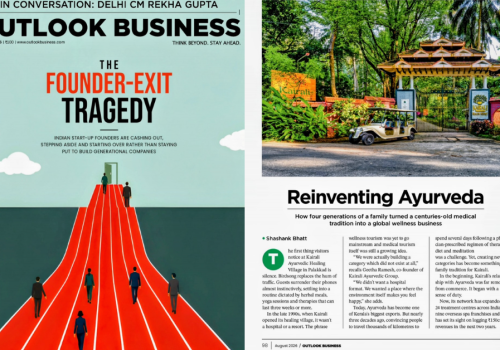
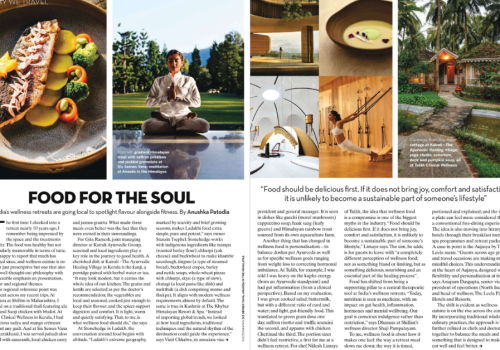




Living360 recently featured Kairali – The Ayurvedic Healing Village in Palakkad, Kerala, offering readers a closer look at its physician-led approach to Ayurveda, where consultation and individual assessment come before treatments are selected.
That may sound like a small operational detail. It is not.
For international travellers exploring Ayurveda, it points to one of the most useful distinctions to understand before choosing where to go: the difference between Ayurveda offered as a wellness experience and Ayurveda practised within a physician-led system of care.
The Living360 feature, published on 10 August 2026, describes Kairali as an NABH-accredited Ayurvedic healing village where consultations, constitutional assessment and individual treatment planning come before therapies are selected.
It is a useful starting point for a larger conversation about what personalised Ayurveda actually means.
Treatment should follow assessment, not the other way around
In many wellness settings, the sequence is familiar. A guest chooses a massage, oil treatment or wellness package and then experiences that service largely as booked.
Classical Ayurvedic practice works from a different premise.
Before deciding what may be appropriate, the practitioner first tries to understand the individual: their constitution, current state, routines, diet, sleep, stress, medical history and the particular concerns that brought them to consultation.
At Kairali, this begins with an assessment of prakriti (an individual’s constitutional nature) alongside vikriti (their present state of balance or imbalance). These concepts help the physician build a more individual picture rather than working from a symptom label alone.
The practical consequence is straightforward: two people arriving with similar concerns need not receive identical programmes.
That principle of individualisation is more important than any single therapy associated with Ayurveda.
What a consultation changes
According to Living360, Kairali’s initial assessment includes its Prakruti Analysis, followed by consultation with a BAMS-qualified Ayurvedic physician. The physician considers the assessment alongside physical examination, health history, lifestyle, sleep, stress and present concerns before suggesting a programme.
That programme can then be reviewed as the stay progresses rather than treated as a fixed package purchased before arrival.
This distinction also helps explain why treatments such as Panchakarma should be approached carefully in the context of wellness travel.
Panchakarma is often discussed internationally as though it were a single treatment or a standardised cleansing package. In Ayurvedic practice, however, the therapies selected, their sequencing and their suitability depend on clinical assessment.
The important question is therefore not simply, “Does this retreat offer Panchakarma?”
A better question is: Who determines whether it is appropriate, and on what basis?
Why NABH accreditation matters to an international traveller
The Living360 article also gives particular attention to Kairali’s NABH accreditation. Kairali’s verified credentials identify Kairali – The Ayurvedic Healing Village as an NABH-accredited Ayurvedic hospital and Panchakarma clinic.
NABH, the National Accreditation Board for Hospitals and Healthcare Providers, evaluates healthcare organisations against standards relating to areas including patient care, safety, governance and clinical processes. Living360 highlights this accreditation as one of the signals distinguishing Kairali’s model from a conventional spa environment.
For travellers unfamiliar with Ayurveda, credentials such as these can be more useful than broad claims about tradition or authenticity.
They provide something concrete to examine.
Who are the practitioners?
What qualifications do they hold?
Is there a formal consultation?
How are programmes determined?
Are treatments supervised and reviewed?
What healthcare standards does the facility work within?
These questions are worth asking of any destination offering serious Ayurvedic programmes.
Personalisation is more than a wellness questionnaire
The language of “personalised wellness” has become almost universal in hospitality.
Ayurveda means something more specific by individualisation.
Prakriti and vikriti are not simply personality categories. Within Ayurvedic practice, they form part of a broader framework through which practitioners consider constitutional tendencies and present changes.
As Living360 notes, Kairali’s physicians combine this constitutional assessment with discussion of lifestyle, sleep, stress and current health concerns.
That context matters because personalisation should change the programme itself.
Diet may differ. Daily routines may differ. The therapies selected may differ. The pace and sequence of a programme may differ.
In other words, individualisation is not a layer added to a pre-existing package. Ideally, it is what determines the package in the first place.
Ayurveda and the changing wellness-travel conversation
There is now a broad international appetite for retreats that promise rest, recovery and distance from everyday routines.
Ayurveda certainly has a place in that conversation, but reducing it to another category of spa treatment misses much of what makes the system distinctive.
The more useful distinction is not between “traditional” and “modern” wellness. It is between experiences organised around treatments and systems organised around assessment.
The latter asks more of both practitioner and guest.
A consultation may lead to recommendations that are less glamorous than the treatment someone expected to receive. A physician-led programme can include periods of rest, dietary changes, changes to daily routine or therapies selected for reasons that are not immediately obvious from a spa menu.
That is precisely why clinical oversight matters.
A useful lens for choosing an Ayurvedic retreat
The Living360 feature offers an accessible view of daily life at Kairali, from physician consultations and therapies to food, yoga and periods of rest.
But perhaps its most useful observation comes before any of those details.
The treatment is not the starting point. The person is.
For travellers considering Ayurveda in India or elsewhere, that principle provides a practical way to evaluate what they are being offered.
Look beyond the treatment list. Ask how decisions are made.
Because in rigorous Ayurvedic practice, the question is rarely simply which therapy do you want?
It begins with a more demanding one: what does the practitioner need to understand before deciding what is appropriate?
Further reading
Living360: “Inside India’s NABH-accredited Ayurvedic healing village”, published 10 August 2026. The feature looks at consultations, prakriti assessment, physician-led treatment planning and daily life at Kairali – The Ayurvedic Healing Village.
For readers researching a supervised Ayurvedic programme, information on Kairali – The Ayurvedic Healing Village, its consultation process and available programmes can be found through the property’s official information channels.







Leave a Reply