
























Food tastes different when you’re actually there for it.
There was a time when eating required us to stop doing something else.
Today, breakfast happens beside an inbox. Lunch competes with a screen. A snack disappears during a commute. Dinner may be eaten while scrolling through a phone, watching television or finishing the last few tasks of the day.
The food may be good. We may even have chosen it carefully. But somewhere between preparing it, serving it and taking the final bite, we can miss much of the experience.
A mindful eating retreat does not need to begin with complicated dietary rules. Sometimes it can begin with something far simpler: sitting down, removing the distractions and paying attention to what is on the plate.
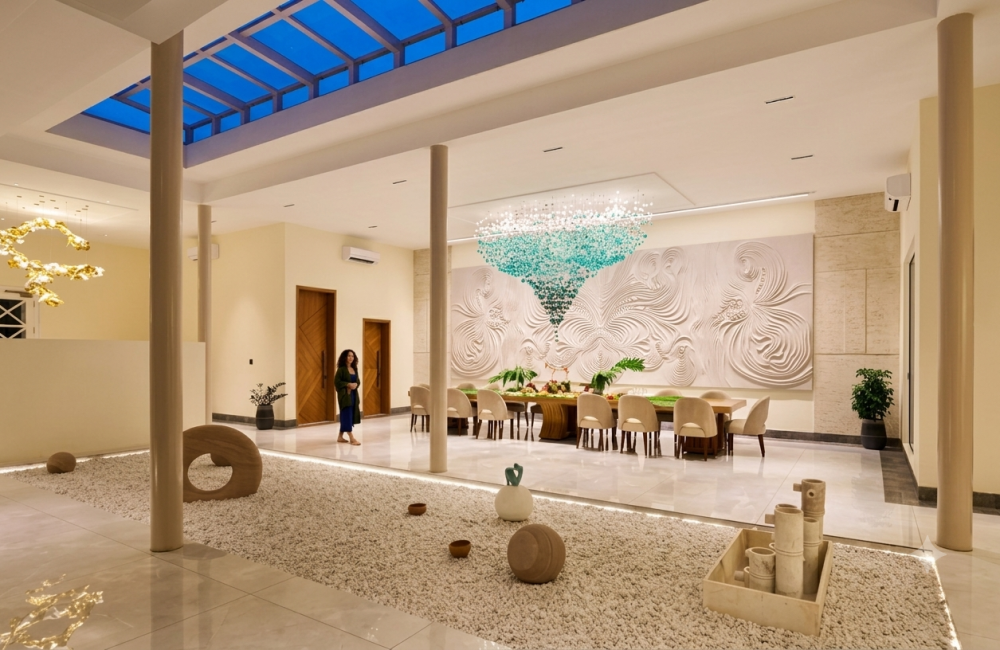
That simple idea is at the centre of The Conscious Table – Cook. Taste. Understand., an experience at Villa Raag in Goa.
We have become very efficient at eating
Modern life rewards efficiency. We answer messages while walking. We listen to meetings while travelling. We fit one task into the space occupied by another.
Food has been absorbed into the same pattern.
The problem is not that every meal must become an elaborate ceremony. Few people have the time or inclination for that. It is that eating has increasingly become background activity.
When attention is elsewhere, a meal can become something we simply complete.
There is a considerable difference between consuming food and experiencing it.
To experience a meal is to notice what happens before the first bite: the aroma of toasted spices, the colour of fresh vegetables, the temperature of a dish as it reaches the table. It is to notice texture, acidity, sweetness, bitterness, softness and crunch.
None of this requires specialist knowledge. It only requires attention.
What changes when we actually taste our food?
Consider how differently we approach something when we know we are expected to describe it.
Suddenly, we notice more.
Is the aroma sharp or gentle? Has an ingredient changed texture through roasting, steaming or simmering? Does a herb appear at the beginning of a mouthful or linger at the end? How does a dish change when an ingredient is added in a different proportion?
Food becomes more interesting when we stop treating flavour as a simple choice between “good” and “bad”.
The same applies to colour and texture. A plate tells us something before we taste it. Ingredients have structure, seasonality and character. Cooking alters each of them.
Paying attention makes a meal slower, but more importantly, it makes it specific.
You remember what you ate.
Cooking is part of the meal, not merely the work before it
Many conversations about mindful eating focus only on what happens once we sit at the table.
But attention can begin much earlier.
Cooking asks us to work with our senses continuously. We wash, cut, grind, mix, smell, taste and adjust. We notice when something needs another minute over heat. We learn that the same ingredient can behave very differently depending on how it is prepared.
This makes cooking a useful counterpoint to the speed of everyday life.
You cannot meaningfully rush every stage. Some things need to simmer. Some ingredients need to be tasted before deciding what comes next. Some preparations make sense only when you understand how individual flavours work together.
Cooking can therefore become less about executing a recipe perfectly and more about developing attention.
Healthy cooking in Goa does not have to mean restrictive eating
Wellness food is often presented through exclusion.
Remove this. Avoid that. Count this. Replace that.
There are circumstances in which individual dietary restrictions matter, particularly when they are medically necessary or advised by an appropriately qualified practitioner. But an interest in eating well does not automatically require turning every meal into a list of prohibited ingredients.
A more useful starting point is curiosity.
What are you eating? Where has it come from? What is in season? How was it prepared? What role does each ingredient play in the finished dish?
Understanding food can create a different relationship with it.
Fresh, local and seasonal ingredients, where practical, make that relationship easier to see. Seasonality is not an abstract wellness idea when you are standing in a kitchen. It is visible in what is available, how ingredients taste and what makes sense to cook at a particular time and place.
For anyone exploring healthy food in South Goa, that emphasis on understanding can be more interesting than another set of dietary commandments.
The Conscious Table at Villa Raag
The Conscious Table at Villa Raag is designed around participation rather than passive dining.
Guests cook alongside the chef, becoming involved in the preparation of the meal rather than arriving only when the finished dishes reach the table.
The purpose is not to turn everyone into a professional cook.
It is to make the process visible.
Ingredients can be examined rather than hidden behind a menu description. Techniques can be understood rather than simply admired. Questions can be asked as the food is prepared. Aroma, texture and flavour become part of the conversation before anyone sits down to eat.
For a healthy cooking experience in Goa, that participation matters. Watching an ingredient change in the pan gives you a different understanding of it from simply encountering it on a plate.
And making the food changes the meal itself.
You know what went into it. You have seen the sequence. Perhaps you chopped, mixed, tasted or adjusted part of it yourself.
The distance between kitchen and table becomes much smaller.
From “What should I eat?” to “Do I understand what I’m eating?”
Food culture has become crowded with rules.
There is always another ingredient to fear, another ingredient to celebrate, another dietary system promising to simplify the question of how we should eat.
The Conscious Table starts somewhere else.
Not with a perfect diet, but with better observation.
Learning what ingredients are. Understanding why they are used. Seeing what cooking does to them. Tasting carefully enough to recognise what you enjoy.
This is also a more realistic way to think about food during a luxury wellness stay in Goa. A meal does not have to advertise its virtue. It can simply be thoughtfully prepared, connected to its ingredients and enjoyed without distraction.
There is pleasure in that, and pleasure deserves a place in conversations about eating well.
Then, finally, sit down
Perhaps the most important part of The Conscious Table happens after the preparation is finished.
You sit down.
Not in front of a laptop. Not halfway through another task. Not treating the meal as an interruption to something supposedly more important.
You look at what has been made.
You notice the aroma before tasting it. You recognise ingredients you handled in the kitchen. You encounter familiar flavours more carefully. You eat with people who have participated in the same process.
Nothing particularly dramatic has happened.
And that may be precisely the point.
In a culture that has become remarkably good at doing several things at once, giving a meal our undivided attention can feel surprisingly unusual.
Food tastes different when you’re actually there for it.
Join The Conscious Table during World Wellness Weekend at Villa Raag.
Website: www.villaraag.com
Call: +91-9555156156






Leave a Reply