






























Irritable bowel syndrome can make ordinary routines unexpectedly complicated.
A meal before a meeting, a long journey, an unfamiliar restaurant or even a stressful week can become difficult when abdominal pain, bloating, constipation or diarrhoea are unpredictable.
IBS is now commonly described as a disorder of gut–brain interaction. Its symptoms can vary considerably between individuals, and there is no single diet, routine or treatment that works for everyone.
This is an important starting point when considering Ayurveda.
Ayurvedic care should not be presented as a cure for IBS or as an alternative to appropriate gastroenterological assessment. Its more credible role is supportive: looking closely at food, sleep, stress, bowel patterns and daily routine within an individualised, physician-led setting.
At Kairali – The Ayurvedic Healing Village in Palakkad, that process begins with consultation rather than a predetermined package.
Why IBS rarely has a simple answer
IBS is not simply “poor digestion.”
People with IBS may experience abdominal pain alongside constipation, diarrhoea or alternating bowel patterns. Bloating and a sensation of incomplete evacuation can also occur.
Symptoms can also change over time.
This variability is one reason simplistic advice can be unhelpful. A food that one person tolerates comfortably may trigger symptoms in another. Someone whose principal difficulty is constipation may require a very different approach from someone experiencing frequent loose stools.
Ayurveda also works from the premise that digestive disturbances should not automatically be approached in the same way.
The terminology differs from modern gastroenterology, but the emphasis on individual patterns is relevant.
How Ayurveda thinks about digestion
A central Ayurvedic concept in digestive health is agni, broadly referring to digestive and metabolic capacity.
Rather than looking only at the presence of a symptom, an Ayurvedic physician may ask how regularly someone becomes hungry, what happens after meals, whether appetite changes during periods of stress, how bowel habits vary, and whether certain foods repeatedly cause discomfort.
Traditional Ayurvedic assessment may also consider prakṛti (individual constitution) and vikṛti (the present pattern of imbalance).
These concepts belong to the Ayurvedic diagnostic framework. They should not be confused with a modern medical diagnosis of IBS.
That distinction matters.
A person should not decide that abdominal symptoms are caused by “high Vāta” or “weak agni” and assume that medical investigation is therefore unnecessary.
Consultation comes before therapy
At Kairali, The Ayurvedic Healing Village, guests are assessed by an Ayurvedic physician before a programme is planned.
For someone who already has an IBS diagnosis, the consultation may include discussion of bowel patterns, appetite, food tolerance, sleep, stress, existing medical conditions and current medications.
The physician may also need to know what investigations have already been completed and whether the person remains under the care of a gastroenterologist or another healthcare professional.
There is no responsible reason for every person with IBS to receive the same Ayurvedic programme.
In fact, individualisation is one of the strongest arguments against selling an “IBS package” built around a fixed list of treatments.
Food deserves careful attention
Food is often where people with IBS begin experimenting on their own.
Unfortunately, this can sometimes lead to increasingly restrictive diets.
Clinical guidance recognises that dietary changes can play a role in IBS management, but individual responses vary, and some dietary strategies are best undertaken with professional guidance.
A residential Ayurvedic setting offers a different advantage: meals can be regular, relatively simple and observed over several days.
Depending on the individual, an Ayurvedic physician may consider meal timing, preparation, portion size, appetite and the way particular foods are tolerated.
The objective should not be to declare certain foods universally “good for IBS.”
It is to observe patterns.
Does eating late make symptoms worse? Does an irregular schedule correspond with more discomfort? Are particular preparations easier to tolerate than others?
These are more useful questions than imposing a generic digestive diet.
Panchakarma is not automatically indicated
The word Pañcakarma is often associated with almost every Ayurvedic residential programme.
That does not mean every person with IBS needs it.
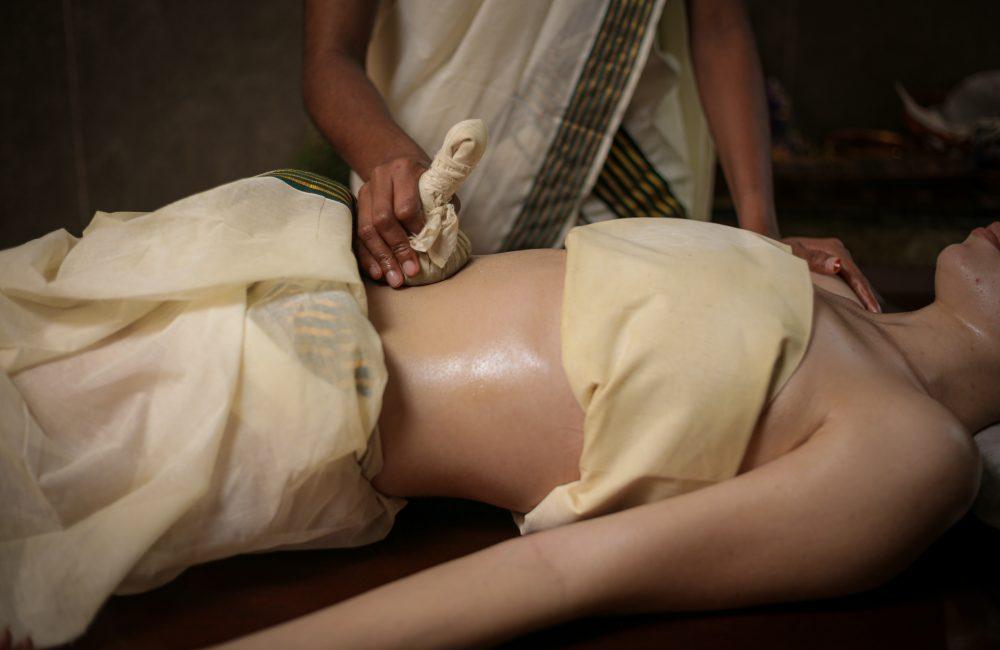
Panchakarma refers to a broader system of physician-supervised Ayurvedic procedures involving preparation, selected interventions and recovery. The suitability of any procedure depends on the individual’s health and clinical assessment.
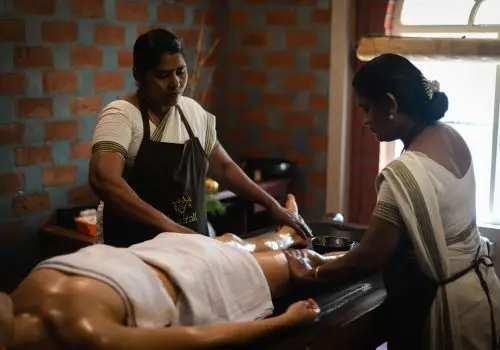
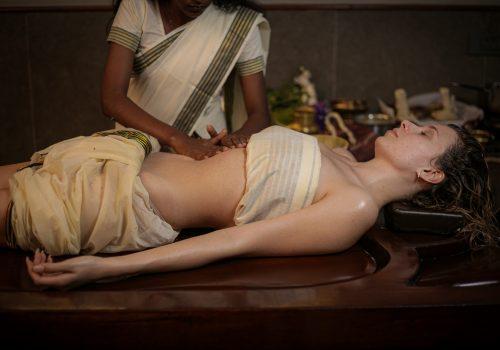
Therapies such as Abhyanga (oil application), Svedana (therapeutic sweating) or Basti (medicated enema therapy) may form part of Ayurvedic practice in appropriate circumstances.
They should not, however, be presented as a standard menu for IBS.
A person experiencing frequent diarrhoea, weakness or dehydration clearly presents a different clinical situation from someone whose predominant complaint is constipation.
The treatment decision belongs with the physician.
The gut and brain are part of the same conversation
One area where contemporary gastroenterology and the broader Ayurvedic emphasis on routine find an interesting point of contact is the relationship between the digestive system and the nervous system.
IBS is classified as a disorder of gut–brain interaction. Stress does not mean that IBS is “all in the mind,” but the communication between the gastrointestinal tract and nervous system is clinically relevant.
This helps explain why a residential programme may include gentle yoga, breathing practices, rest and attention to sleep.
The claim should remain modest.
Meditation or yoga should not be advertised as curing IBS. Their role within a residential programme is to support relaxation, establish routine and give the individual an opportunity to notice how stress and digestive symptoms interact.
Sometimes routine is the intervention worth noticing
One advantage of a residential setting is predictability.
Meals happen at regular times. Consultations and therapies are scheduled. There is protected time for rest. Sleep and waking times are generally more consistent than during an ordinary working week.
None of this is dramatic.
That may be precisely why it matters.
For someone whose everyday routine involves skipped breakfasts, late dinners, constant travel or poor sleep, several days of regularity can make patterns easier to observe.
The useful question at the end of the stay is not simply, “Did my symptoms disappear?”
It may be: “What changed when my day became more regular?”
That insight is more transferable to life at home.
When digestive symptoms need conventional investigation
Not every recurring digestive symptom is IBS.
Clinical guidance recommends further assessment when warning signs suggest another condition may be present. Unexplained weight loss and rectal bleeding are among the recognised reasons for further investigation rather than simply assuming symptoms are functional.
Persistent or severe symptoms also deserve medical attention.
This is particularly important before travelling to a wellness or Ayurvedic centre. A residential programme should not delay appropriate investigation by a gastroenterologist or replace prescribed medical care.
The safest approach is complementary care, with each practitioner understanding what the other is treating or monitoring.
What the Kairali setting changes
Kairali, The Ayurvedic Healing Village is located in Kodumbu, Palakkad, Kerala.
It operates as an NABH-accredited Ayurvedic hospital and also holds the Government of Kerala’s Green Leaf Certification.
The distinction between a hospital-resort and a conventional wellness spa is relevant here.
Guests remain at the property while following a physician-led programme. This allows the Ayurvedic team to observe response over time rather than making a recommendation during a single isolated appointment.
Meals, sleep, bowel patterns and tolerance of any therapies can be discussed during the stay, and the programme can be reconsidered when necessary.
That does not guarantee a particular outcome.
It provides something more practical: continuity of observation.
What should someone with IBS realistically expect?
No responsible Ayurvedic centre should promise to cure IBS.
Nor should a person be told that one herb, one oil therapy or a Panchakarma procedure will permanently resolve a condition that can behave very differently from one individual to another.
A more realistic goal is understanding.
A supervised residential programme may give someone time to examine how food, meal timing, rest, sleep, stress and daily routine relate to their symptoms.
Some people will still need ongoing care from a gastroenterologist. Others may benefit from dietary guidance, psychological therapies, medication or different combinations of treatment depending on their IBS subtype and individual circumstances.
Ayurveda need not compete with those approaches to have a useful role.
Start with the person, not the diagnosis
There is a temptation in wellness to turn every diagnosis into a programme name.
“IBS retreat.”
“Digestive reset.”
“Gut cleanse.”
Ayurveda is more useful when it resists that simplification.
Two people can arrive with the same conventional diagnosis and have very different histories, bowel patterns, food tolerances, stress levels and overall health.
At Kairali, the appropriate starting point is therefore not a fixed IBS protocol.
It is a physician consultation.
That may sound less dramatic than promising digestive transformation. But for a condition as individual as IBS, careful assessment is the more credible place to begin.
Book doctor consultation now at +91-9555156156 or visit www.ktahv.com