


































What a Condé Nast Traveller feature on Indian wellness retreats gets right about food, Ayurveda and eating well
Wellness food has a reputation problem.
Too often, it is associated with restriction. Less salt. Less sugar. Smaller portions. Familiar foods removed and replaced with something that looks healthy but does not necessarily feel satisfying.
Ayurveda approaches food differently.
A recent Condé Nast Traveller feature, “Food for the Soul,” looks at how wellness retreats across India are using local ingredients, regional cooking and personalised menus instead of relying on a generic idea of “healthy food.”
Kairali – The Ayurvedic Healing Village in Kerala, is among the retreats featured.
The article highlights a simple idea that deserves more attention:
Food can support wellbeing without becoming joyless.
Food is not chosen in isolation
At Kairali, meals are not built around a fixed wellness menu.
The feature explains that seasonal and local ingredients play an important role. Grains and lentils may be selected according to a doctor’s recommendation, while vegetables are sourced locally and cooked in ways intended to preserve flavour.
It also mentions kanji, a Kerala rice porridge, served with herbal water or tea.
None of this is particularly complicated.
That is part of the point.
Ayurvedic food does not have to depend on unfamiliar ingredients or elaborate recipes. The emphasis is often on basic questions: what is being eaten, how it is cooked, whether it suits the season, and how comfortably the person can digest it.
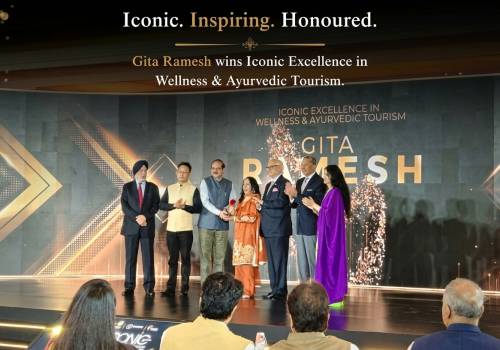
Gita Ramesh, Joint Managing Director of Kairali Ayurvedic Group, describes the food in the feature as “light, warm and quietly satisfying.”
That is a useful way to think about wellness food.
Not restrictive. Not excessive.
Simply appropriate.
Ayurveda asks a different question about healthy food
Modern nutrition discussions often begin with the question: is this food healthy?
Ayurveda adds another question:
Healthy for whom?
A food may be nutritious and still not suit every person in every situation.
Ayurvedic dietary thinking traditionally considers factors such as appetite, digestion, season and individual constitution.
This means a meal is not judged only by its ingredients.
How it is prepared matters.
When it is eaten matters.
How the person feels after eating it matters too.
This is also why Ayurveda places so much emphasis on agni, or digestive capacity.
The idea is simple: food is useful only if the body is able to process it comfortably.
Seasonal food is more than a trend
Seasonal eating has become common language in restaurants and wellness spaces.
In Ayurveda, however, eating with the season is part of a broader framework called ṛtucaryā, or seasonal regimen.
The principle is straightforward.
As temperature, humidity and daylight change, appetite and daily routines can change too. Food choices are adjusted accordingly rather than kept exactly the same throughout the year.
This makes local and seasonal ingredients more than a culinary preference.
They become part of how meals respond to the environment.
The Condé Nast Traveller feature shows this idea appearing across several Indian wellness retreats, each using the food traditions of its own region.
That matters.
Wellness food does not need to look the same everywhere.
A Kerala Ayurvedic kitchen should still taste like Kerala.
Personalisation matters more than the label
One detail in the feature is particularly important: at Kairali, some food choices are made according to doctors’ recommendations.
That changes the meaning of an “Ayurvedic menu.”
Ayurveda is not simply a list of approved ingredients.
The same food may suit one person and not another. Recommendations may vary according to digestion, constitution, current imbalance and season.
That is why reducing Ayurvedic food to turmeric drinks, lentils or vegetarian dishes misses the larger idea.
The ingredient is only one part of the decision.
The person eating it is the other.
Healthy food also needs to be enjoyable
The strongest point in the Condé Nast Traveller feature may be the simplest one.
Food needs to taste good.
Gita Ramesh argues that if food does not bring enjoyment, comfort and satisfaction, it is unlikely to become a sustainable part of someone’s lifestyle.
This is easy to overlook in wellness settings.
A meal can be carefully designed and nutritionally considered, but if it feels like punishment, most people will leave it behind once they return home.
Good food has to work in real life.
It has to fit appetite, culture, routine and preference.
Health and pleasure do not have to be opposites.
Perhaps wellness food needs to become simpler
The future of wellness cuisine may not depend on more complicated ingredients.
It may depend on better judgement.
Local food.
Seasonal produce.
Appropriate portions.
Simple cooking.
Meals that take digestion seriously without removing pleasure from eating.
That is what makes the Condé Nast Traveller feature interesting.
It does not present wellness food as a separate category of food that people must learn to tolerate.
It presents a more practical possibility.
Food can be nourishing, carefully considered and still be something you look forward to eating.
That may be one of the most useful principles Ayurveda brings to the table.








Leave a Reply