


























Stress rarely announces itself dramatically.
More often, it accumulates quietly.
Sleep becomes lighter. The mind stays active long after the workday has ended. The shoulders remain tense. Concentration becomes harder. Rest begins to feel less restorative.
Many people already know that yoga is often recommended for stress. What they want to know is whether there is a credible reason for that recommendation beyond the language of spirituality or general wellness.
There is.
Modern research has increasingly examined yoga in relation to perceived stress, anxiety, sleep and autonomic regulation. The evidence is not uniform, and yoga should not be presented as a cure. But there is enough research to support a more serious conversation about where it may fit within a broader approach to stress management.
Ayurveda approaches the same subject through a different framework.
At Villa Raag in Goa, the useful meeting point between the two is not an attempt to make Ayurveda sound biomedical or yoga sound clinical. It is a more practical question:
How can movement, breath, rest and daily routine be structured in a way that feels appropriate for someone who is already overstimulated?
What chronic stress looks like
Chronic stress is more than a passing emotional state.
When it persists, it can affect sleep, concentration, muscle tension, breathing patterns and other aspects of physical and mental wellbeing.
In modern medicine, prolonged stress is often discussed in relation to the autonomic nervous system and the body’s stress-response mechanisms. Hormones such as cortisol and adrenaline are part of that response, although not every person experiencing stress will display the same physiological pattern.
Ayurveda describes stress through a very different conceptual system.
Within Ayurvedic thinking, persistent restlessness, irregularity and overstimulation may be interpreted in relation to aggravated Vata dosha, the functional principle associated with movement and change.
Practitioners may also consider agni (digestive and metabolic function), ama (an Ayurvedic concept associated with incomplete digestion or impaired processing) and ojas, traditionally associated with resilience and vitality.
These are classical Ayurvedic concepts, not biomedical equivalents of cortisol, neurotransmitters or nervous-system activity.
That distinction matters.
The two systems do not explain stress in the same language. What they do share is an interest in patterns of disrupted rest, excessive stimulation and reduced recovery.
What does the research say about yoga and stress?
A growing body of research has examined yoga as a supportive practice for psychological stress.
Systematic reviews have reported that yoga may help reduce perceived stress in some populations, although study quality, yoga styles and participant groups vary considerably.
Research has also explored yoga’s relationship with anxiety, mood, heart-rate variability and sleep.
This does not mean that every form of yoga produces the same effect or that yoga should replace appropriate medical or psychological treatment.
It does suggest that yoga can reasonably be considered as one component of a wider stress-management approach.
That is a more useful position than either extreme: dismissing yoga as purely spiritual, or presenting it as a universal treatment.
For stress, slower yoga may make more sense
Yoga is often associated with athletic postures, physically demanding flows and visual performance.
For someone who already feels mentally and physically overstimulated, that may not be the most appropriate starting point.
A slower practice can place greater emphasis on breathing, controlled movement, stability and rest.
At Villa Raag, yoga is approached through personalised sessions rather than assuming that every guest needs the same sequence or intensity.
This matters because stress does not present in one standard form.
One person may need movement after long periods of sitting. Another may already feel physically depleted. Someone else may find rapid sequences stimulating rather than calming.
The practice should therefore respond to the person rather than forcing the person into a predetermined style of yoga.
1. Breath-led movement
Breath-paced asana simply means allowing movement to follow a comfortable breathing rhythm rather than rushing from posture to posture.
The emphasis is on steadiness.
Standing, seated and supported poses can be selected according to the person’s capacity, with transitions kept deliberate rather than hurried.
The aim is not to achieve an ambitious posture.
It is to reduce unnecessary effort.
A session designed around stress may therefore involve fewer postures, slower transitions and more attention to how the body responds during the practice.
This is very different from treating yoga as another task to perform well.
2. Pranayama without the performance
Breathing practices, or pranayama, are another area where simplicity matters.
In wellness culture, breathwork is sometimes promoted as though stronger techniques must be more effective.
That is not necessarily a useful assumption.
Gentler practices that encourage slower, more comfortable breathing may be appropriate for people who already feel overstimulated.
Nadi Shodhana (alternate-nostril breathing), for example, is traditionally used as a balancing practice. Other approaches may gently emphasise a longer, unforced exhalation.
These should not be treated as universal prescriptions.
Breathing practices may need modification in pregnancy, cardiovascular conditions, respiratory concerns or for people with a history of panic symptoms. Forceful breathing techniques are not appropriate for everyone.
Where there are relevant health concerns, pranayama should be taught or adapted with appropriate professional guidance.
3. Restorative yoga and the problem of constant effort
Stress can create an unusual contradiction: people feel exhausted but remain unable to settle.
That is one reason restorative yoga has become relevant to discussions around stress and sleep.
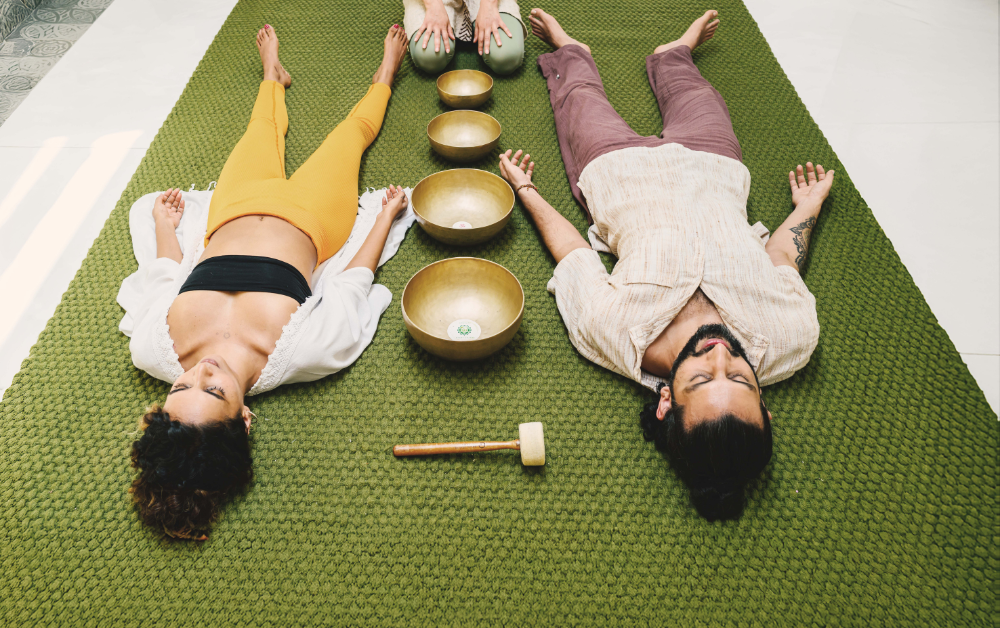
A restorative practice may use supported postures, cushions or bolsters and longer periods of stillness. The purpose is to minimise muscular effort rather than stretch aggressively.
An extended Shavasana (resting posture) or guided body-awareness practice can form part of the session.
Research on yoga and related mind-body practices has reported potential improvements in sleep quality in some groups, although results vary and longer-term consistency appears more meaningful than a single session.
The practical implication is straightforward.
Rest is a skill as much as an absence of activity.
For someone accustomed to constant stimulation, learning to remain still without turning the experience into another performance can itself be significant.
Where Ayurveda adds something different
Ayurveda’s contribution is not that it provides a scientific explanation for yoga.
It does not need to.
Its contribution is individualisation.
A traditional Ayurvedic assessment may consider constitution, current imbalance, digestion, sleep, appetite, activity level, season and other aspects of routine before recommendations are made.
This can influence how yoga is approached.
A physically depleted person may not need the same practice as someone who feels restless but energetic.
A person struggling with sleep may benefit from a different emphasis from someone whose principal difficulty is daytime tension.
The point is not to create rigid dosha-based yoga formulas.
It is to resist the assumption that one wellness routine should work identically for everyone.
Yoga and mental health: where it fits, and where it does not
This boundary is important.
Yoga should not replace psychiatric, psychological or other clinically indicated care for significant mental-health conditions.
It should not be used as a reason to discontinue prescribed medication, delay assessment or avoid professional support.
Where appropriate, however, yoga may complement existing care.
It can provide a structured period for movement, breathing and attention without requiring every emotional experience to be analysed verbally.
For some people, that can make yoga a useful adjunct.
The key word is adjunct.
A mat, a breathing practice or a restorative sequence can support a wider care plan. They are not substitutes for diagnosis or treatment where either is needed.
Why the practice environment matters
The physical setting does not need to be described as “medicine” to be relevant.
Environment affects how easily people can pay attention, rest and follow a routine.
A noisy, crowded or highly stimulating space may make a slow practice more difficult. A quieter setting may make it easier to focus on movement, breathing and rest.
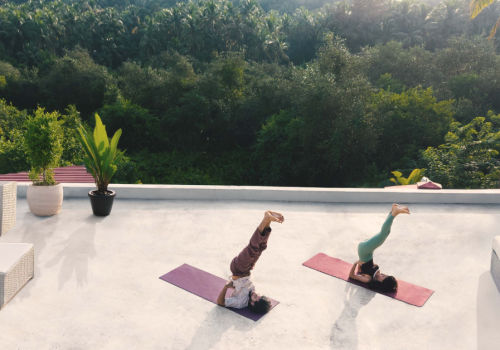
At Villa Raag in Goa, the property offers personalised yoga, meditation and breathwork within a coastal retreat setting, including dedicated spaces for yoga and meditation.
That creates a useful context for slower practice.
The setting itself should not be credited with therapeutic outcomes. Its role is more practical: it can reduce distractions and make it easier for guests to follow a structured routine.
A retreat should not become another productivity project
This may be the most important point.
People often arrive at wellness retreats carrying the same mindset that contributed to their exhaustion in the first place.
They want to optimise sleep.
Optimise breathing.
Optimise yoga.
Optimise recovery.
Then they judge themselves when the body does not respond immediately.
A stress-focused yoga practice works against that impulse.
The value lies partly in doing less with more attention.
A shorter sequence performed comfortably may be more appropriate than an intense class.
Five quiet minutes may be more useful than forcing a complicated meditation routine.
Rest may need to remain unproductive.
That can be uncomfortable at first, particularly for people whose identity is strongly tied to performance.
But it is also where yoga becomes more than exercise.
What yoga can realistically offer for stress
Yoga should not be sold as a cure for chronic stress.
It can, however, offer several useful things:
- a structured period away from constant stimulation
- gentle physical movement
- greater awareness of breathing
- regular opportunities for stillness
- a routine that may support sleep and perceived stress when practised consistently
- a practical complement to appropriate medical or psychological care
Those benefits do not require mystical claims.
Nor do they require yoga to become another branch of modern medicine.
The evidence is strongest when the claims remain modest.
The useful middle ground
The conversation around yoga often gets trapped between two extremes.
One side dismisses it as spiritual tradition without relevance to modern health.
The other makes claims that go far beyond what research can support.
Neither position is particularly helpful.
Yoga can be understood more simply: as a structured practice involving movement, breath, attention and rest that has shown potential benefits for stress and related outcomes in modern research.
Ayurveda adds another layer by asking how that practice should change according to the individual rather than assuming everyone needs the same intervention.
At Villa Raag, that is the more useful meeting point between traditional practice and contemporary evidence.
Not yoga as a cure.
Not yoga as performance.
But yoga as a carefully adapted practice for people who may need less stimulation, more rest and a more sustainable relationship with their own routines.
Interested in exploring personalised yoga, meditation and Ayurvedic-informed wellness at Villa Raag? Speak with the team to understand which programme may be appropriate for your needs and existing health circumstances.
Website: www.villaraag.com
Call: +91-9555156156







Leave a Reply