






























Ayurveda Aahara is suddenly appearing in conversations about Ayurvedic food, wellness retreats and traditional nutrition.
The regulation itself, however, is not new.
India’s Food Safety and Standards Authority of India (FSSAI) notified the Food Safety and Standards (Ayurveda Aahara) Regulations in May 2022. What changed more recently was the regulatory infrastructure around them. In September 2025, FSSAI introduced a distinct Ayurveda Aahara category on its FoSCoS portal for licensing and registration.
That distinction matters.
Ayurveda Aahara is not simply a new name for food served at an Ayurvedic retreat. Nor does preparing meals according to Ayurvedic principles automatically make a kitchen, menu or product “Ayurveda Aahara compliant”.
The framework applies to a defined category of food products, with rules covering formulation, labelling and claims. FSSAI has also published recognised Ayurveda Aahara preparations and continues to issue regulatory directions around the category.
For travellers choosing an Ayurvedic retreat in Kerala, the more useful question is therefore not whether a property uses the phrase Ayurveda Aahara.
It is what, precisely, the property means by it.
What is Ayurveda Aahara?
At its simplest, Ayurveda Aahara refers to foods prepared according to recipes, ingredients and principles recognised within the regulatory framework established by FSSAI.
The 2022 regulations created a specific legal category for such foods. FSSAI subsequently developed a compendium drawing on recognised Ayurvedic sources and, in 2025, introduced a distinct licensing route through FoSCoS.
This is significant because Ayurveda has always given food an important place within daily life and clinical thinking.
But tradition and regulation are not the same thing.
A meal can be inspired by Ayurvedic dietary principles without necessarily being a packaged Ayurveda Aahara product regulated under this specific category.
That distinction tends to disappear when Ayurveda Aahara is used as a marketing phrase.
It should not.
Ayurveda Aahara does not mean every Ayurvedic meal needs a special label
This is where the discussion becomes more useful for retreat guests.
An Ayurvedic kitchen may make decisions based on season, individual dietary requirements, digestion, preparation methods and physician recommendations. Those practices can form part of an Ayurvedic approach to food.
The Ayurveda Aahara regulations, by contrast, establish requirements for foods falling within the regulated category.
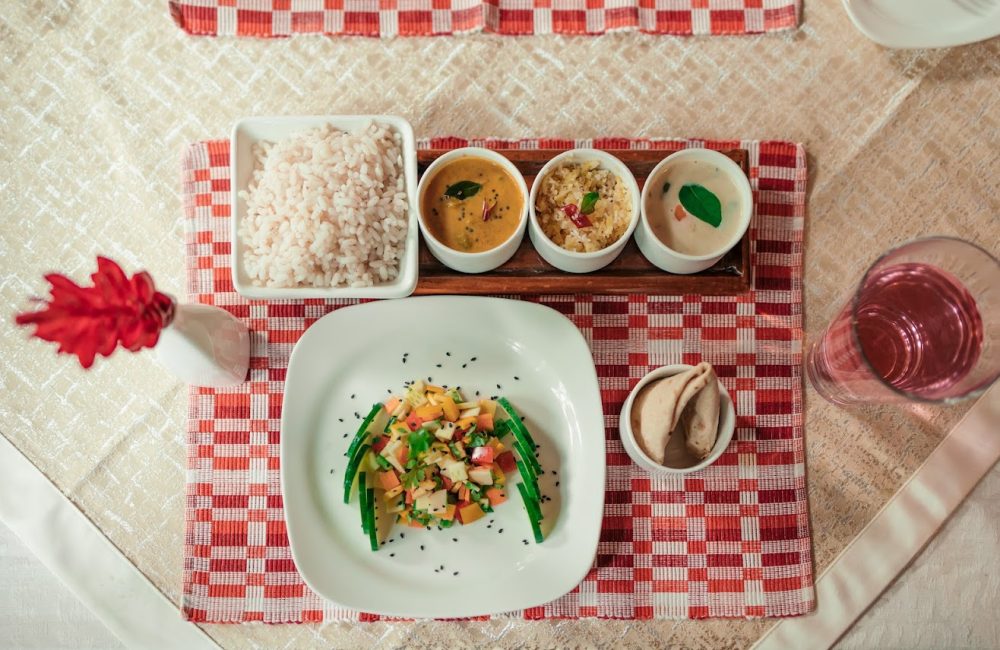
So the bowl of rice gruel served at breakfast and a packaged Ayurvedic food product offered for retail are not automatically the same regulatory question.
This matters because “compliance” can easily become an imprecise claim.
A retreat should be able to distinguish between:
- food prepared in its kitchen as part of a guest’s meals;
- a formulation prescribed or recommended under appropriate professional supervision;
- and an Ayurveda Aahara food product manufactured, labelled or sold under the FSSAI framework.
Treating all three as interchangeable may sound convenient. From a regulatory perspective, it is not sufficiently precise.
Why did the 2025 FoSCoS change matter?
The September 2025 development made the regulatory pathway more visible.
FoSCoS, FSSAI’s online food-compliance system, introduced Ayurveda Aahara as a distinct kind of business for licensing and registration.
For manufacturers and food businesses operating in this category, that creates a clearer administrative structure around what had already been established through the 2022 regulations.
For consumers, the potential benefit is equally practical.
A regulated category can make it easier to ask basic questions:
Who manufactures this product?
Under what licence?
What exactly is being claimed on the label?
Which ingredients and preparation are being used?
Does the product belong within the recognised regulatory framework?
Those are more useful questions than whether something is described as “traditional”, “authentic” or “detoxifying”.
The claims matter as much as the ingredients
Ayurveda Aahara is sometimes discussed as though regulation simply confirms that a traditional recipe is beneficial.
That is too broad.
Food regulation also concerns what manufacturers are allowed to say about a product.
FSSAI’s framework includes requirements around labelling and health-related claims, and current directions distinguish between recognised claims and product-led claims that may require notification to the Food Authority.
This should make the Ayurveda sector more careful with language, not less.
An Ayurvedic food should not become a convenient route for making sweeping promises about disease, immunity, weight loss or other health outcomes.
The fact that a preparation has a classical Ayurvedic basis does not remove the need for modern food-safety and advertising compliance.
For consumers, restraint should be reassuring.
The strongest sign of credibility is often not how much a retreat promises about its food, but how accurately it describes what that food is intended to be.
What Ayurveda Aahara means for an Ayurvedic retreat in Kerala
For international guests, food is often one of the least understood parts of an Ayurveda programme.
The common expectation is that meals will simply be “dosha specific”.
In practice, a physician-led Ayurvedic setting can be more nuanced.
Food may be adjusted according to the guest’s assessment, the broader programme, appetite, digestion and other practical considerations. The meal itself is part of the day’s structure rather than an independent wellness product.
This is why Ayurveda Aahara should not reduce Ayurvedic nutrition to another certification badge.
A thoughtful retreat should instead be able to explain where traditional kitchen practice ends and regulated food-product compliance begins.
At Kairali – The Ayurvedic Healing Village in Palakkad, the wider Ayurvedic programme operates within an NABH-accredited Ayurvedic hospital setting.
For this article, however, we would not describe Kairali’s retreat kitchen, packaged foods or specific formulations as Ayurveda Aahara licensed or compliant unless the relevant current FSSAI documentation has been verified by the team.
That level of specificity is important.
“Practising Ayurvedic food principles” and “holding the relevant regulatory status for an Ayurveda Aahara product” are not identical statements.
What should wellness travellers actually look for?
A guest does not need to become a food-regulation specialist before booking an Ayurveda retreat.
But a few straightforward questions can reveal a great deal.
If a property advertises Ayurveda Aahara products, ask what exactly carries that designation.
If packaged foods are sold, check that the manufacturer and FSSAI information are clearly identified.
If health claims are prominent, look closely at how specific those claims become.
And when a retreat describes meals as personalised, ask who makes the dietary decisions. Is the menu simply divided into Vata, Pitta and Kapha options, or is food considered within a broader physician-led programme?
The answers matter more than the buzzword.
Ayurveda has always taken food seriously. Regulation asks the industry to do the same
There is a temptation whenever a new regulatory category gains attention to treat it as validation of everything that came before it.
Ayurveda Aahara deserves a more careful reading.
FSSAI’s 2022 regulations did not suddenly invent the Ayurvedic relationship with food. Nor did the 2025 FoSCoS licensing framework transform every Ayurvedic kitchen into a newly regulated clinical service.
What the framework does provide is something valuable: clearer boundaries.
It asks businesses to be specific about what they manufacture, how it is classified, how it is labelled and what they claim about it.
That is good for Ayurveda.
A serious traditional system should not need vague language to make itself relevant to modern consumers.
It should be able to explain the difference between tradition, clinical practice, food preparation and a regulated commercial product.
The next question for Ayurvedic retreats is transparency
Ayurveda Aahara may well become a more familiar phrase as food manufacturers, Ayurvedic institutions and wellness properties respond to the regulatory framework.
But familiarity should not be mistaken for compliance.
For retreats, this is an opportunity to become more transparent rather than more promotional.
Tell guests when a dish is simply part of the Ayurvedic kitchen.
Tell them when food is being adjusted as part of a physician-guided programme.
And when a packaged product falls under the Ayurveda Aahara framework, identify its regulatory status accurately.
For travellers searching for an Ayurvedic retreat in Kerala, that distinction is more meaningful than another promise about “food as medicine”.
The future of Ayurvedic nutrition will depend partly on preserving its traditional principles.
It will also depend on being precise about what those principles mean once food is manufactured, labelled, marketed and sold in a regulated modern market.
Speak with a Kairali Ayurvedic physician about how diet is incorporated into a physician-led Ayurveda programme.
Website: www.ktahv.com
Call: +91-9555156156