





























A yoga practice may begin with the body, but it rarely remains only physical.
There is movement, certainly. But there is also breathing, concentration, awareness of tension and the repeated effort to bring attention back to what is happening in the present moment.
That combination has made yoga increasingly relevant to discussions around mental wellbeing.
Research has examined yoga in relation to perceived stress, anxiety, depressive symptoms and sleep. The findings are encouraging in several areas, although the quality of evidence varies and no single practice works equally well for everyone.
At Kairali, The Ayurvedic Healing Village in Palakkad, Kerala, yoga is practised within a wider Ayurvedic setting that also makes room for physician-guided care, regular meals, rest and a quieter daily routine.
The aim is not to promise permanent calm.
It is to understand how movement, breath and attention can become useful parts of caring for mental wellbeing.
Yoga Is More Than Physical Exercise
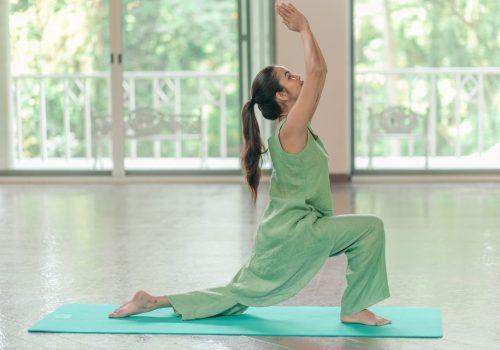
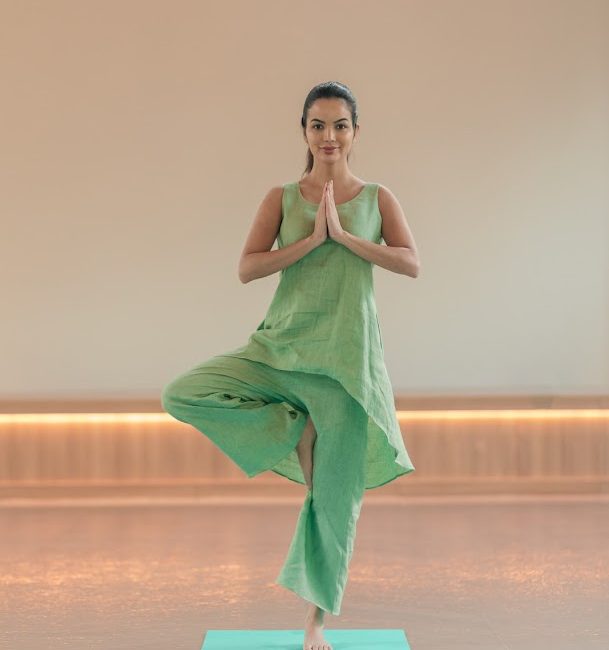
The global popularity of yoga has made its postures, or āsanas (physical positions), its most visible feature.
But physical movement is only one dimension of the broader yogic tradition.
Breathing practices, meditation and sustained attention are equally relevant. During a yoga session, the practitioner may be asked not only to move the body but also to notice breathing, physical effort, restlessness and distraction.
That makes the experience different from ordinary exercise.
A posture may ask a simple question: can you remain attentive to your breathing while the body is working?
A meditation practice may ask another: can you notice a thought without immediately following it?
Neither exercise promises to remove difficult emotions. What they can encourage is greater awareness of how the body and mind respond to pressure.
Can Yoga Help With Stress?
Stress is one of the most frequently studied areas of yoga research.
A 2024 systematic review examining yoga among adults experiencing stress found evidence of short-term improvement in perceived stress compared with passive control groups. However, the authors rated the quality of that evidence as low, which means the results should be interpreted cautiously.
A separate 2025 meta-analysis covering 36 studies also found an overall reduction in perceived stress associated with yoga, while reporting substantial variation between studies.
This is an important distinction.
Yoga should not be described as eliminating stress. Stress is part of ordinary human physiology and, in appropriate amounts, serves useful functions.
A more realistic role for yoga is helping some people create periods of reduced stimulation and develop greater awareness of their response to physical and psychological tension.
At Kairali, this approach is reinforced by the wider setting.
A yoga session does not take place in isolation from the rest of the day. It sits alongside meals, Ayurvedic consultations and therapies, periods of rest and time in a quieter environment.
Why Breathing Matters
Most people breathe without paying much attention to it.
Yoga changes that relationship.
In many practices, breathing is deliberately coordinated with movement. Practitioners learn to notice when breathing becomes shallow, when effort turns into strain or when tension appears unnecessarily in the body.
That observation can become useful beyond the yoga mat.
A rushed breath may accompany a rushed mind.
Physical tension may appear before a person consciously recognises that they are stressed.
Slowing down long enough to notice these changes does not solve the external cause of stress. But it can make the body’s response easier to recognise.
Yoga therefore offers something that is surprisingly uncommon in everyday life: structured time in which attention is deliberately directed inward.
Yoga, Anxiety and Low Mood
Claims around yoga and mental-health conditions require particular care.
Research does suggest possible benefits.
A recent systematic review of yoga for depressive disorders found improvement in depression severity compared with passive controls, although the authors noted inconsistencies in the quality of the evidence.
Another meta-analysis examining people with Parkinson’s disease, multiple sclerosis and stroke found reductions in depressive and anxiety symptoms among participants practising yoga, though findings from a specific clinical population should not automatically be generalised to everyone.
The responsible conclusion is therefore not that yoga “treats anxiety and depression”.
Yoga may be a useful complementary practice for some people, particularly when movement, breathing and meditation help them regulate stress or create a more stable daily routine.
Clinical anxiety, depression and other mental-health conditions, however, may require assessment and treatment from appropriately qualified professionals.
Yoga can accompany that care.
It should not be asked to replace it.
Sleep Is Part of Mental Wellbeing
Poor sleep affects much more than tiredness.
It can influence concentration, irritability, emotional regulation and our ability to cope with everyday demands.
Yoga has therefore also been studied in relation to sleep.
A systematic review and meta-analysis of women found that yoga was associated with improvements in sleep outcomes compared with inactive control groups, although the size of the benefit varied between populations.
Other research examining yoga alongside depressive symptoms and anxiety has similarly reported improvements in self-reported sleep quality.
Again, context matters.
At a residential retreat, sleep may be affected by multiple changes occurring at the same time: more regular meal timings, physical activity, quieter evenings, reduced commuting and greater opportunity for rest.
It would be misleading to attribute every improvement exclusively to yoga.
The wider daily rhythm matters too.
How Yoga Is Practised at Kairali
At Kairali, The Ayurvedic Healing Village, yoga is part of a broader physician-guided approach to wellbeing.
KTAHV is an NABH-accredited Ayurvedic hospital in Palakkad, Kerala.
Guests may practise yoga alongside Ayurvedic consultations, physician-recommended therapies, dietary guidance and periods of rest.
Importantly, yoga should not become another form of competition.
The purpose is not to achieve the most difficult posture or keep pace with someone else’s flexibility.
Age, mobility, health history, fitness and previous experience all affect what kind of practice is appropriate.
For one person, a more active session may feel suitable.
For another, gentle movement, breathing practices or meditation may be more appropriate.
The principle is simple: practice should respond to the person rather than requiring the person to conform to the practice.
Where Yoga and Ayurveda Meet
Yoga and Ayurveda are distinct traditions, but they share an interest in how everyday patterns influence wellbeing.
Ayurveda pays close attention to factors such as sleep, digestion, appetite, movement, daily routine and individual constitution.
Yoga adds another dimension: direct observation of the body and mind in the present moment.
Together, they can encourage questions that are easy to overlook during a busy week.
How am I breathing when I feel under pressure?
Where do I hold unnecessary tension?
Am I resting when I am tired, or simply continuing until the day is finished?
How much mental stimulation do I experience without a genuine pause?
What happens when movement becomes deliberate rather than rushed?
These are not diagnostic questions.
They are observational ones.
And observation is often where meaningful changes in routine begin.
The Value of a Quieter Environment
Place also changes how a practice is experienced.
An hour of yoga followed immediately by traffic, messages and another meeting is very different from practising within a residential setting where the rest of the day moves more slowly.
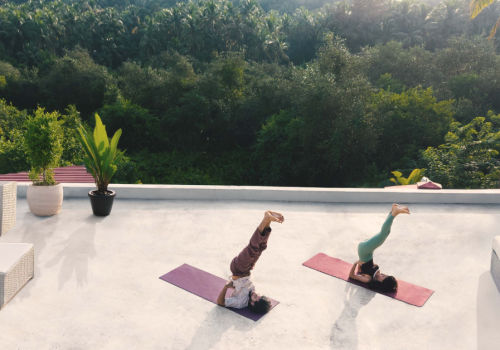
At Kairali, the natural surroundings and programme structure create space around the practice itself.
There may be time to walk.
To rest between activities.
To eat without simultaneously working.
To sit quietly rather than reaching automatically for a phone.
None of those activities is dramatic.
That may be precisely their value.
Mental wellbeing is not always supported by adding another intervention to an already full schedule. Sometimes it requires reducing the amount of demand placed on attention.
Emotional Resilience Does Not Mean Being Calm All the Time
Wellness language sometimes creates an unrealistic picture of emotional health.
A balanced person is imagined as permanently calm, positive and unaffected by difficulty.
Human beings do not work that way.
Sadness, anger, worry and frustration are normal responses to life.
Yoga does not need to eliminate those emotions in order to be useful.
A more realistic form of emotional resilience is the ability to notice what is happening without being immediately overwhelmed by it.
That may mean recognising physical tension earlier.
Taking a slower breath before reacting.
Becoming aware that the mind is racing.
Or simply accepting that a difficult day is difficult without treating that experience as a personal failure.
In this sense, yoga is less about controlling emotions than becoming more attentive to them.
Meditation and Yoga Nidra
Physical postures are not the only yogic practices relevant to mental wellbeing.
Meditation and Yoga Nidra, a guided practice of deep relaxation and awareness, also form part of the broader yoga landscape.
Research into Yoga Nidra and sleep is developing, with recent systematic reviews examining its possible role in sleep disorders. However, the evidence base is still evolving and should not be overstated.
These practices can nevertheless introduce something valuable: deliberate rest.
That may sound simple.
For someone accustomed to constant activity, it may not be.
Remaining physically still while maintaining awareness can reveal just how active the mind remains even when the body has stopped moving.
Over time, learning to observe that activity is itself a practice.
What Yoga Cannot Do
A serious conversation about yoga and mental health also needs clear boundaries.
Yoga cannot diagnose a mental-health condition.
It should not be used as a reason to discontinue prescribed medication.
And attending a yoga retreat is not a replacement for psychotherapy, psychiatric care or emergency mental-health support where these are needed.
Persistent or severe anxiety, depression, panic, trauma-related symptoms, major sleep disturbance or other significant psychological concerns deserve appropriate professional assessment.
This does not reduce the value of yoga.
It clarifies its role.
Yoga can support wellbeing without being positioned as a cure.
It can complement clinical care without competing with it.
And it can help people develop greater awareness of their own patterns without pretending that awareness alone resolves every mental-health problem.
The Real Power May Be Attention
The phrase “mind-altering power of yoga” sounds dramatic.
The reality may be quieter and more useful.
Yoga repeatedly asks us to pay attention.
To breathing.
To movement.
To effort.
To rest.
To discomfort.
To distraction.
And to the point at which healthy effort begins to become unnecessary strain.
At Kairali, that practice takes place within a wider Ayurvedic environment built around physician guidance, routine, food, treatment and rest.
The goal is not to emerge incapable of feeling stress.
It is to become more aware of how stress is experienced, what contributes to it and what helps create genuine periods of recovery.
In a world where attention is continuously being pulled outward, learning to direct some of it inward may be one of yoga’s most relevant contributions to mental wellbeing.
Website: www.ktahv.com
Call: +91-9555156156