




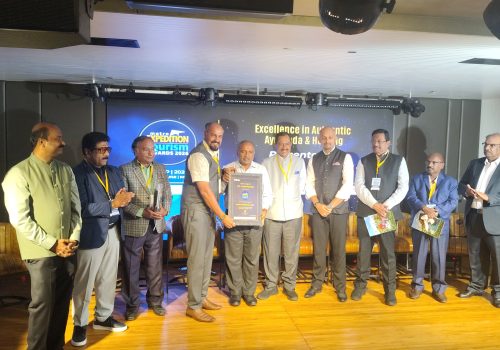










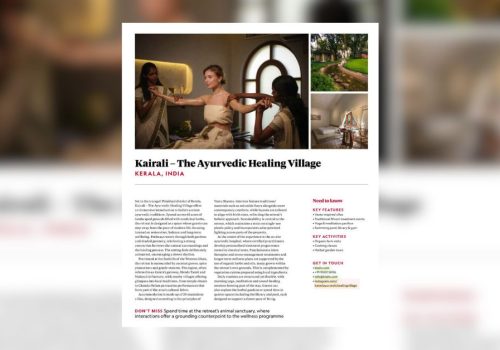




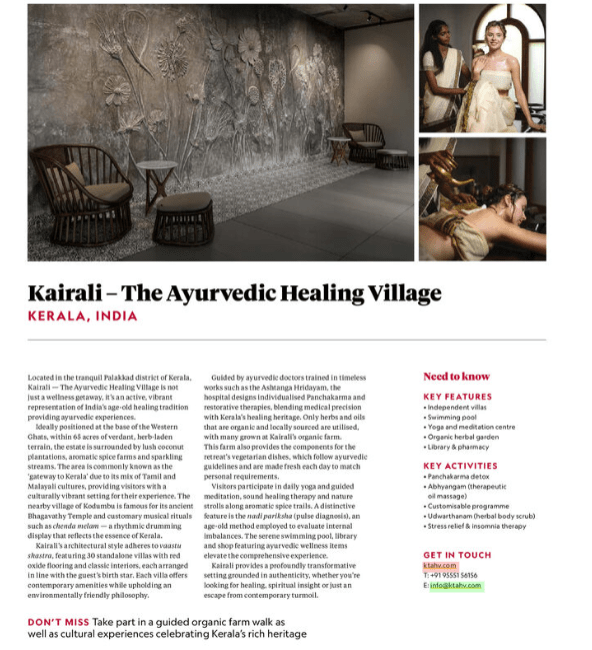

Kairali – The Ayurvedic Healing Village in Palakkad, Kerala, has been featured in the National Geographic Traveller (UK) Luxury Collection 2025.
For Kairali, the feature is significant because it places a physician-led Ayurvedic destination within a wider international conversation about luxury travel.
In this context, luxury is not defined only by accommodation, design or privacy. It can also mean having time for a structured health programme, access to qualified practitioners and an environment organised around rest and recovery.
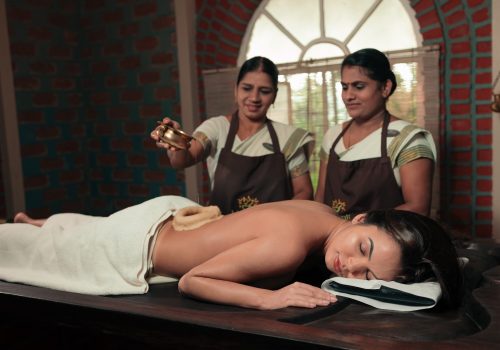
The National Geographic Traveller coverage presents Kairali through its combination of Ayurveda, natural surroundings, Panchakarma, organic meals, yoga and meditation. It also refers to the property’s effort to bring established Ayurvedic knowledge together with environmentally conscious practices.
Why this feature matters
Ayurveda is now offered across a broad range of travel settings.
Some properties provide spa treatments influenced by Ayurveda. Others offer residential care led by Ayurvedic physicians. To an international traveller researching from a distance, the distinction is not always immediately visible.
Coverage in a publication such as National Geographic Traveller can introduce readers to a form of Ayurveda travel in which the programme, setting and clinical framework are considered together.
The feature should not be treated as medical endorsement or proof of therapeutic outcomes. Its relevance is editorial: it brings a Kerala-based Ayurvedic destination to the attention of an international travel audience.
A residential setting built around Ayurvedic care
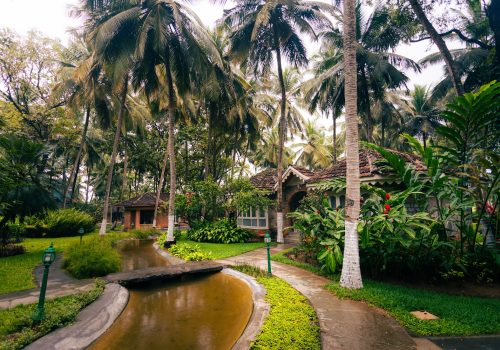
Kairali – The Ayurvedic Healing Village is an NABH-accredited Ayurvedic hospital in Kodumbu, Palakkad.
Guests begin with an assessment by an Ayurvedic physician. The consultation may consider the individual’s health history, present concerns, physical capacity and Ayurvedic constitution before a programme is planned.
In Ayurvedic terminology, this can include an assessment of prakṛti, or underlying constitution, and vikṛti, the person’s current pattern of imbalance.
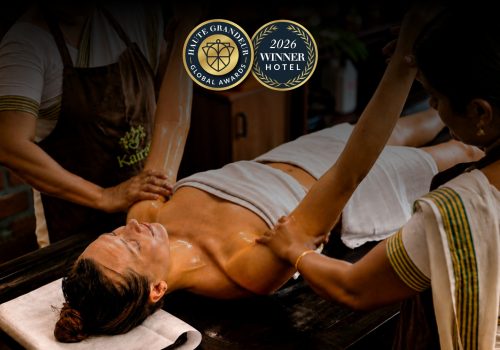
The resulting plan may bring together physician-directed therapies, food, movement and daily routines. These elements are not intended to function as unrelated resort activities. They are coordinated according to the individual assessment and reviewed during the stay.
Panchakarma is not a standard package
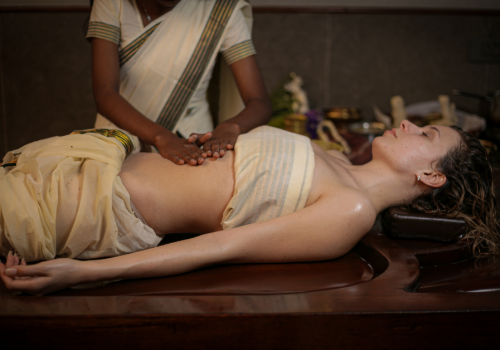
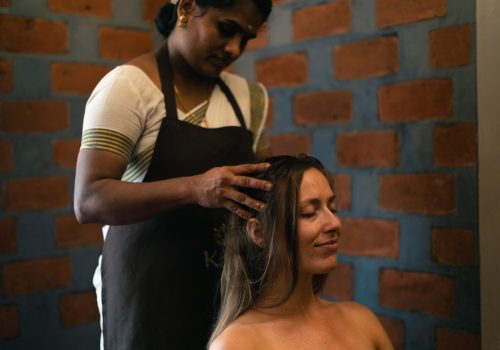
Panchakarma is among the practices associated with Kairali in the National Geographic Traveller coverage.
The term is often used loosely in the international wellness industry. In clinical Ayurveda, however, Panchakarma is not a fixed sequence that should be offered identically to every guest.
A physician must first consider whether a person is suitable for particular preparatory, principal or restorative procedures. Age, strength, digestion, medication use, health history and the purpose of treatment may all influence the plan.
Some guests may receive selected components rather than a complete Panchakarma programme. Others may be advised that an intensive procedure is not appropriate.
This capacity to adapt or decline treatment is an important part of responsible Ayurvedic care.
Food as part of the programme
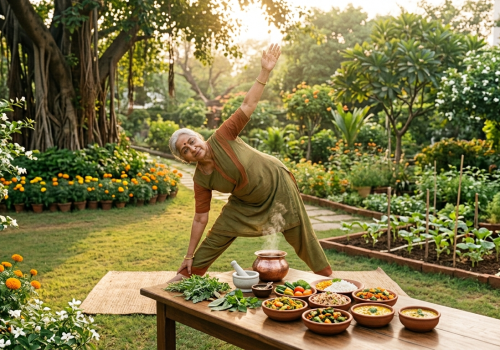
The National Geographic Traveller coverage also refers to organic, farm-fresh food at Kairali.
Within a residential Ayurvedic setting, meals are not simply an additional hospitality feature. Food may be planned according to digestive comfort, physician guidance and the stage of the programme.
This does not mean that every guest receives the same “Ayurvedic menu.” Dietary requirements can differ according to constitution, appetite, medical needs and the treatments being undertaken.
The most useful principle is coordination. The food, daily timetable and clinical programme should support one another rather than compete for the guest’s attention.
Yoga and meditation in context
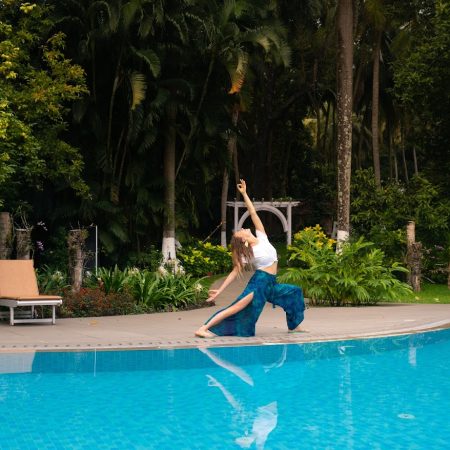
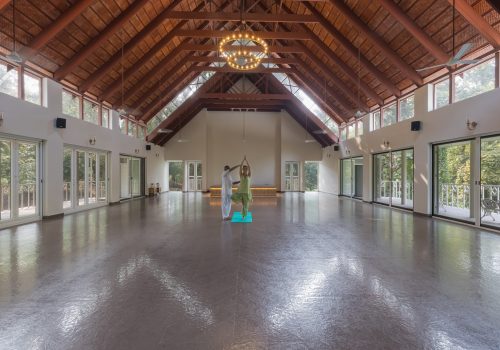
Yoga and meditation also appear in the National Geographic Traveller description of the Healing Village.
At an Ayurvedic hospital-resort, these practices can support the daily structure of a stay. They may help guests move more deliberately, reduce stimulation and establish routines that can be continued after departure.
They do not replace medical assessment or physician-led treatment.
The intensity and form of movement should also be adjusted to the individual. A guest undergoing an intensive procedure or recovering from illness may require a different practice from someone visiting primarily for rest.
What sustainability claims require
The original brief described rainwater harvesting, greywater reuse, pollinator habitats, soil-health measures, artisan partnerships and therapist training.
These may be worthwhile initiatives, but they should not be attributed to the National Geographic Traveller feature unless the published page states them. They should also not be presented as verified Kairali programmes without current internal documentation.
The feature’s accessible wording supports a more limited statement: Kairali combines Ayurvedic practice with environmentally conscious methods in a natural setting.
A future article focused specifically on sustainability should be based on documented information such as:
- the property’s current environmental certification;
- water and waste-management records;
- energy or sourcing policies;
- named community programmes; and
- measurable environmental targets.
Specific evidence makes a stronger case than general claims about regenerative or planet-positive hospitality.
Recognition without overstatement
Media coverage can be valuable, but it should be described accurately.
The National Geographic Traveller feature does not guarantee that every guest will experience better sleep, improved digestion, reduced stress or rehabilitation. These are individual health outcomes that depend on many factors and require appropriate evidence.
Nor should representative guest transformations be created to illustrate the article. A patient or guest case may be published only when it is genuine, verified and supported by the necessary consent.
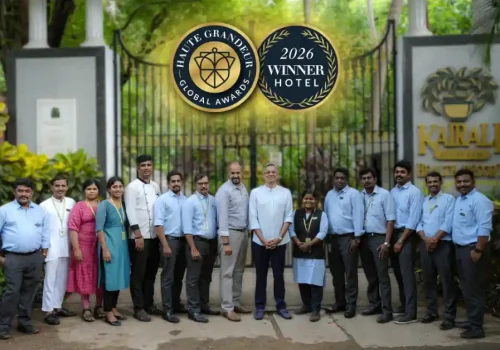
The most defensible significance of the feature is straightforward: an international travel publication has included Kairali, The Ayurvedic Healing Village in its Luxury Collection 2025 and presented it as a destination where Ayurveda, nature, food, yoga and meditation form part of the residential experience.
More than a conventional idea of luxury
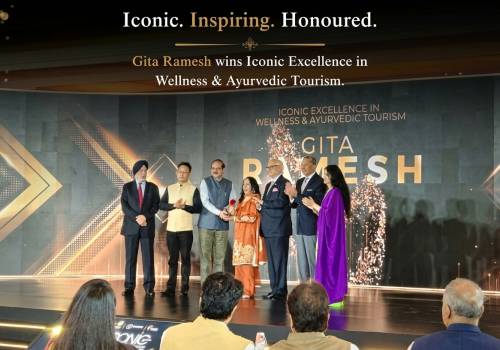
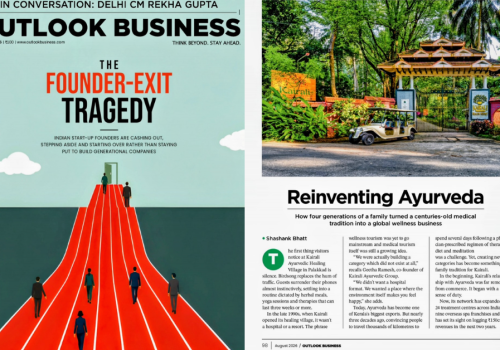
Kairali Ayurvedic Group was founded in 1989 by K.V. Ramesh and Gita Ramesh and draws on four generations of Ayurvedic practice in the founders’ family.
It should not be described as having 115 or 130 years of corporate history. The group has more than three decades of institutional experience, supported by a longer family lineage in Ayurvedic practice.
That distinction reflects the broader point of the National Geographic Traveller feature.
At a destination such as Kairali, luxury is not only a matter of surroundings. It is also found in time, supervision, individual attention and the discipline of following a structured programme without the interruptions of ordinary life.
The feature gives this model of travel greater international visibility. Its value lies not in turning Ayurveda into another luxury trend, but in showing that a carefully organised residential setting can create the conditions in which traditional clinical practice is delivered with greater attention.
Source: https://magazine.natgeotraveller.co.uk/NGTC-Luxury-Oct-2025-Full-Mag/
Start with a free consultation at +91-9555156156 or learn more at www.ktahv.com.