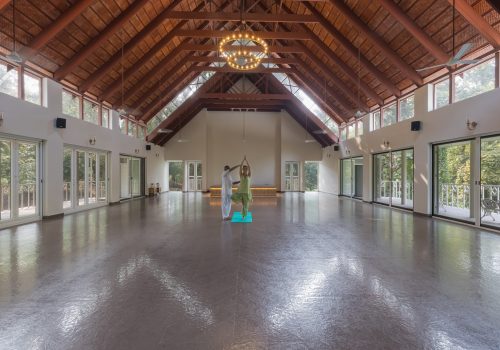

































The end of the day changes more than the light.
Activity begins to slow. Meals, movement and conversation give way to rest. For Ayurveda, this transition matters because wellbeing is understood not only through what we do, but also through when we do it.
That makes the evening a useful time for quieter practices such as gentle yoga, breathing exercises and meditation.
At Kairali, The Ayurvedic Healing Village in Kerala, yoga forms part of a wider approach to daily routine and physician-guided Ayurvedic care. The aim is not to turn every evening into a ritual, but to create a deliberate transition between the activity of the day and the conditions needed for rest.
Why the evening calls for a different kind of yoga
A vigorous morning practice and a quiet evening session serve different purposes.
Later in the day, slower postures can help shift attention away from constant activity. Restorative poses such as Supta Baddha Konasana (Reclining Bound Angle Pose) and Balasana (Child’s Pose) place less emphasis on exertion and more on releasing muscular tension and settling the body.
This is particularly relevant in a retreat setting, where yoga is not treated as an isolated fitness session. It sits alongside meals, therapies, rest and other elements of the daily schedule.
The principle is straightforward: the practice should suit the time of day rather than compete with it.
Breathing as a transition into rest
Breathwork can also play a role in evening practice.
Techniques such as Nāḍī Śodhana (alternate-nostril breathing) and Bhrāmarī (humming-bee breath) are traditionally used as calming practices within yoga.
Their value in an evening routine is partly practical. They require stillness, attention and a slower pace, which can provide a clear boundary between daytime activity and the period before sleep.
Rather than thinking of pranayama as a way to “clear energy channels,” a more useful contemporary description is that it encourages deliberate, controlled breathing and focused attention.
For many people, that alone makes it a meaningful way to close the day.
Meditation without the performance of stillness
Evening meditation is sometimes presented as something elaborate or spiritual. It does not need to be.
A few minutes of seated attention can simply create space to notice how the body and mind have changed over the course of the day.
In an Ayurvedic setting, this fits naturally with the broader emphasis on observation. Appetite, digestion, sleep, mood, energy and daily routine are all relevant to how an Ayurvedic practitioner understands an individual.
That same habit of observation can be useful outside the consultation room as well.
The aim is not to force the mind into complete silence. It is to become more attentive to what is already happening.
Ayurveda has always paid attention to time
One of the more interesting aspects of Ayurveda is the attention it gives to rhythm.
Classical Ayurvedic thought considers daily routine, seasonal change, food timing, sleep and patterns of activity as part of health rather than as background details.
This is why the idea of an evening practice makes sense within Ayurveda. It recognises that the body does not exist independently of time and environment.
Modern wellness culture often turns this idea into broad claims about “aligning with nature.” That language can become vague very quickly.
A more precise interpretation is that human habits change across the day and across the year, and Ayurveda asks practitioners to pay attention to those changes when considering diet, activity, rest and treatment.
What about the moon?
Ayurvedic and Indian cultural traditions contain references to lunar cycles, and yoga communities may also incorporate practices associated with the new or full moon.
However, these ideas should be distinguished from claims that particular moon phases reliably produce specific physiological or psychological effects.
Evidence for such effects remains limited, and an editorial discussion of lunar practice should not present symbolic or traditional associations as established medical facts.
For some people, observing a full moon or new moon can nevertheless provide a useful point for reflection. The value may lie less in a measurable lunar effect on the body than in the discipline of pausing, noticing time and stepping outside a continuously accelerated routine.
That distinction matters.
Tradition can be meaningful without requiring every traditional association to be converted into a scientific claim.
The setting changes the experience
Kairali’s Kerala setting gives evening practice a particular character.
The slower pace of a residential Ayurvedic programme, combined with time outdoors and a structured daily schedule, makes it easier to notice transitions that are often lost in ordinary life.
Dusk becomes a recognisable part of the day rather than simply the moment when the lights are switched on.
A yoga or meditation session in that setting does not need to promise transformation. Its value can be considerably simpler: movement becomes quieter, attention becomes narrower, and the day is given a deliberate ending.
A quieter way to think about wellbeing
Ayurveda is sometimes presented through dramatic promises: detoxification, transformation, spiritual awakening or complete balance.
Its more useful lessons are often less theatrical.
Eat with attention. Sleep at an appropriate time. Notice seasonal changes. Adjust activity to circumstances. Observe how routines affect you. Seek qualified guidance when treatment is needed.
Evening yoga belongs comfortably within that framework.
It is not about chasing a particular state or attributing every change in mood to the movement of the moon. It is about recognising that rest is easier to enter when the hours before it are treated differently from the hours of work and activity.
In a culture where the day increasingly has no clear ending, that may be one of Ayurveda’s most practical observations.
Website: www.ktahv.com
Call: +91-9555156156