






















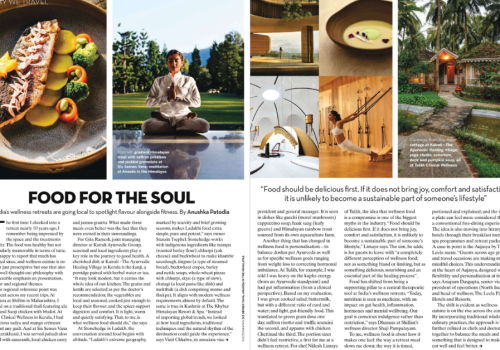




There is something useful in Shilpa Shetty’s approach to fitness that has little to do with celebrity discipline or elaborate workout routines: consistency.
In recent interviews, she has spoken about adapting exercise as she has grown older, moving between yoga, strength work, functional training and simpler forms of movement depending on what her body needs. She has also described prāṇāyāma (breath regulation), quiet time in the morning and warm water with turmeric as recurring parts of her routine.
That idea translates well into Ayurveda.
Ageing well, from an Ayurvedic perspective, does not necessarily mean doing more. It often means becoming more discerning about what the body can sustain: regular movement rather than sporadic intensity, enough recovery, a stable daily rhythm and practices that leave us feeling better rather than depleted.
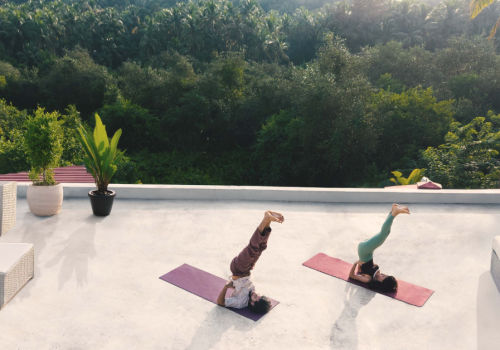
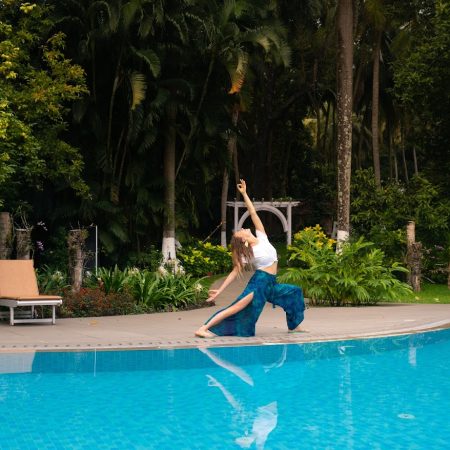
At Villa Raag in Goa, that principle feels particularly easy to understand. A slower morning provides space to notice how the body actually feels before deciding what it needs.
Here are five simple practices that take inspiration from that approach while remaining grounded in Ayurvedic principles.
1. Begin with Sūrya Namaskāra, but stop before it becomes a competition
Sūrya Namaskāra (sun salutation) is a flowing sequence that coordinates movement and breath across several major joints and muscle groups. Shilpa Shetty has publicly shared Sūrya Namaskāra as part of her yoga practice, including as a way of beginning the day.
The Ayurvedic lesson is not that everyone needs to complete a particular number of rounds. It is that movement should be appropriate to the person, the season and their present capacity.
For someone who feels stiff, restless or depleted, four slow rounds may be more useful than twenty hurried ones. Someone who tends towards heaviness and sluggishness may prefer a slightly more energetic pace. On a hot morning, particularly for a person who already runs warm, reducing intensity may make more sense than pushing through.
This is where Ayurveda differs from the idea of a universal morning routine. The practice matters, but so does the response to it.
A useful question after Sūrya Namaskāra is therefore not, “How many rounds did I finish?”
It is, “How do I feel now?”
Ideally, the answer is more awake, more mobile and more settled, not exhausted.
2. Give five minutes to prāṇāyāma
Prāṇāyāma is often treated as the quieter part of yoga, something to do after the “real” exercise is finished. That underestimates its place in a sustainable routine.
Shilpa has repeatedly spoken about breathwork as part of her daily practice and has said that even when she does not have time for a full āsana practice, she continues with prāṇāyāma.
For a minimalist morning, the practice does not need to become complicated.
A few minutes of slow, comfortable breathing can create a deliberate transition between sleep and the demands of the day. Nāḍī Śodhana (alternate-nostril breathing) is another traditional option when practised comfortably and without strain.
Ayurveda pays close attention to irregularity: irregular sleep, meals, digestion, energy and daily schedules. Breath practice does not correct all of these, nor should it be presented as a treatment for them. What it can do is introduce a period of steadiness into a morning that might otherwise begin with notifications, deadlines and immediate stimulation.
Five attentive minutes are enough to make the practice real.
3. Spend a little time close to the floor
Modern life asks us to sit frequently, but usually in one position: hips and knees at roughly ninety degrees, often for hours at a time.
A simple squat such as Mālāsana (garland pose) asks the lower body to move differently. It involves the ankles, knees and hips through a range many adults gradually stop using.
There is no need to force the full posture. If the heels lift, support them. If balance is uncertain, hold the back of a chair. If the knees are uncomfortable, use a shallower variation or leave the pose out altogether.
The aim is not to produce a photographically perfect squat.
It is to preserve useful movement.
That distinction becomes increasingly important with age. A sustainable yoga practice should support ordinary capacities such as getting up from the floor, walking comfortably, turning, reaching and maintaining confidence in movement.
Thirty seconds practised regularly may ultimately matter more than an ambitious pose attempted occasionally.
4. Practise balance before you begin to lose it
Vṛkṣāsana (tree pose) appears simple until the body begins to wobble.
That wobble is useful information.
Standing on one leg asks the feet, ankles, hips, vision and attention to work together. It also makes distraction immediately obvious. The mind moves, the gaze moves and often the body follows.
From an Ayurvedic perspective, this quality of steadiness is particularly relevant when there is too much movement and irregularity in daily life, qualities traditionally associated with increased Vāta doṣa.
The practice can remain very simple. Place one foot against the opposite ankle, calf or inner thigh, avoiding pressure directly on the knee. Fix the gaze on one unmoving point. Stay for several comfortable breaths and change sides.
There is no prize for holding the pose longest.
The useful part is repeatedly losing balance, making a small correction and finding stability again.
That is a surprisingly good metaphor for ageing well.
5. Keep the morning drink simple, and do not turn it into a cure
Shilpa Shetty has spoken publicly about beginning her morning with combinations involving warm water, ghee, turmeric and black pepper.
These ingredients are familiar within Indian food traditions and Ayurvedic practice. Turmeric, or haridrā, has a long history of culinary and traditional use. Ghee is also an established food and therapeutic medium within Ayurveda, while black pepper is commonly used as a culinary spice and in traditional formulations.
But a traditional ingredient is not automatically appropriate for every person, in every quantity, every day.
That is an important distinction.
A warm morning drink should not be presented as a shortcut for weight loss, “detoxification”, immunity or disease prevention. Nor does adding more ingredients necessarily make it more Ayurvedic.
If you enjoy warm water in the morning, that alone may be enough. If you regularly use turmeric, ghee or other Ayurvedic preparations for a specific health purpose, particularly alongside medication or an existing medical condition, the choice is better individualised with a qualified practitioner.
Minimalism applies here too.
The point is not to construct the most impressive tonic. It is to develop a morning rhythm you can live with.
A realistic 20-minute morning
The difficulty with wellness routines is rarely knowing what to do. It is continuing to do them once ordinary life resumes.
So instead of an elaborate protocol, try a genuinely short framework:
- 2 minutes: Sit quietly and notice the breath.
- 7 minutes: Practise a few comfortable rounds of Sūrya Namaskāra.
- 2 minutes: Spend time in Mālāsana or another gentle hip-and-ankle movement.
- 3 minutes: Practise Vṛkṣāsana on both sides.
- 5 minutes: Use slow breathing or Nāḍī Śodhana.
- 1 minute: Drink warm water without looking at your phone.
Twenty minutes.
No complicated equipment. No target number of calories. No requirement to perform the routine perfectly.
And importantly, no assumption that the same routine will suit everyone.
Ayurveda’s contribution to the conversation about ageing is not simply another list of wellness practices. It is the insistence that context matters. Constitution, current health, climate, digestion, sleep, strength and life stage all affect what is appropriate.
That becomes more valuable, not less, as we grow older.
The lesson worth taking from a disciplined yoga practitioner such as Shilpa Shetty is therefore not to reproduce her routine exactly. It is to notice the principle underneath it: keep moving, keep adapting and make the practices simple enough to repeat.
A morning at Villa Raag may make that rhythm easier to discover. The more useful test, however, is whether some part of it survives when you return home.
That is where a ritual becomes a habit.
Website: www.villaraag.com
Call: +91-9555156156






Leave a Reply