





















As an Ayurvedic physician, I often hear a very similar story from women and working professionals who spend most of the day at a desk. A tired lower back. A tight neck. A heavy head. Restless sleep. And that wired-but-tired feeling that doesn’t quite go away. The issue isn’t only the long hours of sitting; it’s the way we sit — uninterrupted, on autopilot — that gradually strains both body and mind.
At Kairali – The Ayurvedic Healing Village, we remind guests that the body responds even to very small shifts. Tiny ones. You don’t always need a yoga mat, stretchy clothes, or a 60‑minute class. You can simply use the time you already spend sitting and turn a few of those minutes into short, body-awakening breaks.
In this article, this blog will walk you through five simple, office-friendly practices that can fit around your workday without drawing much attention.
Why sitting all day feels so draining – from an Ayurvedic lens
Ayurveda, the traditional Indian system of health that focuses on balance between body, mind, and environment, sees prolonged, still sitting as something that can disturb two key principles:
– Vata dosha – linked with movement, the nervous system, and dryness
– Kapha dosha – linked with stability, heaviness, and structure
When Vata is overstrained and Kapha becomes stagnant, the body often sends very clear signals. In people who sit for long hours, I frequently see patterns like these:
– Stiff neck and shoulders from a forward-head, rounded-shoulder posture
– A dull ache in the lower back and hips by late afternoon
– Heaviness after meals, sluggish digestion, and frequent bloating
– Mental fatigue, scattered focus, and a lower threshold for stress
Short, regular movement breaks can restore some circulation, support joint lubrication, and soothe an over-stimulated nervous system. Think of them as small reset buttons hidden between emails, meetings, or study blocks. One of our senior guests in her 60s once told me these breaks felt “like opening a window in a stuffy room” – the same body, but suddenly there is more space and ease inside.
Before you begin, remember that these are general Ayurvedic lifestyle suggestions, not a treatment plan. If you’re pregnant, recovering from surgery, or living with a serious spine or heart condition, please speak with your doctor before starting anything new.
—
1. Tadasana: Mountain Pose for posture awareness
Many guests realise in their very first yoga session at the Healing Village that they’ve almost forgotten how it feels simply to stand well. Just standing. The nervous system tends to relax when the body feels clearly aligned and supported from the ground upward.
How to practise (office version)
1. Stand with your feet hip-width apart, weight spread evenly over both feet.
2. Gently engage your thighs and soften your knees so they’re not locked.
3. Lengthen your spine, and roll your shoulders back and down away from the ears.
4. Imagine a soft thread lifting the crown of your head towards the ceiling.
5. Keep your face relaxed and breathe slowly for 5–10 steady breaths.
What you may feel
– A sense of length and space along the spine
– A more open chest and easier breathing
– A calm, alert feeling instead of a slouched, sleepy posture
Ayurvedic view
Tadasana brings grounding and stability. This supports Vata and gives the nervous system a steady, clear reference point, rather like pressing “reset” on your posture.
—
2. Bhujangasana: Desk-supported Cobra to open the chest
Most people work with a rounded upper back, collapsed chest, and shoulders drifting forward toward the screen. When this goes on for months or years, it often leads to mid-back stiffness, tightness across the chest, and shallow, unsatisfying breathing.
If lying on the floor isn’t possible in your office, you can adapt Cobra Pose using your desk as support.
How to practise (desk-supported)
1. Stand about one arm’s length away from your desk so you can reach it comfortably.
2. Place both palms on the desk, shoulder-width apart, fingers spread for stability.
3. As you inhale, soften your knees and gently arch your upper back, drawing the chest forward and slightly up while keeping your pelvis stable and neutral.
4. Keep your neck long and relaxed, without dropping the head back.
5. Hold for 3–5 easy breaths, then release. Repeat up to 3 times if it feels good.
What you may feel
– A pleasant stretch through the front of the chest and shoulders
– Mild warmth and activation along the spine and upper back
Caution
If you have severe lower back pain, disc prolapse, or a history of recent spine surgery, avoid deeper arching. Keep the movement very subtle, stay within a pain-free range, or skip this pose and spend more time with Tadasana and breathing practices.
—
3. Marjariasana–Bitilasana: Seated Cat–Cow for spinal mobility
At Kairali, I often recommend a chair-based Cat–Cow sequence for guests who sit for long hours or have limited mobility. It’s surprisingly discreet — many people do it between video calls — yet it can make a noticeable difference to a tight or achy back.
How to practise (chair version)
1. Sit towards the front edge of your chair with your feet flat, grounded on the floor.
2. Place your hands comfortably on your knees or thighs.
3. Inhale: gently arch the back, roll the shoulders back, and lift the chest slightly (Cow).
4. Exhale: round the back, draw the navel in towards the spine, and let the chin move towards the chest (Cat).
5. Continue moving slowly with your breath for 10–15 rounds, staying gentle and avoiding any strain.
What you may feel
– Gradual warmth and increased suppleness along the spine
– Softer muscles between the shoulder blades
– Breathing that feels easier and less restricted in the chest
Ayurvedic view
Smooth, rhythmic spinal movement supports the flow of **prana** (life-force). This may help reduce the sense of heaviness, dullness, and congestion linked with aggravated Kapha in the back and chest region.
—
4. Balasana: Chair Child’s Pose for deep exhale
The classic Child’s Pose is done on the floor. Many busy mothers, managers, and corporate professionals, however, appreciate a chair-based version that respects their clothing, time limits, and office setting. At our retreat, this variation is a favourite among guests who feel emotionally overwhelmed, because the position naturally invites a longer, more complete exhale.
How to practise (chair-supported)
1. Sit a little away from your desk, with both feet resting firmly on the floor.
2. Place your forearms or folded arms on the desk in front of you.
3. Gently slide your chair back until your chest lowers towards the desk and your forehead can rest comfortably on your forearms or on a soft cloth or cushion.
4. Let your back round in a way that feels supported and allow your belly to soften.
5. Breathe out slowly through the nose, letting the exhale be slightly longer than the inhale.
6. Stay for 6–10 breaths, then come up slowly, bringing the head up last.
What you may feel
– A gentle release and decompression along the lower back and hips
– A sense of the nervous system “settling” with each long exhale
– Thoughts slowing down and becoming less crowded, even for a minute
If you have uncontrolled high blood pressure, avoid letting the head drop too low. Keep it almost level with the chest or use higher support so you feel no pressure, heaviness, or throbbing in the head.
—
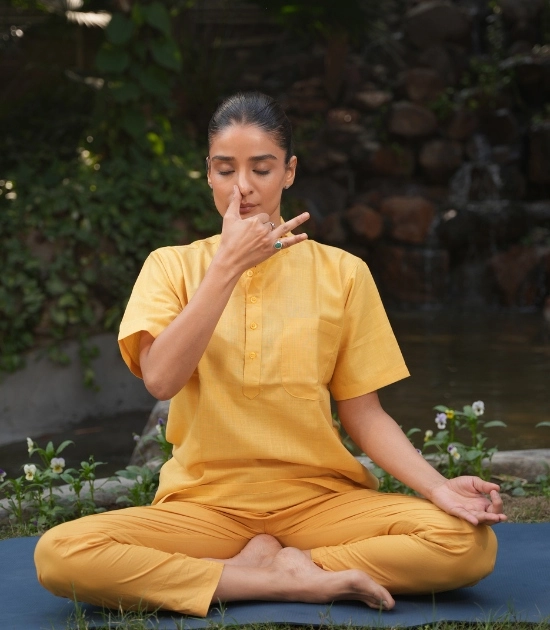
5. Anulom Vilom: Alternate-nostril breathing to reset the mind
Long hours of screen time can leave the mind buzzing while the body feels drained. At our retreat, I often see that just 5–7 minutes of Anulom Vilom before dinner helps many guests fall asleep more easily and shift from work mode into a calmer, more restful state.
How to practise (basic version)
1. Sit upright in your chair, feet grounded, shoulders relaxed away from the ears.
2. With your right hand, place your thumb on the right nostril and your ring finger lightly near the left nostril.
3. Close the right nostril gently, inhale through the left for a count of 4.
4. Close both nostrils softly, pause for a moment, then open the right and exhale for a count of 4.
5. Inhale through the right nostril, close both again briefly, then exhale through the left. This completes one full round.
6. Practise 6–8 rounds, keeping the breath smooth, comfortable, and never forced.
What you may feel
– The mind becoming quieter, more even, and less reactive
– Reduced strain around the eyes, temples, and forehead
– Clearer focus before your next task or a softer landing at the end of the workday
If you have significant respiratory or heart problems, learn this practice under qualified guidance first, and keep the count shorter if needed so there is no breath hunger or discomfort.
How to weave these practices into a real workday
You don’t have to do all five practices in one block. In fact, it’s often more realistic to start with just two and anchor them to things you already do, so they become natural pauses instead of “yet another task” on your list.
You might experiment with something like this:
– After every long call: 1 minute of Seated Cat–Cow
– Before lunch: a brief Tadasana, followed by Desk-supported Cobra
– During a mid-afternoon slump: Chair Child’s Pose and 6 rounds of Anulom Vilom
At Kairali, our physicians and yoga therapists regularly design small, personalised micro-routines for guests to continue at home or at work. The focus is always on regularity, easy breathing, and listening to the body’s signals. If any posture creates pain — not just stretch or mild effort — come out of it slowly and modify or skip that practice.
—
When to seek personalised guidance
If you live with chronic back or neck pain, a history of slipped disc, recent surgery, uncontrolled hypertension, or pregnancy, personalised advice is very helpful before adding new movements or postures. Yoga and Ayurveda are at their best when adapted to the individual.
A short consultation with a qualified practitioner can help you clarify:
– Which practices suit your current condition and which to avoid
– How long and how often to practise safely
– Which times of day support your dosha balance and your work schedule
Gentle, regular movement breaks are a kind and realistic way to care for your body during long sitting hours. With a few conscious pauses spread across the day, your chair time can shift from feeling draining and dull to feeling steadier, more energising, and clearer in the mind.
Website: www.ktahv.com
Call: +91-9555156156