



















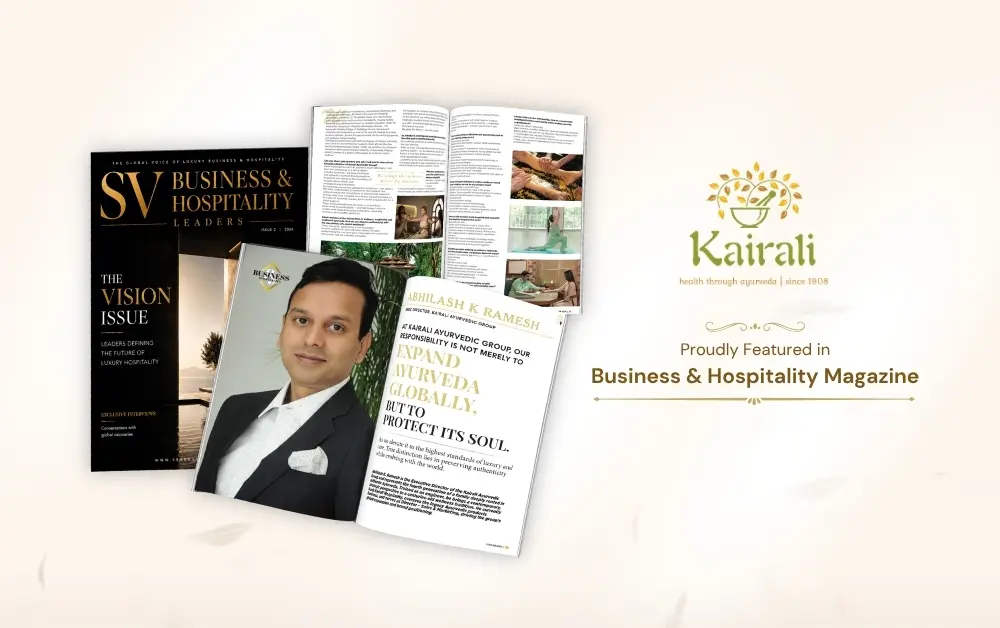

A conversation with Abhilash K. Ramesh, Executive Director, Kairali Ayurvedic Group
In an era where wellness is often packaged for speed, spectacle, and trend cycles, the challenge for heritage healthcare systems is not visibility alone — it is preservation. For Kairali Ayurvedic Group, founded on more than a century of Ayurvedic practice, growth is inseparable from responsibility.
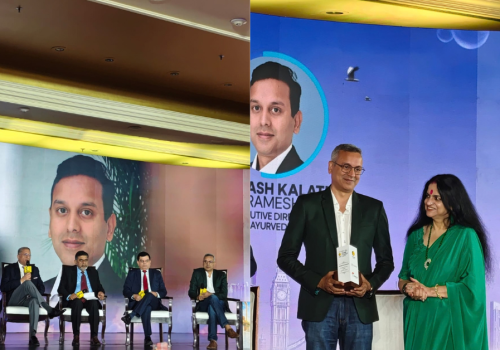
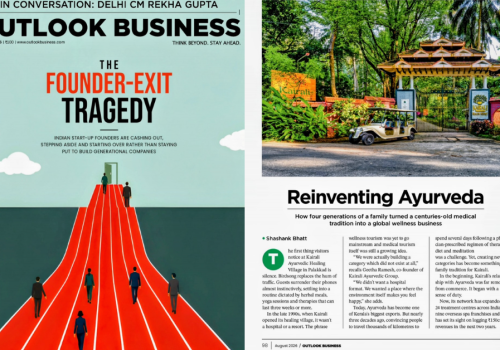
In this interview featured in SV Business & Hospitality Magazine, Abhilash K. Ramesh, Executive Director of Kairali Ayurvedic Group, speaks about the balance between authenticity and global expansion, the evolving expectations of wellness travellers, and the discipline required to scale Ayurveda without reducing it to a lifestyle aesthetic.
For Abhilash K. Ramesh, Ayurveda’s future depends on interpretation without distortion. While wellness hospitality continues to evolve globally, he believes Ayurveda must remain clinically grounded and ethically communicated.
According to him, authenticity in Ayurveda does not mean rigidity. It means preserving the medical philosophy and treatment integrity of the system while making its experience accessible to modern international audiences. At Kairali, this balance is reflected in treatment protocols that continue to follow classical Ayurvedic texts under the supervision of qualified BAMS doctors, while hospitality standards evolve to meet contemporary expectations.
He describes this approach succinctly:
“We adapt the delivery — never the doctrine.”
This philosophy shapes everything from personalised wellness programmes to operational standards across Kairali’s hospitality and therapeutic offerings.
A fourth-generation perspective on Ayurveda
Born into the Kairali Ayurvedic legacy, Abhilash grew up observing how Ayurvedic care transformed people’s lives beyond symptom management. He describes his leadership journey as gradual and immersive — shaped through direct exposure to operations, patient care systems, consultations, and international business development.
Rather than viewing Ayurveda purely as heritage, he sees it as a living medical system that must evolve responsibly. His focus today is building what he calls a “future-ready Ayurveda brand” — one capable of operating within global compliance frameworks while preserving clinical depth and philosophical integrity.
With experience spanning marketing, international partnerships, and wellness hospitality, his leadership reflects a hybrid outlook: commercially aware, but rooted in long-term institutional credibility.
Why commodification is Ayurveda’s biggest risk
One of the strongest themes in the interview is the concern around the commercial dilution of Ayurveda.
Abhilash notes that Ayurveda is increasingly reduced to spa rituals and surface-level wellness branding in international markets. While global interest in holistic wellbeing has created opportunities, it has also created pressure to simplify complex systems into marketable experiences.
He argues that responsible scaling requires protecting Ayurveda’s medical foundation through:
- rigorous practitioner training
- proper diagnosis before treatment
- standardised therapeutic protocols
- regulatory compliance across markets
- careful communication without exaggerated claims
For him, credibility matters more than acceleration. Expansion, he suggests, should strengthen trust in Ayurveda rather than weaken it through over-commercialisation.
Rethinking excellence in wellness hospitality
In the interview, Abhilash defines excellence in Ayurvedic hospitality as multidimensional. It is not limited to luxury infrastructure or service design, but extends into clinical ethics, patient trust, and continuity of care.
He emphasises several principles:
- clinical precision in diagnosis and treatment planning
- personalised therapies rooted in prakriti assessment
- transparent communication with guests
- seamless hospitality that supports healing rather than distracting from it
- emotional and psychological comfort alongside physical care
This integrated view reflects Kairali’s positioning within wellness hospitality: not as a resort model borrowing Ayurvedic language, but as a healthcare-led hospitality environment.
Leadership in a heritage organisation
Leading a legacy institution, according to Abhilash, requires stewardship rather than short-term expansion thinking.
He describes leadership as the responsibility of safeguarding accumulated trust while preparing the organisation for future relevance. That includes investing in practitioner education, operational systems, research orientation, and ethical governance.
Importantly, he rejects the idea that heritage brands can rely solely on nostalgia. In his view, institutional longevity depends on disciplined adaptation.
His management philosophy centres on measured decision-making, long-term thinking, and maintaining clarity of purpose during growth.
Wellness, sustainability, and organisational culture
The conversation also touches on sustainability — not as a marketing layer, but as an extension of Ayurvedic philosophy itself.
Abhilash explains that this influences decisions around sourcing, treatment environments, community engagement, and operational practices. Ayurveda’s understanding of balance, he suggests, naturally extends beyond individual wellbeing into environmental and social responsibility.
Internally, he advocates a culture where scientific understanding and traditional wisdom coexist. Practitioners and teams are encouraged to remain connected both to classical Ayurvedic foundations and to emerging research and global standards.
Building institutions, not trends
Perhaps the clearest insight from the interview is Abhilash’s distinction between building a wellness brand and building a wellness institution.
Trends, he suggests, reward visibility. Institutions require patience, consistency, systems, and trust accumulated over decades.
His advice to emerging wellness entrepreneurs reflects that belief:
- stay rooted in purpose
- prioritise expertise before expansion
- protect integrity while scaling
- avoid chasing trends at the cost of substance
In a wellness industry increasingly driven by aesthetics and rapid commercialisation, his perspective stands apart for its restraint. The ambition is global — but so is the responsibility.
Read More : https://www.calameo.com/read/002703923e448d648862a