
























Waking up by the sea at Villa Raag in Goa, your body usually gives the first honest report of how you’ve slept, long before the mind catches up. Some mornings feel wide, unhurried, almost liquid. Other days, even after eight hours in bed, everything feels compressed, restless, or fogged over. In my clinical work with yoga and somatic practitioners, this difference shows up most clearly in the fascia and in how settled—or keyed up—the nervous system is.
A focused 20‑minute morning somatic flow can quietly shape the rest of your day. At Villa Raag, we keep these practices short and simple, mirroring the space itself: clean light, uncluttered corners, gentle sounds, nothing extra. That way, your nervous system slowly learns that it’s safe to soften instead of brace.
Why fascia matters to how you feel
In Ayurveda, we speak of dhatu – the body tissues that hold and nourish us over time. Fascia isn’t listed as a separate tissue in classical texts, yet in practice it behaves like a fine, continuous web that weaves through muscle, fat (medas), bone (asthi), and even the subtle pathways of prana (life‑movement). When that web is hydrated and elastic, many people describe their body as light, joints as roomy, with a quiet, steady sort of stamina. When it becomes tight or dried out, the language shifts quickly: stiffness, quick irritation, shallow breath, or a sense of being “wrapped too tightly” inside the skin.
At Villa Raag, our experts repeatedly notice that guests with long‑standing neck or low‑back tightness often share signs of aggravated Vata dosha (the principle of movement): rough or dry skin, appetite that comes and goes, broken or restless sleep, looping worry. In such cases, slow, intentional movement that communicates directly with fascia usually settles the pattern more reliably than aggressive stretching or gritting the teeth and “pushing through” the pain.
A morning somatic flow isn’t about burning calories or chasing flexibility. It’s more like a quiet, curious conversation with your connective tissue and your nervous system.
Somatic flow and the nervous system
Somatic work starts from the body’s lead: instead of forcing it into fixed shapes, you move just slowly enough that you can genuinely track sensation as it arises—heat, subtle pull, trembling, softening, or release. This kind of attention speaks straight to the autonomic nervous system, especially if you practice at roughly the same time each morning so the body starts to expect it.
Blended with Ayurvedic principles, the practice can be quietly tailored:
– Grounding for Vata – slow, rhythmic, floor‑based motions help signal safety and containment, easing that scattered, “all over the place” feeling.
– Cooling for Pitta– smooth pacing without competition or comparison, and less focus on “doing the pose right”, softens the inner drive to outperform.
– Mobilising for Kapha – gentle spirals and oscillations wake up circulation and alertness without tipping into the heaviness, resistance, or overwhelm that can follow very hard effort.
Many guests share that after 15–20 minutes of this kind of movement, their mind feels clearer and more here than after a strong vinyasa class. There’s often a comfortable weight in the limbs, paired with a bright, settled sense behind the eyes – a pattern we link with moving out of hyper‑vigilance towards a more regulated, responsive state.
A 20‑minute morning somatic sequence
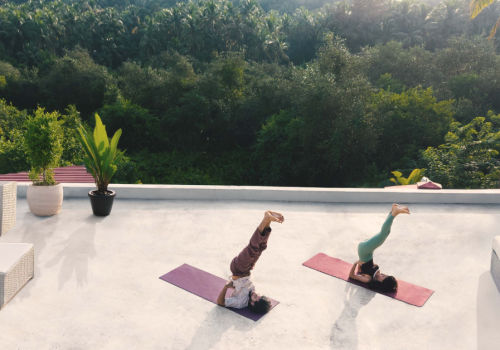
This is the outline we often offer guests at Villa Raag. It’s deliberately lean: only a mat, an open window or balcony door if possible, natural light, and whatever sounds drift in from the sea or trees.
1. Arrive and scan (2 minutes)
– Sit or lie on your back, knees bent.
– Notice five anchor points: back of head, shoulder blades, back of ribs, pelvis, and feet.
– Simply sense where contact with the mat feels firm, and where there’s emptiness, gripping, or dullness.
This brief scan becomes your personal daily reference point. Many women I work with first sense hormonal shifts (pre‑menstrual or peri‑menopausal) here: extra clenching in the jaw, tighter holding in the lower belly, or a dragging density in the thighs and pelvis that wasn’t there a few days before.
2. Gentle spinal waves (4 minutes)
– Lying on your back, feet hip‑width apart.
– As you exhale, slowly tilt the pelvis so the lower back softens towards the mat.
– As you inhale, release to neutral, allowing a slight, comfortable arch if it comes naturally.
– Move as if the mat is a quiet teacher giving feedback to each small section of your spine.
Keep the wave small, exploratory, and unhurried rather than big and dramatic. Track any warmth, tingling, or sense of space moving along the spine. If your breath gets choppy or you feel you’re rushing ahead to “finish” the movement, treat that rush as a signal and ease the pace.
3. Somatic hip circles (4 minutes)
– Still lying on your back, draw one knee towards the chest.
– Trace slow, modest circles in the air with that knee, letting the motion subtly transmit into the hip joint and surrounding tissue.
– Reverse the direction, then change legs.
The point isn’t to create the largest circle possible, but to feel whether the circle is even and smooth. Tight fascia often reveals itself as abrupt corners, tiny grabs, or catches somewhere in the arc. Over several days, guests usually notice those circles becoming rounder and silkier, without ever feeling like they muscled their way there.
4. Side‑body glide (4 minutes)
– Lie on one side, knees lightly bent, head resting on a folded towel or cushion.
– With an inhale, slide your top hand along the floor overhead, lengthening through the side waist and ribs.
– With an exhale, let the hand return slowly towards the hip.
Sense this less as a pointed stretch and more as a long, spreading expansion through the ribs, side waist, and even into the outer hip. Many corporate professionals tell us that a few days of this simple glide softens their habitual “shrug” around the shoulders and side neck – the posture that silently accumulates over hours hunched over a laptop or phone, especially when deadlines stack up.
5. Seated neck and jaw release (3 minutes)
– Sit in any easy, supported position, hands resting on your thighs.
– Let the jaw hang a touch, lips relaxed, and breathe softly through the nose.
– Draw very small “yes” and “no” gestures with the head, at maybe half the speed you’d use in conversation.
At Villa Raag, we see again and again that once the jaw lets go, the pelvic floor often softens within just a few breaths. For women experiencing menstrual cramps, post‑partum recovery challenges, or peri‑menopausal pelvic tension, this jaw–pelvis relationship can be a surprisingly helpful, accessible support you can return to even outside of practice.
6. Integration rest (3 minutes)
– Lie back, arms easy, palms turned up or resting on the belly.
– Sense the silhouette of your body on the mat – which areas feel broad and heavy, which feel narrow, lifted, or held.
– Notice any shifts: a temperature change, gentle pulsing, a wave of lightness, or a pleasant tiredness.
Even a couple of undisturbed minutes here help the nervous system register this pattern of ease more firmly, so it’s easier to access later in the day when you’re at your desk or moving through airports.
How Villa Raag’s design supports this practice
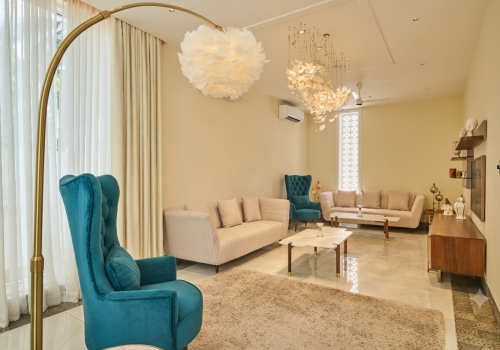
The physical space around you is always feeding your senses, and through them, your nervous system. At Villa Raag, the minimalist architecture – clear lines, uncluttered rooms, soft earth‑toned fabrics, the steady background of sea noise – quietly strips away a lot of visual and sound clutter without you having to “try” to relax. Many guests say their breath drops deeper into the belly almost instantly when they step into the bedroom or onto the balcony, sometimes before they’ve even unpacked.
If you wake in a room like that and offer yourself 20 minutes of somatic practice before checking your phone or glancing at emails, you’re sending Agni (your digestive and metabolic fire) and your mind a very consistent message: the day is starting from steadiness, not alarm.
We often recommend that guests:
– Keep the mat unrolled in the same corner, so beginning practice is literally a one‑step decision rather than a setup task.
– Link the flow to a simple pre‑practice ritual: a few sips of warm water, a drop of oil rubbed slowly into the temples, or three leisurely breaths by the window while watching the particular quality of that morning’s light.
– Write down three words immediately after practice to describe how the body feels. Over three or four days, these words nearly always evolve – a direct, honest way of tracking change without devices, graphs, or scores.
When to adapt or seek guidance
Ayurvedic and somatic work are naturally individual by design. Your age, menstrual cycle stage, quality of sleep, and medical history all shape what’s suitable on any given morning. If you’re living with acute pain, have had recent surgery, or manage complex medical conditions, it’s sensible to:
– Speak with your primary doctor about any movement restrictions or red flags.
– Share these details with the on‑site Ayurvedic physician or yoga therapist; we frequently adjust ranges of motion, time spent in each phase, or even the sequence itself so it fits the actual person in front of us, not an idealised version.
There will be days when 20 minutes feels like too much, especially after long‑haul flights or a night of broken sleep. On mornings like that, a 5‑minute version – just the initial scan and a few gentle spinal waves – can be plenty. From what I’ve seen over the years, it’s regularity and kindness towards your own body that change things, far more than intensity or perfection.
A quiet reset, every morning
A thoughtfully arranged villa, a short somatic flow, and soft yet precise Ayurvedic guidance can together create something very simple yet deeply impactful: mornings where your body feels like an ally you can lean on, instead of a problem you have to push through. For many guests—especially those carrying long workdays, moving through hormonal transitions, or arriving with layers of travel fatigue—this internal shift often feels like the most meaningful part of their stay, more than any single treatment.
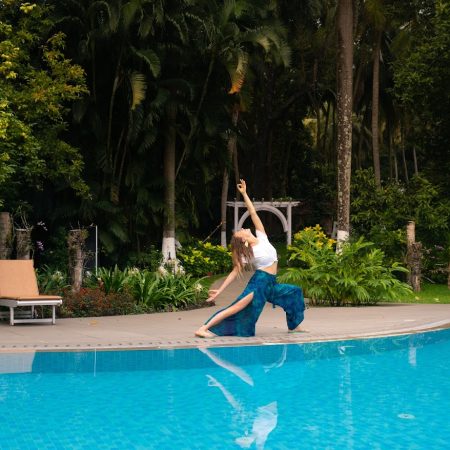
At Villa Raag, that shift can begin the moment you open your eyes, touch the cool floor with your bare feet, hear the sea, and offer your fascia and nervous system 20 undisturbed minutes of straightforward, attentive movement.
Website: www.villaraag.com
Call: +91-9555156156