
























Core strength is often reduced to one visible idea: abdominal muscles.
But the muscles that help us remain stable while walking, standing, bending, lifting or changing direction are more complex than the familiar “six-pack”. The trunk works as a coordinated system involving abdominal muscles, muscles around the spine, the diaphragm and the pelvic floor.
This is why useful core training is not simply about doing more repetitions.
It is about control, breathing, balance and the ability to maintain stability while the rest of the body moves.
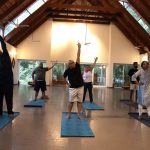
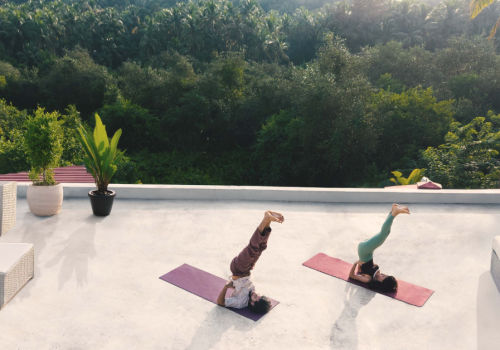
Yoga can contribute to that kind of training. At Kairali, The Ayurvedic Healing Village in Palakkad, Kerala, yoga sits within a broader physician-guided Ayurvedic environment where movement is accompanied by appropriate rest, daily routine and individually selected therapies.
The connection is less about combining as many wellness practices as possible.
It is about recognising that strength also depends on recovery.
What Do We Mean by the “Deep Core”?
There is no single muscle called the deep core.
Instead, the term is commonly used for a group of muscles that contribute to trunk and spinal stability. These include the transversus abdominis, the deeper spinal muscles including the multifidus, the diaphragm and the pelvic-floor musculature.
Together with larger trunk muscles, they help control pressure and movement around the spine.
Good core function therefore matters well beyond exercise.
It is involved when we:
- rise from a chair
- carry a bag
- walk over uneven ground
- reach for something overhead
- change direction
- maintain an upright sitting position
- lift an object from the floor
This is why core training need not be aggressive to be useful.
Controlled movement can sometimes ask more of the stabilising system than fast repetitions performed without attention to alignment.
Where Yoga Fits
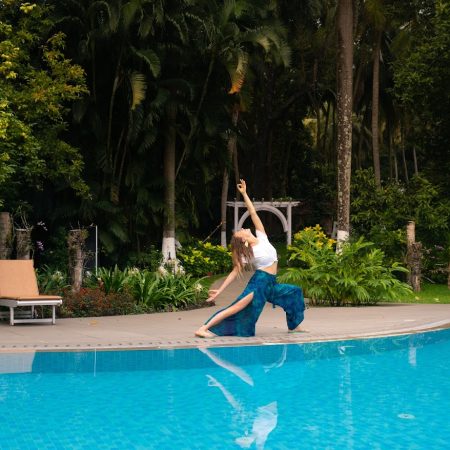
Yoga combines several elements relevant to physical stability: body-weight loading, balance, mobility, isometric holds, controlled transitions and breathing.
Research examining exercise for chronic non-specific low-back pain has found that both yoga and core-stabilisation exercise can improve certain functional outcomes compared with minimal or no intervention. At the same time, core-stability exercises are not consistently superior to other well-designed forms of exercise.
That is an important limitation.
There is no evidence-based reason to treat one particular yoga sequence as the secret to spinal stability.
The more useful principle is regular, appropriate movement performed with enough control to develop strength and coordination over time.
Yoga provides one way of doing that.
Breath Is Part of Trunk Stability
Breathing and core function are often discussed as though they are separate.
They are not entirely separate.
The diaphragm is primarily a respiratory muscle, but it also contributes to pressure regulation and postural control. Research on core-stabilisation approaches increasingly recognises the relationship between breathing mechanics and trunk function.
This gives breath-led movement a practical role.
During a demanding posture, holding the breath unnecessarily can increase tension and make the movement more difficult to control.
A slower breath encourages the practitioner to notice what is happening.
Can the spine remain steady while the arms or legs move?
Does the breath disappear when effort increases?
Is the posture still controlled, or has strain replaced stability?
These are useful questions because they turn yoga away from performance and toward awareness.
Five Yoga Movements That Challenge Core Control
No posture is appropriate for everyone. Existing back pain, osteoporosis, recent surgery, pregnancy, joint problems or other health concerns can change what is suitable.
The examples below are therefore general movement examples rather than a prescription.
At a supervised retreat, teachers can modify practices according to mobility, experience and health context.
1. Tabletop Knee Hover
Beginning from hands and knees, lifting the knees slightly from the floor creates a controlled stability challenge.
The movement requires the trunk to remain relatively steady while weight is distributed through the hands and feet.
The useful part is not how long the position is held.
It is whether the practitioner can maintain comfortable breathing and control.
2. Side Plank Variations
Side-plank positions challenge lateral trunk stability as well as shoulder and hip control.
They can be modified considerably, including by keeping one knee on the ground.
That flexibility makes the posture more useful than treating the full expression as the only legitimate version.
3. Boat Pose
Nāvāsana (Boat Pose) asks the practitioner to balance while maintaining trunk control.
Depending on the individual, the knees may remain bent and the hands may provide support.
Again, the purpose is not simply to create abdominal fatigue.
The more interesting challenge is whether posture and breathing can remain organised as effort increases.
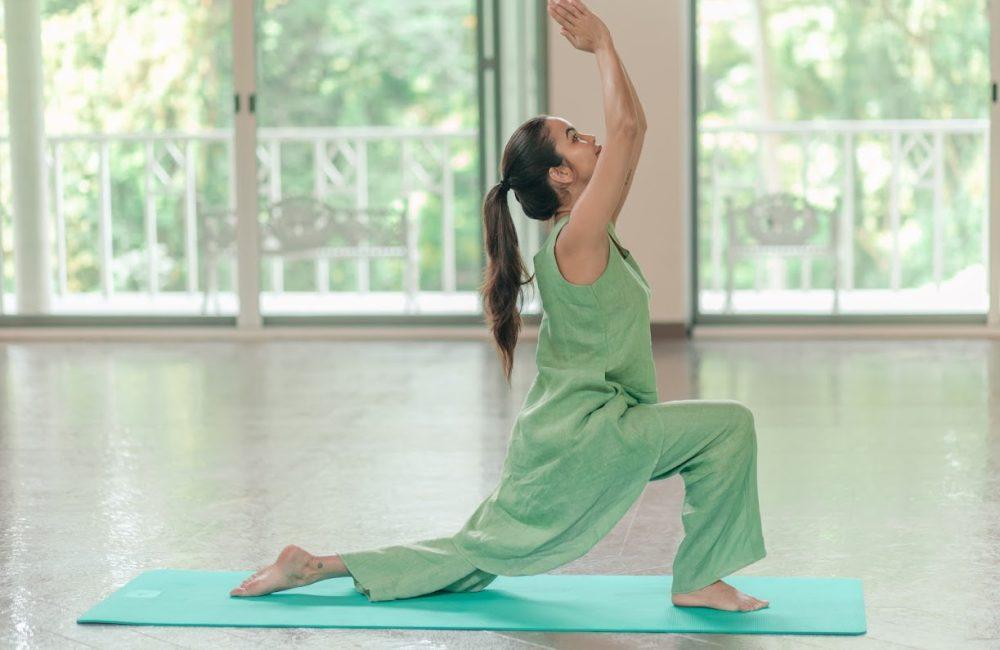
4. Controlled Lunge Variations
Lunges involve more than leg strength.
Because the base of support changes, the trunk has to respond to shifts in balance.
Adding rotation increases complexity further, although twisting variations are not appropriate for every practitioner.
A slower transition is often more valuable than a deeper pose.
5. Downward-Facing Dog With Controlled Leg Movement
Moving one leg while maintaining the rest of the body relatively stable creates another form of trunk-control challenge.
The movement can be kept small.
There is no requirement to bring the knee to the nose or perform repeated pulses for the exercise to have value.
The principle remains the same: movement around a stable centre.
More Difficulty Does Not Automatically Mean Better Training
Yoga culture can sometimes make progression unnecessarily dramatic.
Hold longer.
Twist further.
Lift the leg higher.
Move into the advanced variation.
But stability training does not work according to spectacle.
A modified posture performed with control may offer a more appropriate training stimulus than an advanced pose completed through compensation.
This becomes particularly important in a residential wellness setting, where guests may arrive with very different levels of mobility, strength and prior yoga experience.
At Kairali, yoga can be adapted rather than treated as a standardised class that every guest must perform identically.
The body in front of the teacher matters more than the photograph of the final posture.
What Ayurveda Adds to the Conversation
Ayurveda does not describe the transverse abdominis or multifidus.
Those are modern anatomical terms.
It would therefore be misleading to suggest that classical Ayurvedic treatment was designed specifically to “activate” those muscles.
What Ayurveda can contribute is a wider framework around individual capacity, routine, recovery and appropriate levels of exertion.
Ayurvedic physicians traditionally consider constitution, current imbalance, digestion, sleep, age, physical strength and daily habits when making recommendations.
That perspective can be useful alongside yoga.
A person who is already physically exhausted may not benefit from adding an intense practice simply because strengthening is desirable.
A beginner and an experienced practitioner should not necessarily receive the same sequence.
Someone with significant pain may require medical or physiotherapy assessment before loading the area further.
Personalisation means considering these differences.
At Kairali, Yoga Is Not an Isolated Activity
Kairali, The Ayurvedic Healing Village (KTAHV) is an NABH-accredited Ayurvedic hospital-resort in Kodumbu, Palakkad, Kerala. Its programmes operate within a physician-led Ayurvedic framework.
This matters when yoga is incorporated into a residential stay.
The practice does not have to carry the entire burden of the programme.
There is room for movement.
There is also room for meals, physician consultation, prescribed Ayurvedic therapies, sleep and unstructured rest.
That wider structure can make physical practice more sustainable.
The objective is not to spend the day exhausting the body and then use Ayurveda to “repair” it.
A more coherent approach is to keep activity and recovery in proportion from the beginning.
Where Abhyanga and Other Ayurvedic Therapies Fit
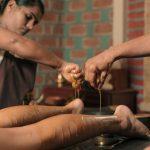
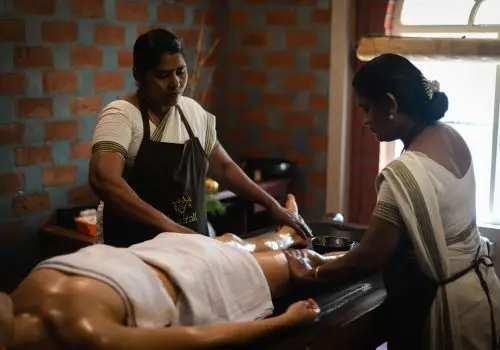
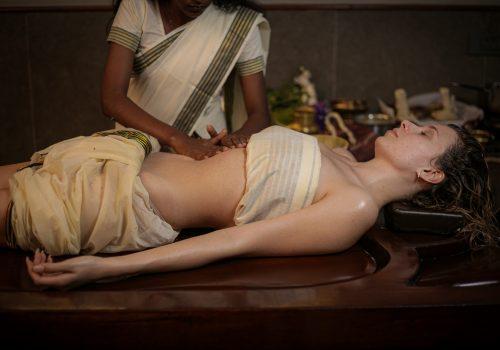
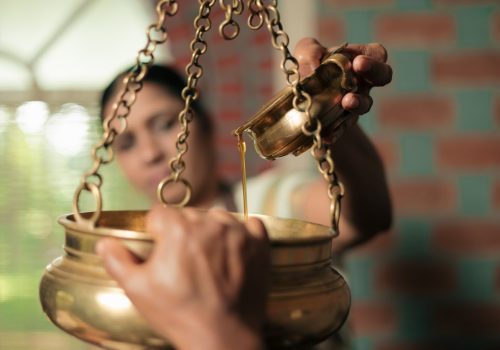
Abhyanga refers to traditional Ayurvedic oil application.
Other therapies may also be selected by a physician according to the individual assessment.
What should be avoided is the claim that an oil therapy directly switches on the core muscles, corrects spinal mechanics or makes a yoga pose physiologically more effective.
Those claims have not been established.
The role of Ayurvedic therapy is better described on its own terms.
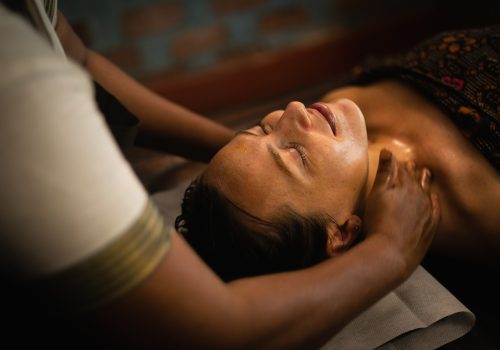
A guest may receive physician-selected therapies as one part of an Ayurvedic programme while yoga provides a separate form of movement and physical practice.
They can coexist without needing an invented mechanism to connect them.
The same applies to Kaṭi Basti, a localised Ayurvedic procedure used traditionally in the lower-back region. It should be discussed as a physician-selected therapy, not as a universal preparation for core exercise.
What About Dosha-Specific Yoga?
Dosha language is sometimes applied too literally to exercise.
Vāta people are told to move slowly.
Pitta people are told not to compete.
Kapha people are told to exercise vigorously.
These may be useful broad tendencies in some contexts, but they are not substitutes for individual assessment.
Ayurveda does not reduce a person to one permanent label.
Prakṛti refers to constitutional pattern, while vikṛti describes the current state of imbalance. Health history, age, strength, sleep, climate and current symptoms also matter.
A person identified as Pitta-predominant may still need strengthening.
Someone with Kapha characteristics may still need rest.
A Vāta-predominant person may enjoy and tolerate vigorous practice.
This is why good personalisation requires more than matching each dosha with a predetermined yoga sequence.
Diet Should Not Be Used as an Exercise Hack
The same caution applies to food.
Claims such as drinking ginger water to improve core activation, using buttermilk to counterbalance a particular pose, or taking Triphala to improve exercise recovery create connections that the evidence does not support.
Ayurvedic dietary guidance can still form part of a residential programme.
But it should be based on the person’s overall assessment rather than attached mechanically to individual yoga poses.
At Kairali, meal planning belongs within the wider Ayurvedic programme.
It does not need to be presented as a performance supplement.
Meditation Has a Different Role
Meditation does not strengthen the transverse abdominis.
Its contribution is different.
A deliberate period of attention can help a practitioner notice physical tension, fatigue, breathing and the tendency to push unnecessarily.
That can influence how movement is approached.
Someone who becomes more aware of strain may learn to stop before technique deteriorates.
Someone who notices habitual breath-holding may begin to change it.
Someone accustomed to exercising competitively may discover that slower movement can still be demanding.
The connection between meditation and physical training is therefore not that the nervous system magically “switches on” the core.
It is that attention can improve the quality of practice.
Can Yoga Help With Back Discomfort?
This is an area where the evidence is encouraging but needs careful interpretation.
Systematic reviews have found that yoga can produce small to moderate improvements in function and pain for some people with chronic non-specific low-back pain compared with no exercise or minimal intervention.
But yoga is not risk-free.
A Cochrane review found increased reports of adverse events compared with no exercise, with worsening back pain among the most common events reported.
This reinforces the case for sensible supervision.
If someone already has persistent or significant back pain, the answer is not simply to perform more “core-strengthening” yoga poses.
Clinical assessment may be necessary, particularly where pain is severe, follows injury, is associated with weakness or numbness, or is otherwise concerning.
Yoga can be one part of movement and rehabilitation.
It is not a universal diagnosis or treatment plan.
Core Strength Is Also About Everyday Movement
The value of stability training becomes clearer outside the yoga studio.
A strong, well-coordinated trunk contributes to ordinary movement.
Standing from a chair.
Carrying luggage.
Walking.
Gardening.
Working at a desk and changing position comfortably.
Reaching.
Turning.
The objective therefore does not have to be an impressive posture.
For many people, the more meaningful outcome is simply feeling more controlled and confident during everyday movement.
This is where the original idea of “deep core strength” becomes useful.
Not visible abdominal definition.
Not endless repetitions.
Stability that serves movement.
Why Recovery Belongs Beside Strength
Exercise creates a demand on the body.
Adaptation occurs when that demand is followed by sufficient recovery.
Sleep, food, rest and sensible training frequency therefore belong in any serious conversation about strength.
This is also where yoga and a residential Ayurvedic routine can fit together without overclaiming.
Yoga provides structured movement.
Ayurvedic care provides its own physician-guided framework.
Regular meals and sleep provide basic recovery.
Meditation and quieter periods reduce the pressure to turn every hour into another activity.
None of these needs to be described as a miracle mechanism.
The strength of the approach is the structure itself.
Stronger Does Not Have to Mean Harder
There is a persistent assumption in fitness that useful exercise should feel extreme.
Deep-core training offers a useful counterpoint.
A small movement can be difficult when performed slowly.
A simple posture can demand considerable coordination.
Breathing normally while maintaining stability can be harder than performing another repetition quickly.
Yoga lends itself naturally to this type of practice because it gives the practitioner time to notice how movement is being produced.
Ayurveda adds another question:
Is this amount of effort appropriate for this person today?
Together, those questions create a more measured approach to physical strength.
At Kairali’s Palakkad setting, yoga can therefore be understood not as an isolated fitness class but as one element within a broader rhythm of movement, physician-guided Ayurveda, nourishment and recovery.
The goal is not to leave with a “six-pack”.
It is to understand strength in a more useful way: as the capacity to move with stability, breathe without unnecessary tension, recognise physical limits and recover sufficiently to practise again.
When to seek professional assessment
Persistent or significant back pain, pain following an injury, progressive weakness, numbness or other concerning symptoms should be assessed by an appropriate healthcare professional. Yoga should be modified to individual capacity and should not replace necessary medical or physiotherapy care.
Explore yoga within a physician-guided Ayurvedic setting
For those interested in combining appropriately adapted yoga with a residential Ayurvedic programme, speak with a Kairali Ayurvedic physician about the yoga and meditation options suitable for your programme.
Book your doctor consultation now at +91-9555156156 or visit www.ktahv.com