





























Most people are familiar with the bright yellow turmeric found in every Indian kitchen. It has been used for centuries in cooking, home remedies, and Ayurvedic practice.
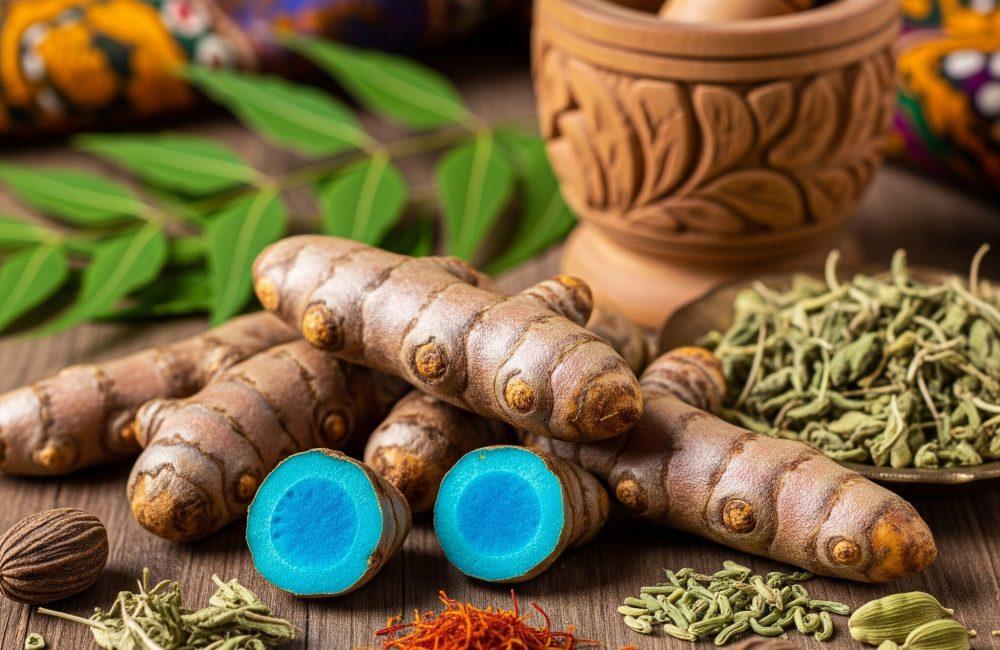
Far fewer have heard of blue turmeric (Curcuma caesia), also known as Kali Haldi or black turmeric. Hidden beneath its rough outer skin is a striking bluish-black rhizome with a distinctive camphor-like aroma. Unlike common turmeric, it is rarely used as a culinary spice. Instead, it has traditionally been valued for its medicinal applications in Ayurveda and regional healing traditions.
As interest in lesser-known medicinal plants continues to grow, blue turmeric is attracting renewed attention. But what exactly is it, and how does Ayurveda understand its role?
What is Blue Turmeric?
Blue turmeric (Curcuma caesia) is a perennial herb belonging to the Zingiberaceae, or ginger, family. It grows naturally in parts of Northeast India, Madhya Pradesh, Odisha, and several tribal regions, where it has been used for generations in traditional healthcare practices.
At first glance, its rhizome resembles ordinary turmeric. Slice it open, however, and the difference becomes immediately apparent. Instead of the familiar golden-yellow flesh, blue turmeric reveals a deep bluish-black interior with a sharp, camphor-like fragrance.
Its rarity and distinctive characteristics have made it one of India’s more intriguing medicinal plants.
How Is Blue Turmeric Different from Yellow Turmeric?
Although both plants belong to the Curcuma genus, they have traditionally been used for different purposes.
| Feature | Yellow Turmeric (Curcuma longa) | Blue Turmeric (Curcuma caesia) |
|---|---|---|
| Colour | Golden yellow | Bluish-black |
| Aroma | Warm and earthy | Camphor-like and aromatic |
| Traditional use | Culinary and medicinal | Primarily medicinal |
| Major constituents | Rich in curcuminoids | Rich in essential oils and aromatic compounds |
Yellow turmeric has become an everyday kitchen ingredient, while blue turmeric has remained largely within traditional medicinal practice.
How Ayurveda Understands Blue Turmeric
Although blue turmeric is not as widely discussed in classical Ayurvedic literature as Curcuma longa, it has an established place in Ayurvedic practice and regional traditions.
It is traditionally described as having:
- Tikta (bitter) and Katu (pungent) tastes
- A heating nature
- Properties that are traditionally considered useful in balancing Kapha and Vata, when prescribed appropriately by a qualified practitioner
Because of these qualities, Ayurvedic practitioners have traditionally used blue turmeric in formulations intended for conditions associated with congestion, sluggishness, or impaired digestive function. As with all Ayurvedic herbs, its selection depends on an individual’s Prakriti (constitution), Vikriti (current imbalance), digestive capacity, and overall clinical assessment.
Traditional Uses of Blue Turmeric
Across different parts of India, particularly in tribal communities, blue turmeric has been used in a variety of traditional preparations.
These have included:
- Herbal preparations traditionally used during coughs and seasonal respiratory discomfort
- External applications for muscular and joint discomfort
- Traditional preparations used to support skin health and wound care
- Ritual and cultural practices in several indigenous communities
These uses are based on traditional knowledge that has been passed down through generations and may vary between regions. They should not be interpreted as established clinical indications.
What Does Modern Research Say?
Blue turmeric has attracted increasing scientific interest because its rhizome contains a range of naturally occurring compounds, including essential oils, terpenoids, flavonoids, and aromatic constituents.
Laboratory studies have explored their antioxidant, antimicrobial, and anti-inflammatory properties. However, much of this research remains preliminary, and well-designed human clinical studies are still limited.
Compared with yellow turmeric, which has been extensively studied, blue turmeric remains relatively under-researched. More clinical evidence is needed before firm conclusions can be drawn about its therapeutic applications.
Is Blue Turmeric Safe?
Blue turmeric is considered a potent medicinal herb and should not be consumed indiscriminately.
Traditional Ayurvedic practice recommends that its internal use be guided by a qualified practitioner, as suitability depends on the individual rather than the herb alone.
It may not be appropriate for everyone, particularly during pregnancy or for individuals with certain digestive sensitivities. Anyone considering medicinal use should seek professional guidance before adding it to their routine.
Can Blue Turmeric Replace Yellow Turmeric?
No.
Although they belong to the same botanical genus, the two plants have traditionally served different purposes.
Yellow turmeric continues to be widely used as both a culinary spice and an important Ayurvedic herb. Blue turmeric, by contrast, has traditionally been reserved for more specialised medicinal applications and is not considered a substitute for the turmeric used in everyday cooking.
Rather than replacing one another, the two herbs occupy different roles within Ayurvedic practice.
The Ayurvedic Perspective
The growing popularity of blue turmeric reflects a broader interest in India’s medicinal plants. While this renewed attention is encouraging, Ayurveda reminds us that the value of any herb lies not in its rarity but in its appropriate use.
A herb is selected because it suits the individual—not because it is fashionable.
That principle has guided Ayurvedic practice for centuries. Blue turmeric is one example of the remarkable diversity of India’s botanical heritage, but like every medicinal herb in Ayurveda, its use is most meaningful when it is personalised, carefully considered, and guided by knowledgeable practitioners.
FAQ
Blue turmeric, often associated with certain rare turmeric varieties in traditional herbal practices, is valued in Ayurveda for its potential wellness-supportive and therapeutic properties. It has historically been used in herbal preparations for digestion, inflammation management, respiratory balance, and overall vitality.
Ayurveda believes blue turmeric may help support the body through its warming, stimulating, and balancing qualities. It is traditionally thought to aid digestion (Agni), support circulation, and help reduce toxin accumulation (Ama) when used appropriately under guidance.
Traditional Ayurvedic and folk uses of blue turmeric may include support for:
Digestive health
Joint and muscle comfort
Respiratory wellness
Skin balance
Immune support
However, many of these traditional uses require more modern scientific research for confirmation.
Blue turmeric may not be suitable for everyone, especially pregnant women, individuals with sensitive digestion, or people taking medications without medical supervision. Ayurveda emphasizes personalized use based on dosha constitution, health condition, and seasonal balance.
Ayurveda does not follow a one-size-fits-all approach. Herbs may affect individuals differently depending on digestion, dosha imbalance, lifestyle, and existing health conditions. At Kairali – The Ayurvedic Healing Village, Ayurvedic physicians provide personalized wellness guidance to ensure herbs and therapies are used safely and effectively according to individual needs.