































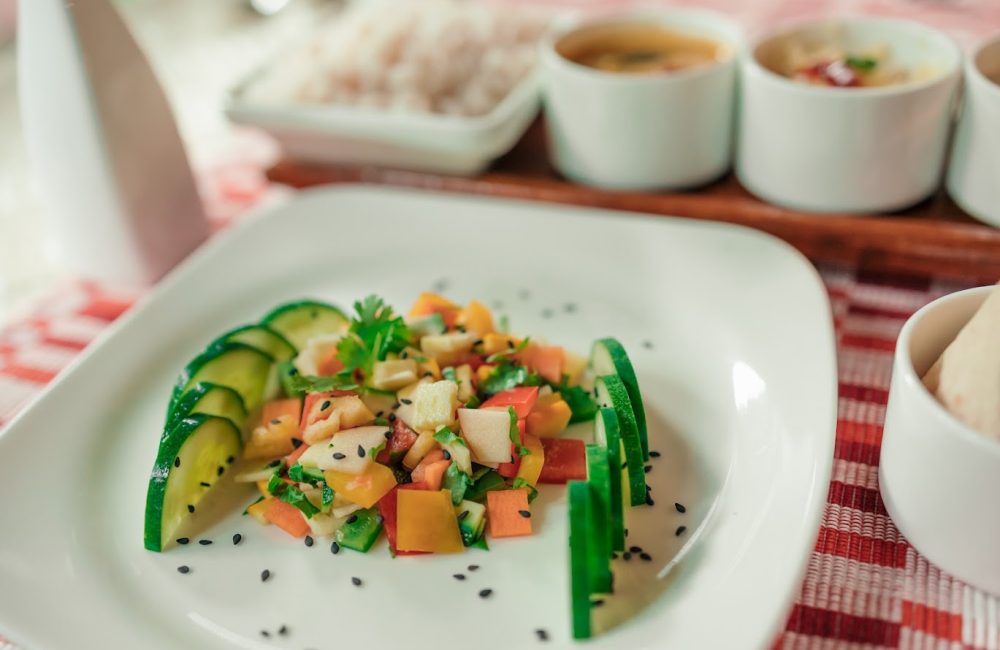

Ayurveda does not define one perfect diet for everyone.
Instead, food is considered in relation to the individual: their constitution, current state of balance, appetite, digestive capacity, the season, and even the time of day.
That makes the Ayurvedic approach to food quite different from many modern diet trends. The question is not simply, “Is this food healthy?” but rather, “Is this food appropriate for this person, at this time, in this form?”
At Kairali – The Ayurvedic Healing Village in Palakkad, Kerala, this principle informs the way meals are planned as part of a broader physician-led Ayurvedic programme.
Food in Ayurveda: More Than a List of Ingredients
Ayurveda places considerable importance on āhāra, or food, as part of daily health.
But Ayurvedic nutrition is not based only on individual ingredients. It also considers how food is prepared, how much is eaten, when it is eaten, and how well it is digested.
A meal that suits one person may feel heavy or uncomfortable for another. The same food may also be more appropriate in one season than another.
This is why classical Ayurvedic dietary advice tends to be contextual rather than universal.
What Makes a Food Suitable in Ayurveda?
Several principles commonly shape Ayurvedic food choices.
1. Freshness and Seasonality
Ayurvedic dietary thinking generally favours freshly prepared meals and ingredients suited to the season.
Seasonal eating is part of ṛtucaryā, the Ayurvedic framework for adapting food and daily routines to changes in climate and environment.
This does not mean that every meal must be strictly local or seasonal. Rather, it reflects a broader principle: the body’s needs can change with external conditions.
2. Digestibility
A central Ayurvedic concept is agni, often translated as digestive or metabolic capacity.
From this perspective, even a nutritious food may not be appropriate if it is difficult for an individual to digest.
Cooking methods therefore matter. Warm, cooked meals may be preferred in some circumstances, while heavier, richer or more complex foods may need to be moderated depending on appetite and digestive capacity.
3. Individual Constitution
Ayurveda describes three primary doṣas: Vāta, Pitta and Kapha.
These are not simply personality types. In classical Ayurvedic practice, they form part of a broader framework used to understand constitution, physiological tendencies and patterns of imbalance.
Food choices may therefore be adjusted according to a person’s prakṛti (constitution) and vikṛti (current state of imbalance).
This is one reason generic “Vata diets” or “Pitta diets” found online can oversimplify the Ayurvedic approach.
4. Preparation and Quantity
How a food is prepared can change how it is experienced.
Ayurveda pays attention to whether foods are cooked, raw, roasted, fermented or combined with spices and other ingredients.
Quantity matters as well. A food that is suitable in moderation can become difficult to digest when eaten in excess.
Foods Commonly Used in Ayurvedic Cooking
There is no single Ayurvedic menu, but several food groups appear frequently in traditional Ayurvedic cooking.
Whole Grains
Rice, barley and other grains are commonly used depending on the individual and the meal.
Rather than assigning a universal benefit to every grain, Ayurveda considers qualities such as heaviness, dryness, warmth and digestibility when deciding what may be appropriate.
Cooked Vegetables
Seasonal vegetables form an important part of many Ayurvedic meals.
Pumpkin, gourds, leafy vegetables and other produce may be prepared with spices and cooking methods chosen according to digestive needs and the season.
Cooking can also make certain vegetables easier for some people to tolerate than eating them raw.
Fruits
Fruit is widely used in Ayurvedic dietary practice, but the emphasis is generally on freshness, ripeness and suitability for the individual.
Rather than treating fruit as automatically beneficial in unlimited quantities, Ayurveda considers how it fits with the rest of the meal and the person’s digestion.
Lentils and Pulses
Mung beans and other pulses are common sources of plant-based protein in Indian and Ayurvedic cooking.
Their preparation matters. Soaking, cooking thoroughly and combining them with suitable spices are traditional ways of making pulses easier to digest.
Ghee and Dairy
Ghee has a long history of use in Ayurvedic cooking and classical preparations.
Milk and other dairy products also appear in Ayurvedic dietary traditions, but their suitability depends on the person, preparation and context.
They are not automatically recommended for everyone.
Herbs and Spices
Ginger, cumin, coriander, fennel, turmeric and black pepper are among the many spices used in Ayurvedic cooking.
Their role extends beyond flavour. Classical Ayurvedic dietary practice considers the qualities of spices and how they influence appetite and digestion.
However, more is not necessarily better. The type and quantity used should suit the individual.
Are There Foods Ayurveda Says Everyone Should Avoid?
Not usually.
Ayurveda tends to be more contextual than a simple “eat this, avoid that” system.
That said, some broad habits are generally viewed less favourably.
Highly processed foods, excessive amounts of fried food, very heavy meals and eating beyond appetite may be harder for some people to digest.
Ayurveda also pays attention to repeated patterns of eating that leave a person feeling consistently heavy, sluggish or uncomfortable.
The response is not necessarily to remove an entire food category. It may involve changing the quantity, preparation, timing or combination of foods.
What Does Sāttvic Food Mean?
The term sāttvic comes from sattva, a concept associated in Indian philosophical traditions with clarity, steadiness and balance.
In contemporary wellness culture, “sattvic diet” is sometimes presented as a rigid list of permitted and forbidden foods.
The traditional idea is more nuanced.
A sāttvic way of eating generally emphasises fresh, simply prepared foods and moderation. It is as much about the quality and context of eating as it is about specific ingredients.
It should not be confused with a universal medical diet.
How Food Is Approached at Kairali
At Kairali – The Ayurvedic Healing Village, food forms part of the broader residential Ayurvedic programme rather than functioning as a separate wellness trend.
Meals are planned in relation to the individual programme and the principles of Ayurvedic dietary practice.
This matters because Ayurveda traditionally does not separate food, daily routine and therapeutic care into unrelated categories.
Dietary recommendations may change depending on a person’s constitution, digestive capacity, stage of a programme and the physician’s assessment.
In that sense, the meal is not simply another element of hospitality. It sits within the same framework as the rest of the Ayurvedic programme.
Why a Personalised Ayurvedic Diet Is Different From an Online Dosha Diet
One of the most common simplifications of Ayurveda is the idea that knowing your dominant dosha automatically tells you what to eat.
Clinical Ayurvedic assessment is more detailed than that.
Two people with similar constitutions may receive different dietary guidance because their current symptoms, digestion, age, environment and other factors differ.
A person may also need different foods at different times of the year or at different stages of care.
This is why Ayurveda is better understood as an individualised framework for making dietary decisions rather than a fixed diet plan.
So, What Is the Best Food According to Ayurveda?
The most Ayurvedic answer is that there is no single “best food.”
A suitable diet is one that:
- is appropriate for the individual’s constitution and present condition;
- can be digested comfortably;
- takes the season and environment into account;
- uses sensible preparation methods;
- is eaten in an appropriate quantity;
- and supports the person’s broader health needs.
Fresh vegetables, grains, pulses, fruits, ghee, herbs and spices can all have a place in an Ayurvedic diet. Their value depends on how and when they are used.
The Larger Lesson From Ayurvedic Nutrition
Modern nutrition conversations often search for superfoods, forbidden foods or one dietary pattern that everyone should follow.
Ayurveda begins from a different assumption: food works within a context.
The same ingredient can be helpful in one situation and unsuitable in another. The preparation can matter as much as the ingredient. Appetite can matter as much as nutritional theory.
That does not mean every digestive problem can be solved by changing food, nor should Ayurvedic dietary advice replace medical assessment when symptoms are persistent.
What it does offer is a useful way of thinking about eating: pay attention not only to what is considered healthy in general, but also to how your body actually responds.
For anyone exploring Ayurvedic nutrition more seriously, an assessment with a qualified Ayurvedic practitioner can provide more meaningful guidance than following a generic online dosha diet.
Website: www.ktahv.com
Call: +91-9555156156