






























Ayurveda and Yoga are increasingly being explored as complementary parts of patient-centered healthcare. Their role is most credible when they are supported by qualified practitioners, appropriate regulation, clinical oversight, and realistic expectations.
Healthcare is not only about diagnosing a condition and prescribing a treatment.
It is also about understanding how a person sleeps, eats, moves, manages stress, follows medical advice, and experiences life with an ongoing health concern.
This broader view is one reason interest in integrative healthcare is growing among patients, practitioners, and policymakers.
Ayurveda and Yoga can be part of that conversation. But they should not be presented as replacements for conventional medicine, or as solutions for every health condition.
Their value is better understood as complementary.
What does patient-centered care actually mean?
Patient-centered care starts with the individual rather than the therapy.
Two people with the same diagnosis may have very different needs. One may be struggling with sleep. Another may have limited mobility. A third may be finding it difficult to maintain regular meals or manage stress.
Good care considers these differences.
Ayurveda has traditionally taken an individualized approach to health, looking at factors such as digestion, routine, diet, sleep, constitution, and changes in physical or mental state.
These traditional ideas can add another perspective to a person’s care, but they should be described carefully.
For example, agni is an Ayurvedic concept associated with digestion and transformation.
Ama is a traditional Ayurvedic concept associated with symptoms such as heaviness and sluggishness.
It is important not to describe ama as a scientifically established toxin or metabolic substance. Ayurvedic concepts belong to Ayurveda’s own system of understanding the body and should not automatically be treated as equivalents of modern biomedical terms.
Where Yoga may help
Yoga is often discussed as though it were one single intervention. In reality, it can include movement, breathing practices, meditation, relaxation, and different levels of physical intensity.
That matters because the evidence is not the same for every type of Yoga or every health outcome.
Research has explored Yoga for areas including stress, sleep, balance, emotional well-being, and some forms of musculoskeletal discomfort.
For some people, a suitable Yoga practice may help them relax, move more comfortably, or develop a more consistent sleep routine.
Some participants report short-term improvements in relaxation, comfort, or sleep, although individual experiences vary.
These changes may also help some people feel more engaged with their overall care plan.
That is a reasonable supportive role.
It is different from claiming that Yoga can prevent complications, reduce hospital visits, or guarantee better adherence to medication. Claims like those require much stronger and more specific evidence.
Yoga is also not risk-free for everyone. People with injuries, mobility limitations, pregnancy-related considerations, or certain medical conditions may need adapted practices and professional guidance.
Ayurveda and long-term health concerns
Living with a chronic condition often involves more than managing the condition itself.
Sleep may be affected. Energy levels may change. Stress can increase. Exercise may become more difficult. Eating patterns and daily routines may become inconsistent.
Selected Ayurveda and Yoga practices may support some patients with aspects of chronic-condition care when used under appropriate supervision.
Ayurveda is not one intervention. It includes diet, lifestyle recommendations, herbal preparations, massage and oil therapies, Yoga-related practices, and supervised procedures such as Panchakarma.
The evidence for these approaches varies considerably.
A breathing practice may have a different evidence base from an herbal formulation. A gentle movement program cannot be evaluated in the same way as a complex Panchakarma program.
It is therefore more useful to ask, “What does the evidence say about this particular practice for this particular purpose?” rather than, “Does Ayurveda work?”
Stress and sleep: where careful language matters
Stress and poor sleep are among the most common reasons people explore Yoga and complementary healthcare.
Selected breathing, meditation, relaxation, and movement practices may help support relaxation or healthier sleep routines.
But these practices should not be described as treating anxiety disorders, depression, or other mental-health conditions unless there is strong evidence for the specific intervention and context.
Herbal products require even greater care.
An Ayurvedic herb may be traditionally used for a particular purpose, but traditional use does not automatically establish modern clinical effectiveness.
Herbs can also interact with prescribed medicines.
For that reason, anyone taking prescription medication should discuss herbal preparations with an appropriately qualified healthcare professional before using them.
“Natural” should never be treated as another word for “risk-free.”
Panchakarma is more than a wellness buzzword
Panchakarma is frequently described online as a “detox” or “cleanse.”
Those words can be misleading.
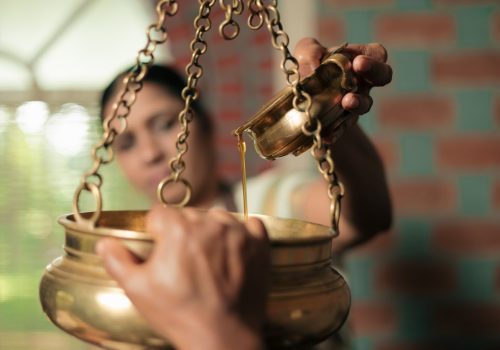
A more accurate description is a supervised Panchakarma program, described in Ayurveda as a sequence of preparatory and procedural therapies.
The exact program can vary according to the individual and the practitioner’s assessment.
This distinction is important because traditional Ayurvedic explanations should not be presented as scientifically proven physiological effects.
Panchakarma may have an important place within classical Ayurvedic practice, but claims about what it does in biomedical terms require appropriate research.
Regulation matters
Growing international interest in traditional medicine does not automatically mean that every Ayurvedic service or product meets the same standards.
Regulation differs between countries.
Practitioner qualifications vary.
Manufacturing requirements can vary as well.
If agreements between governments, regulators, and healthcare institutions lead to enforceable standards and effective oversight, possible long-term benefits could include:
- clearer practitioner standards;
- stronger product labeling requirements;
- better monitoring of adverse effects;
- more consistent manufacturing controls;
- improved communication between different healthcare providers; and
- better-quality research.
But policy announcements and memoranda of understanding should not be confused with immediate benefits for patients.
Implementation matters.
Herbal product safety deserves more attention
Ayurvedic products are sold in many countries, but international availability does not mean international uniformity.
A product sold in Bengaluru and one sold in Berlin may be governed by different rules.
Product standards may improve consistency, but regulations still differ between countries.
Patients should use appropriately authorized products and discuss herbal preparations with a qualified clinician, particularly if they already take prescription medicines.
Quality, sourcing, manufacturing standards, and possible interactions all matter.
What genuine integration looks like
Integrative care only works when the different people involved in a patient’s care know what is happening.
If you are receiving Ayurvedic care, your primary clinician should know which herbal products, supplements, and therapies you are using.
Your Ayurvedic practitioner should also know about your diagnoses, medications, medical history, and other treatments.
Tell both your primary clinician and Ayurvedic practitioner about all diagnoses, medicines, and supplements.
Do not change prescribed treatment without the prescribing clinician’s approval.
This kind of two-way communication is one of the simplest and most important patient safeguards.
One example of a supervised Ayurvedic setting
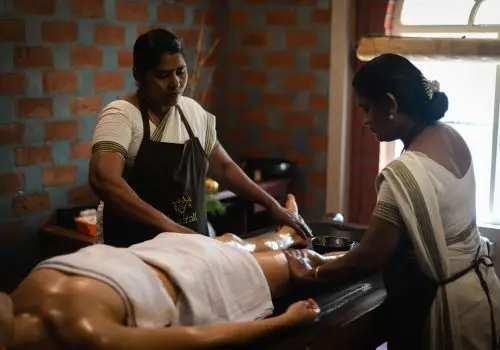
At Kairali – The Ayurvedic Healing Village in Palakkad, Ayurveda is practiced within an NABH-accredited Ayurvedic hospital setting, including physician-led assessment and supervised Panchakarma programs.
The significance of this example is not that one institution proves the effectiveness of Ayurveda.
It illustrates something more practical: when Ayurveda is delivered within a healthcare setting, practitioner qualifications, supervision, safety procedures, and clear communication become central.
These standards matter wherever patients seek care.
Complementary, not competing
Ayurveda and Yoga do not need to compete with conventional medicine to have a meaningful role in healthcare.
Nor should conventional medicine be portrayed as lacking a “missing dimension.”
A more useful approach is to ask where selected practices may safely support the person receiving care.
For some people, that may mean a guided Yoga practice that supports relaxation.
For others, it may mean closer attention to sleep, food routines, daily activity, or other lifestyle factors discussed within an Ayurvedic consultation.
In some cases, supervised Ayurvedic therapies may also be considered as part of a broader care plan.
But the same principle should apply throughout: understand what is traditional, what has been studied, what remains uncertain, and what requires medical supervision.
Patient-centered healthcare is not defined by how many systems of medicine it combines.
It is defined by whether the person receives care that is informed, coordinated, safe, and appropriate to their needs.
Evidence note: Evidence for Ayurveda and Yoga varies by practice and condition. Traditional use alone does not establish clinical effectiveness or safety.
Before considering Ayurveda or Yoga
Patients should:
- tell all healthcare professionals about medicines, supplements, and complementary therapies they use;
- avoid changing prescribed medicines without approval from the prescribing clinician;
- check practitioner qualifications;
- use appropriately authorized and traceable herbal products;
- ask about possible medicine-herb interactions; and
- seek professional guidance if they are pregnant, have a chronic medical condition, or have physical limitations that may affect Yoga practice.








Leave a Reply