




























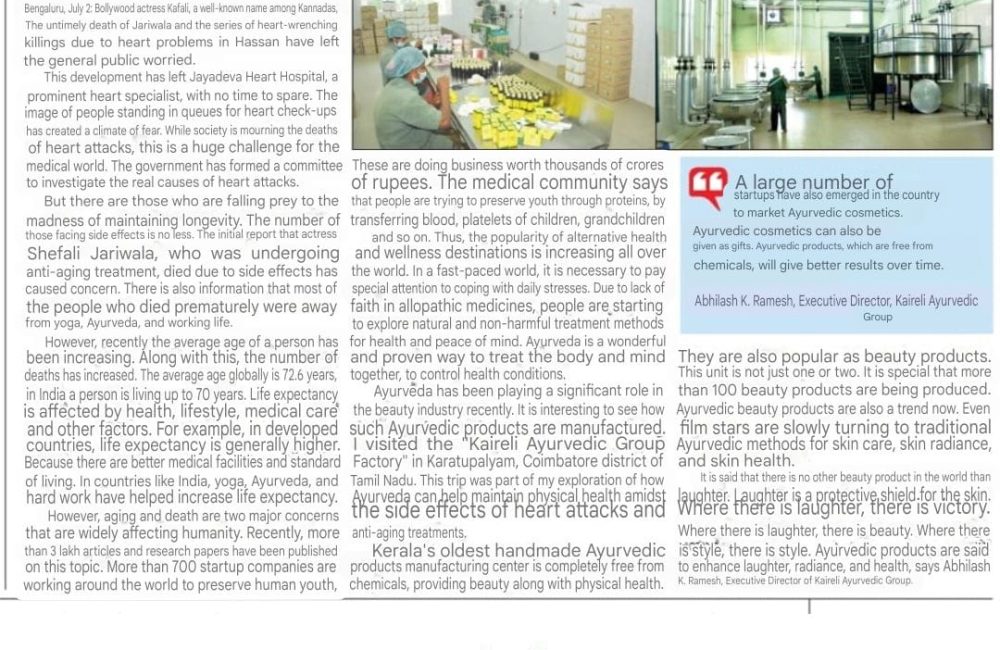

A recent feature in the Kannada daily Varthe examined the increasing public interest in Ayurvedic cosmetic products. The coverage reflects a broader question now shaping the beauty industry: what do consumers expect when a skincare product describes itself as Ayurvedic?
For many buyers, the answer goes beyond the presence of a familiar herb on the label. They want to know how the formulation was developed, where it was manufactured, whether the ingredients are appropriate for regular use, and whether the product’s claims are proportionate to the available evidence.
This shift is creating greater interest in Ayurveda-based skincare. It is also placing more responsibility on manufacturers to distinguish rigorous formulation from superficial branding.
Why consumers are looking more closely at skincare
Beauty products were once judged largely by immediate experience: texture, fragrance, packaging and visible cosmetic effect.
Those factors still matter, but many consumers now ask more detailed questions. They examine ingredient lists, sourcing, manufacturing standards and the purpose of individual ingredients. They are also more cautious about exaggerated promises.
This does not mean that all synthetic ingredients are harmful or that every natural ingredient is automatically safe. “Natural” is not a scientific guarantee.
What has changed is the level of scrutiny.
Consumers increasingly want products whose ingredients and intended functions can be explained clearly. Ayurveda attracts attention in this environment because it offers an established framework for understanding substances according to their qualities, preparation and suitability.
Ayurvedic skincare is more than herbal branding
An Ayurvedic cosmetic is not defined simply by adding neem, turmeric or aloe vera to a conventional formulation.
In classical Ayurveda, ingredients are selected according to their properties, the way they are processed, the substances with which they are combined and the purpose for which the final preparation is intended.
This distinction matters because the same herb may be used differently depending on the formulation.
Haridrā (turmeric), for example, has a long history of external use in Ayurvedic preparations. Nimba (neem) is traditionally valued in skin and cleansing formulations. Kumārī (aloe vera) is commonly used in preparations intended to soothe and moisturise the skin.
These traditional uses should not be converted into promises that a cosmetic product will cure acne, remove pigmentation or treat infection. Cosmetic products can cleanse, moisturise, condition or support the appearance of the skin. Clinical conditions require appropriate professional assessment.
The Ayurvedic understanding of skin
Ayurveda treats the skin as part of a wider physiological system rather than as an isolated surface.
Skin appearance may be considered alongside digestion, sleep, diet, environmental exposure and individual constitution. This helps explain why Ayurvedic beauty practices have traditionally included both topical applications and attention to daily routine.
The Ayurvedic concept of tvak refers to the skin, while broader descriptions of complexion and tissue nourishment appear across classical discussions of health and personal care.
In modern skincare, this perspective should be applied carefully. It does not mean that every cosmetic concern originates from an internal imbalance. Nor does it mean that topical products can correct systemic health conditions.
Its practical value lies in encouraging a more considered approach: appropriate cleansing, suitable oils or creams, regular routines and attention to individual sensitivity.
What responsible Ayurvedic cosmetics should demonstrate
Growing interest in Ayurvedic beauty also creates room for vague claims. Products may use traditional imagery or Sanskrit terminology without explaining their formulation or manufacturing standards.
Consumers should therefore look for several basic signals.
Clear ingredient information
The label should identify what the product contains and how it is intended to be used. Familiar herbal names should not replace a complete ingredient declaration.
Appropriate claims
A cosmetic should not present itself as a treatment for a medical condition. Claims should remain within the product’s intended role, such as cleansing, moisturising, conditioning or supporting skin appearance.
Manufacturing controls
Quality depends on more than ingredient selection. Hygiene, consistency, testing, storage and production controls all affect the finished product.
Suitability and safety guidance
Herbal ingredients can still cause irritation or allergic reactions. Directions for use, patch-test guidance where appropriate and caution statements should be easy to find.
Traceable formulation logic
A product should be able to explain why particular ingredients are used together. Ayurveda is a formulation system, not a collection of fashionable individual herbs.
Kairali’s approach to Ayurvedic product development
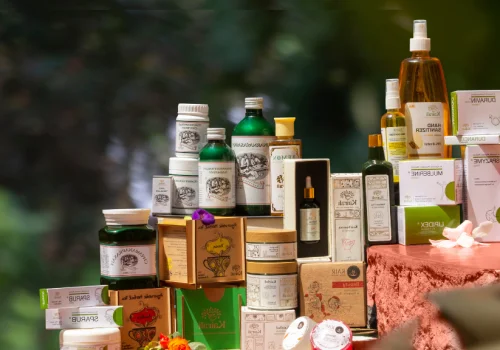
Kairali Ayurvedic Products Pvt. Ltd. operates a WHO-GMP-certified Ayurvedic pharmaceutical manufacturing facility in Tamil Nadu. It produces classical and proprietary Ayurvedic formulations.
That manufacturing background is relevant to the cosmetic category because it places emphasis on documented processes, formulation consistency and controlled production.
Kairali Ayurvedic Group was founded in 1989 and draws on four generations of Ayurvedic practice in the founders’ family. Its product work sits within a wider clinical and manufacturing structure rather than functioning as a separate beauty trend.
Kairali’s approach is best understood through three principles.
First, formulations are developed with reference to Ayurvedic ingredient knowledge and established preparation methods.
Second, products are manufactured within defined quality systems rather than through informal or small-batch processes without consistent controls.
Third, cosmetic communication must remain distinct from medical claims. A skincare product may support cleansing, moisturising or the appearance of healthy skin. It should not be presented as a substitute for dermatological or Ayurvedic clinical care.
The role of familiar Ayurvedic ingredients
A number of ingredients associated with Ayurvedic skincare are now widely recognised. Their familiarity, however, can lead to oversimplification.
Turmeric
Turmeric has a long history of use in Indian personal-care practices and Ayurvedic external preparations. In cosmetics, it may be included for its traditional skin-conditioning role and its characteristic botanical properties.
It should not be described as a guaranteed treatment for acne, inflammation or pigmentation.
Neem
Neem is traditionally used in cleansing and skin-focused preparations. Its inclusion should be explained in relation to the complete formulation rather than presented as a standalone cure for skin problems.
Aloe vera
Aloe vera is widely used in modern and traditional skincare for its moisturising and soothing qualities. Suitability still depends on concentration, processing and the other ingredients in the product.
Saffron
Saffron has a recognised place in traditional beauty preparations and is often associated with complexion care. Cosmetic claims should remain measured and should not promise permanent brightening or pigmentation removal.
Ashwagandha
Ashwagandha is better known for its traditional use within the Rasāyana category of rejuvenative substances. Where used in topical cosmetics, its function should be described according to the actual formulation rather than borrowing claims from oral supplements or clinical research.
Why manufacturing credibility matters
Ayurvedic cosmetics occupy a difficult space.
They draw from a traditional medical system, but many are sold as general beauty and personal-care products. This can blur the line between traditional context, cosmetic purpose and medical treatment.
Responsible manufacturers must keep those categories clear.
A classical reference does not automatically validate every modern cosmetic claim. A well-known herb does not guarantee a well-designed formula. Attractive packaging does not establish purity, safety or effectiveness.
Manufacturing certification, transparent labelling and proportionate communication provide more useful evidence than words such as “chemical-free,” “pure” or “miracle.”
Trust must be earned product by product
The Varthe coverage points to rising interest in Ayurvedic cosmetics. That interest should not be mistaken for unconditional trust.
Trust is built when a product does what it claims, explains what it contains and avoids promising more than a cosmetic can reasonably deliver.
For established Ayurvedic manufacturers such as Kairali, the opportunity is not simply to participate in a natural-beauty trend. It is to show what disciplined Ayurvedic product development looks like: clear formulation logic, controlled manufacturing, accurate labelling and respect for the boundary between skincare and clinical treatment.
That boundary strengthens Ayurveda rather than limiting it.
As more consumers examine the origins and purpose of the products they use, the future of Ayurvedic beauty will depend less on heritage language and more on whether manufacturers can make their standards visible.
Editorial note: Cosmetic products are not intended to diagnose, treat, cure or prevent disease. Persistent skin concerns, infections, allergic reactions or sudden changes in the skin should be assessed by a qualified healthcare professional.
Website: www.kairaliproducts.in
Call: +91-9555156156