































A lesser-known relative of the turmeric found in most Indian kitchens is attracting attention for a new reason.
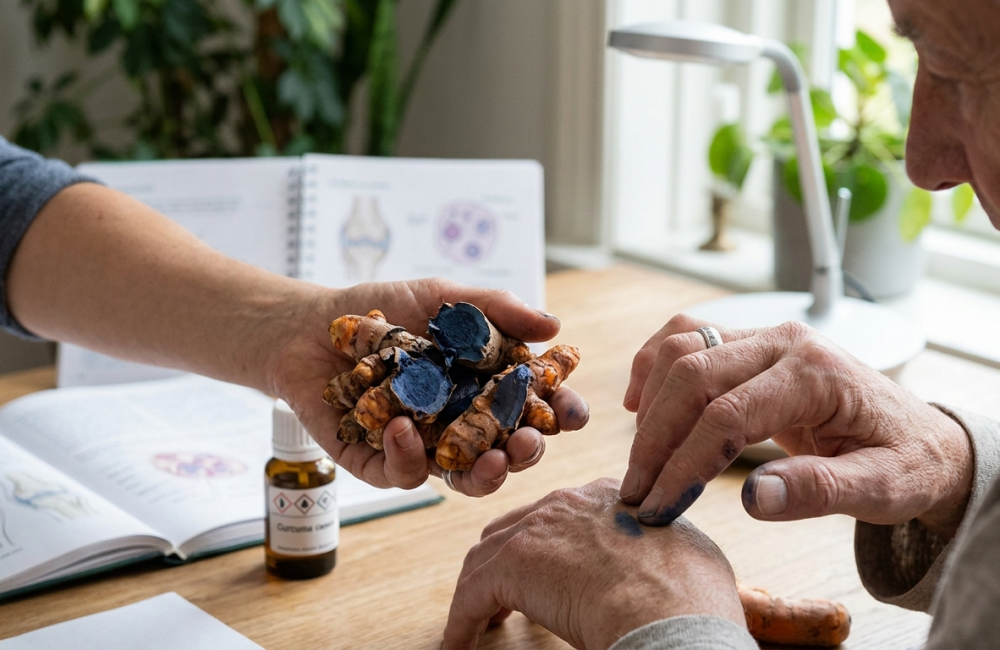
Blue turmeric, or Curcuma caesia, has recently been studied for its possible effects on cartilage cells and inflammatory processes linked with joint health.
That may sound promising for people living with arthritis or persistent joint pain.
But the research is still at an early stage.
A recent study published in Food & Function examined the compounds found in blue turmeric, how some of them behaved after simulated digestion, and what happened when an extract was tested on human cartilage cells exposed to an inflammatory stimulus.
The findings were interesting.
They were not proof that blue turmeric can prevent or treat arthritis.
That difference matters.
What Is Blue Turmeric?
Blue turmeric is the common name used for Curcuma caesia Roxb., a plant from the same botanical family as ordinary yellow turmeric, Curcuma longa.
But the two are not the same.
They contain different combinations of plant compounds, and research on one species should not automatically be applied to the other.
The recent study on Curcuma caesia identified several phenolic compounds and examined how available some of these remained after simulated digestion.
This is important because turmeric research is often reduced to one familiar word: curcumin.
Medicinal plants are more complex than that.
Different species contain different compounds, and those compounds may behave differently in the body.
What Did the Study Look At?
The researchers focused on two main questions.
First, they examined the chemical composition of blue turmeric and looked at what happened to its compounds during simulated gastrointestinal digestion.
Second, they tested the extract on human cartilage cells known as chondrocytes.
These cells were exposed to an inflammatory stimulus commonly used in laboratory research. The researchers then looked at markers linked with inflammation, oxidative stress and cellular function.
The extract showed potentially protective effects in this laboratory model.
That gives researchers a reason to study blue turmeric further.
But it does not tell us what would happen if a person with arthritis consumed blue turmeric.
A Laboratory Study Is Not the Same as a Human Trial
This is where health headlines can move too quickly.
A plant extract affects inflammation in cultured cells.
The next headline says the plant “protects joints”.
Soon after, it may be described online as a natural remedy for arthritis.
These are very different claims.
Cell studies are useful because they help scientists understand possible mechanisms. They can show which compounds deserve further attention and which biological pathways may be involved.
But they cannot tell us whether someone will experience less pain, better mobility or slower joint damage.
Those questions require well-designed human studies.
Researchers would need to examine safety, preparation, absorption, dose and real clinical outcomes before drawing stronger conclusions.
So the most accurate reading of this study is simple: blue turmeric may be worth further investigation, but its benefits for human joint health are not yet established.
Why Ayurveda Should Still Pay Attention
The research is still interesting from an Ayurvedic perspective.
Ayurveda has used medicinal plants for centuries, often as part of wider formulations and individualised treatment plans.
Modern research allows scientists to ask different questions.
They can identify specific compounds, study how those compounds behave during digestion, and observe how extracts interact with cells.
Ayurveda and modern biomedical research do not use the same language, and they do not need to.
Ayurveda traditionally looks at the qualities of a substance, the individual receiving it and the wider therapeutic context.
Modern science looks at chemistry, pharmacology, cellular pathways and measurable biological effects.
The useful question is not whether one system can be forced to “prove” the other.
It is whether modern research can help us understand traditional medicinal plants more clearly.
Blue turmeric may now be one of those plants.
The Problem With Turning Every Plant Into a Supplement
Promising research often creates another problem.
A study is published.
A biological effect is reported.
The finding reaches health media.
Then the plant begins appearing in powders, capsules and extracts marketed around the strongest possible interpretation of the research.
That process can move faster than the evidence.
Ayurveda does not traditionally assume that every medicinal plant should be taken every day by everyone.
The choice of a plant depends on context: the individual, the preparation, the reason for using it and the judgement of the practitioner.
That is very different from seeing the words “anti-inflammatory” in a study and deciding that a botanical should be taken for joint protection.
With less common plants, there are also questions around sourcing, cultivation and sustainability.
Those questions should be addressed before demand grows faster than the evidence.
What About Ordinary Yellow Turmeric?
Blue turmeric should also not be confused with the yellow turmeric commonly used in food and Ayurvedic formulations.
Yellow turmeric and curcumin have been studied much more extensively.
Some human studies have investigated their possible role in inflammatory and musculoskeletal conditions.
Even there, the evidence is not as simple as many wellness claims suggest.
Results can depend on the type of extract, how well it is absorbed, how much is used and who is being studied.
Research on a concentrated curcumin extract cannot automatically be translated into claims about ordinary culinary turmeric.
The same caution should apply to blue turmeric from the beginning.
What Do We Actually Know?
At this stage, a few points are reasonably clear.
Researchers have identified biologically active compounds in Curcuma caesia.
Laboratory findings suggest that blue turmeric extracts may influence inflammatory and oxidative processes in cartilage cells.
These findings justify further research.
But several important questions remain unanswered.
We do not yet know whether consuming blue turmeric protects cartilage in humans.
We do not know whether it prevents arthritis.
We do not know which preparation, quantity or duration would be useful, assuming a clinical benefit is eventually shown.
And current laboratory evidence does not justify replacing established medical care with blue turmeric.
Promising Does Not Mean Proven
There is often pressure to turn every positive study on an Ayurvedic plant into a larger claim about traditional medicine.
That is unnecessary.
Ayurveda does not benefit from overstating early research.
It benefits from better research.
This study gives scientists another reason to investigate Curcuma caesia. Future work may help clarify its chemistry, safety and possible clinical relevance.
For now, the strongest conclusion is also the most responsible one.
Blue turmeric is an interesting plant with promising early laboratory findings.
It is not yet a proven remedy for joint disease.
And the gap between those two statements is exactly where the next stage of research needs to happen.








Leave a Reply