













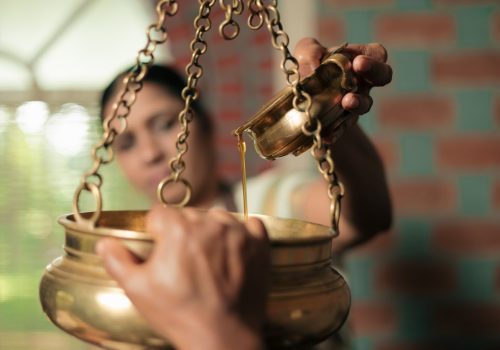















Few Ayurvedic therapies are as visually distinctive as Shirodhara.
A steady stream of warm liquid is poured over the forehead while the person lies quietly beneath it. The movement is repetitive, the setting is intentionally still, and the experience can feel markedly different from the pace of ordinary life.
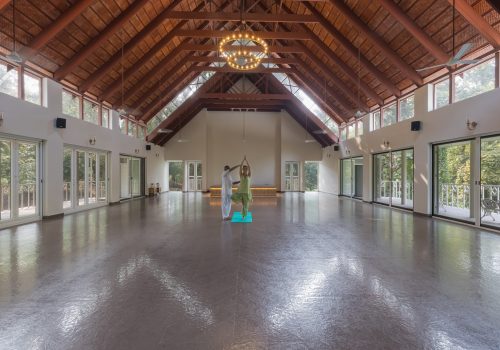
At Kairali – The Ayurvedic Healing Village in Palakkad, Kerala, Shirodhara may form part of a broader physician-guided Ayurvedic programme rather than being treated simply as a standalone relaxation treatment.
That distinction is important.
Shirodhara is often presented in wellness media as a treatment for everything from stress and sleeplessness to headaches and emotional imbalance. Ayurveda has a more individualised approach. Whether the therapy is appropriate, what substance is used and where it fits within a treatment plan depend on the practitioner’s assessment of the person receiving it.
What is Shirodhara?
The word Shirodhara combines shiro (head) and dhara (continuous flow or stream).
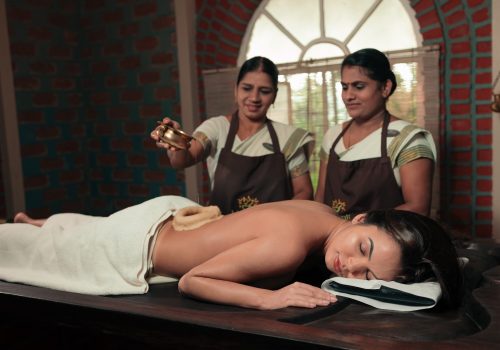
During the procedure, a controlled stream of warm liquid is directed over the forehead for a prescribed period. Depending on the individual and the purpose of treatment, an Ayurvedic physician may select different oils or other traditional preparations.
The repeated movement of the liquid and the quiet setting are central to the experience.
For many people, that sensory repetition is what makes Shirodhara memorable. Attention gradually moves away from external stimulation and towards the continuous sensation across the forehead.
It is easy to understand why the therapy has become associated with calm and rest.
What is less useful is turning that experience into a promise that Shirodhara will reliably “switch off” stress, correct sleep problems or produce a particular neurological effect for everyone.
Individual responses vary.
Why is Shirodhara associated with relaxation?
Modern life gives the mind very few periods of sustained quiet.
Phones interrupt. Work continues beyond working hours. Even rest is frequently accompanied by screens, notifications and background noise.
Shirodhara creates almost the opposite environment.
The person remains still. The sensory input is repetitive rather than constantly changing. Conversation is minimal, and attention can settle on a single physical sensation.
That does not make Shirodhara a guaranteed treatment for stress or anxiety. But it helps explain why many people describe the experience itself as calming.
There is a useful distinction here between experiencing relaxation during a therapy and claiming that the therapy medically treats a particular condition.
The first is a description of experience. The second requires considerably stronger evidence.
How Ayurveda decides whether Shirodhara is appropriate
At a physician-led Ayurvedic centre, Shirodhara should not begin with the assumption that everyone needs the same procedure.
An Ayurvedic consultation may consider prakriti (individual constitution), vikriti (the present pattern of imbalance), sleep, appetite, digestion, daily routine and other aspects of health.
The physician can then decide whether Shirodhara belongs within the treatment plan.
This process also affects the choice of oil or preparation used during the procedure.
That individualisation is one reason it is misleading to describe Shirodhara as simply “warm oil poured on the third eye.” The popular description captures what the treatment looks like, but not how Ayurveda decides when and how to use it.
Shirodhara and sleep
Shirodhara is frequently discussed in relation to sleep.
There is a plausible experiential reason for this association: the therapy takes place in a quiet environment and involves prolonged stillness and repetitive sensory stimulation.
But readers should be cautious with statements that Shirodhara “cures insomnia” or guarantees uninterrupted sleep.
Sleep disturbance has many possible causes, including medical, psychological, behavioural and environmental factors. Persistent insomnia warrants proper assessment rather than relying on any single wellness therapy.
Within Ayurveda, a physician may consider sleep alongside digestion, routine, stress, constitution and other factors before recommending an approach.
Shirodhara may form part of that larger plan in suitable cases, but it is not a universal prescription.
What does a Shirodhara session feel like?
The most striking part of Shirodhara is its simplicity.
There is no complicated sequence for the guest to follow. Once positioned comfortably, the person remains still while the liquid flows in a controlled manner over the forehead.
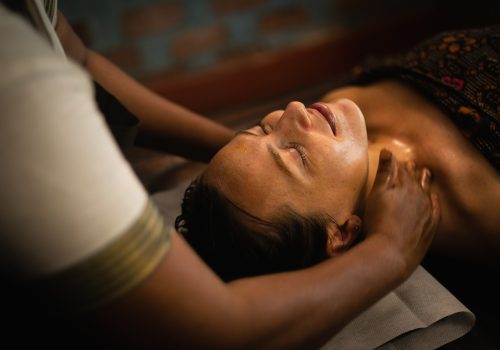
Warmth, repetition and quiet dominate the experience.
Some people find their thoughts become less intrusive as they focus on the physical sensation. Others may simply become aware of how rarely they spend an extended period without having to speak, respond or make decisions.
Neither response needs to be exaggerated into a claim of transformation.
Sometimes the value of a treatment experience is simply that it creates the conditions for genuine rest.
Why the consultation matters at Kairali
At Kairali, The Ayurvedic Healing Village, treatments such as Shirodhara sit within a wider residential Ayurvedic framework.
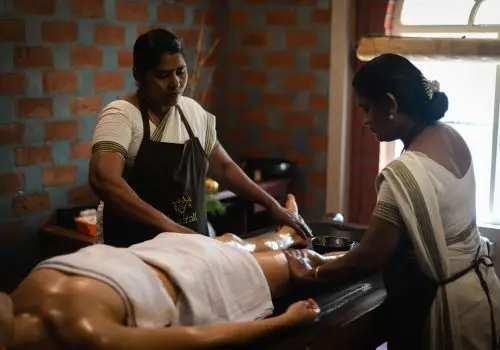
The physician consultation provides the starting point. Therapies may then be combined with dietary guidance, yoga, breathing practices, meditation and periods of rest according to the programme recommended for the individual.
This is different from selecting Shirodhara from a spa menu purely because it sounds relaxing.
The question in Ayurveda is not simply, Would this treatment feel good?
It is also, Is this treatment appropriate for this person at this point in their programme?
That is a more useful way to understand physician-led Ayurvedic care.
Shirodhara is not the same treatment for everyone
One of the recurring problems in contemporary wellness writing is the tendency to turn Ayurvedic therapies into universal formulas.
Abhyanga becomes “the stress massage.” Panchakarma becomes “the detox.” Shirodhara becomes “the sleep treatment.”
Ayurveda itself is considerably more conditional.
The same procedure may be approached differently depending on constitution, present symptoms, season, accompanying therapies and the physician’s clinical judgment.
This does not make the treatment less accessible. It simply means that the context matters as much as the technique.
What we know, and what we should be careful about
Shirodhara has a long place within Ayurvedic therapeutic practice, and many people describe the procedure as deeply relaxing.
That is different from saying that every commonly advertised benefit has been conclusively demonstrated.
Claims that Shirodhara reliably treats anxiety, chronic insomnia, migraine, emotional trauma, cognitive problems or other medical conditions should therefore be approached cautiously.
Traditional use can be described as traditional use.
Personal experiences can be described as experiences.
Neither should automatically be presented as proof of a medical outcome.
That distinction allows Ayurveda to be discussed seriously without stripping it of its traditional context or exaggerating what is known.
A treatment built around stillness
Perhaps Shirodhara feels unusual today because stillness itself has become unusual.
For a period of time, there is little to do except lie quietly while a repeated stream of warm liquid creates a single point of attention.
For some people, that can be profoundly restful.
But the more important Ayurvedic principle sits behind the experience: the therapy is not supposed to exist independently of assessment.
At Kairali, its place within a programme is determined through consultation and individualisation.
That is ultimately what distinguishes Shirodhara as an Ayurvedic procedure rather than simply an unusual relaxation treatment.
It is not the stream of oil alone that defines the practice.
It is the reasoning around when, why and for whom it is used.
Website: www.ktahv.com
Call: +91-9555156156