

















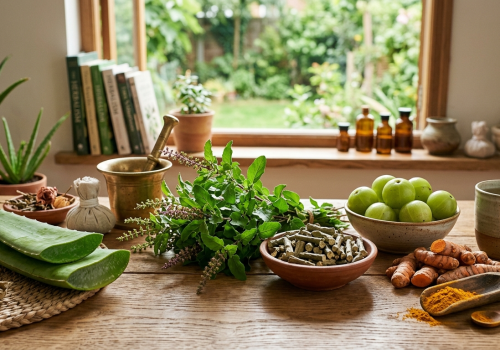













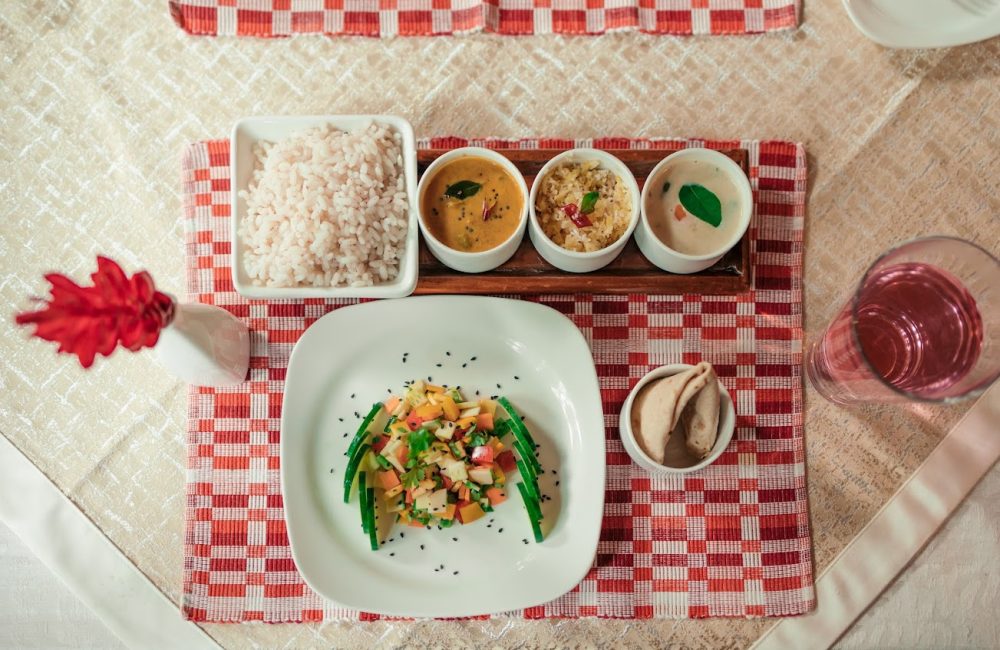

A plate of food can look simple and still carry a great deal of thought.
Warm rice. A lightly cooked vegetable. Dal. A preparation chosen for the season. Spices used with restraint rather than intensity. A meal eaten at a regular time and, ideally, without rushing.
This is closer to the idea behind Sattvik food than the increasingly popular image of a rigid “clean eating” plan.
In contemporary wellness culture, the term Sattvik is often used to describe fresh vegetarian food that is light, minimally processed and gently seasoned. That is broadly useful, but it is only part of the picture.
Within Indian philosophical traditions, sattva refers to a quality associated with clarity, balance and steadiness. Food classified as Sattvik is traditionally understood as supporting those qualities.
Ayurveda adds another layer.
It does not ask only whether a food is theoretically wholesome.
It asks whether that food is appropriate for this person, in this quantity, in this season, with this digestive capacity.
At Kairali, The Ayurvedic Healing Village in Palakkad, Kerala, meals form part of that wider Ayurvedic understanding of daily routine and individual care.
What Does “Sattvik” Actually Mean?
The Sanskrit term sattva is commonly translated as clarity, harmony or balance.
Traditional Indian thought describes three guṇas, or qualities:
- Sattva, associated with clarity and equilibrium
- Rajas, associated with activity and stimulation
- Tamas, associated with inertia and heaviness
Food traditions influenced by this framework classify certain foods according to the qualities they are thought to encourage.
A Sattvik dietary pattern is generally associated with foods that are fresh, uncomplicated, nourishing and comparatively easy to digest.
Contemporary reviews of yogic and Sattvik dietary traditions describe them as predominantly vegetarian and centred on fresh foods, grains, legumes, vegetables, fruits, nuts and seeds.
But Sattvik eating is not simply a nutritional checklist.
How food is prepared, how fresh it is, how much is eaten and the state in which a person eats are also part of the traditional idea.
Is Sattvik Food the Same as an Ayurvedic Diet?
Not exactly.
The two overlap, but they should not be treated as identical.
Ayurvedic dietetics is highly contextual.
It considers factors such as:
- Prakṛti or constitutional pattern
- current imbalance
- agni or digestive capacity
- season
- appetite
- age
- physical activity
- food qualities
- preparation method
- compatibility between foods
Modern reviews of Ayurvedic food principles similarly describe Ayurveda as a system in which diet is adapted to individual constitution and digestive function rather than prescribed universally.
So while a Sattvik meal may emphasise freshness, moderation and simplicity, Ayurveda asks an additional question:
Does this meal suit the person eating it?
That distinction is central.
What Foods Are Commonly Considered Sattvik?
There is variation between traditions, but Sattvik eating commonly includes foods such as:
- freshly cooked grains
- pulses and legumes
- seasonal vegetables
- fresh fruit
- nuts and seeds
- mild herbs and spices
- simple dairy preparations in traditions where dairy is used
- warm, freshly prepared meals
Foods are usually prepared without excessive heaviness or strong stimulation.
Highly processed foods, excessive stimulants and meals that have been stored for long periods generally sit less comfortably within the traditional Sattvik framework.
Some yogic traditions also avoid onion, garlic, caffeine and heavily fermented foods.
But this should not be turned into a universal rule for every person practising Ayurveda.
Food traditions differ, and individual Ayurvedic recommendations may differ as well.
Why Ayurveda Pays So Much Attention to Agni
A meal is not considered useful merely because the ingredients sound healthy.
Ayurveda gives particular importance to agni, a traditional concept referring broadly to digestive and metabolic capacity.
In practical terms, this means a food has to be tolerated and digested appropriately by the person eating it.
A large raw salad may be fashionable, for example, but may not suit someone who consistently experiences bloating or discomfort after raw food.
Another person may digest the same meal comfortably.
Ayurvedic nutrition therefore tends to be less interested in universal “superfoods” and more interested in the relationship between the person and the food.
This is one reason freshly cooked meals often occupy an important place in residential Ayurvedic programmes.
Warmth, preparation method, portion size and timing can all influence how a meal is experienced.
Sattvik Food at Kairali
At Kairali, The Ayurvedic Healing Village, meals are part of the wider physician-guided Ayurvedic programme rather than an independent wellness product.
KTAHV is an NABH-accredited Ayurvedic hospital-resort in Palakkad, Kerala.
Food choices may therefore be considered alongside a guest’s physician consultation, programme, digestive pattern and daily routine.
This is an important distinction.
Not every guest necessarily needs the same foods.
Nor should Sattvik cuisine be interpreted as a standard “detox menu” handed to everyone regardless of context.
The aim is to keep meals appropriate to the wider programme while retaining the principles of freshness, moderation and digestibility that characterise much Ayurvedic cooking.
A Simple Meal Can Be Deliberate
Ayurvedic cuisine does not need to be elaborate.
In fact, one of its more interesting qualities is the attention given to ordinary foods.
A rice preparation.
A lentil dish.
Cooked vegetables.
A soup.
A modest dessert.
What changes is the reasoning behind the meal.
How heavy is it?
How warming or cooling?
How strongly seasoned?
How well does it fit the climate?
How much oil is appropriate?
Does it complement the rest of the day’s programme?
This makes food less about novelty and more about proportion.
What About Kichadi?
Kichadi, or khichdi, is one of the most familiar dishes in Ayurvedic wellness settings.
It is usually prepared from rice and mung dal, with variations in spices, vegetables and consistency.
It is sometimes described online as a “detox meal”.
That description is too strong.
Kichadi does not need detox claims to justify its place in a menu.
Its practical appeal is that it can be prepared simply, served warm and modified relatively easily according to the individual or programme.
For some people, that makes it a comfortable meal during periods when a simpler dietary routine is preferred.
It should be understood as food, not as a medical cleansing intervention.
Seasonal Vegetables, Soups and Grains
Cooked seasonal vegetables and soups also appear frequently in Ayurvedic meals.
Again, the useful question is not whether a particular vegetable “heals” the digestive tract.
It is how the food fits into the broader meal.
Ash gourd, for example, is used in South Indian cooking and may be selected for particular preparations because of its culinary and traditional qualities.
Red rice may be used as one grain option.
Sweet potato can form part of a dessert or savoury preparation.
None of these ingredients needs to be elevated into a medicinal promise.
Their value can lie simply in being part of a well-prepared, varied meal.
The Role of Spices
Ayurvedic cooking and bland food are not synonymous.
Spices are used deliberately.
Cumin, coriander, turmeric, ginger and other familiar ingredients may contribute flavour while also being understood through traditional Ayurvedic qualities.
The important principle is proportion.
More spice is not automatically more Ayurvedic.
The intensity of seasoning may vary according to the dish, season and person.
This is one reason the phrase “minimal spice” can also be misleading.
Ayurvedic cooking is better described as appropriately spiced rather than universally mild.
Does Sattvik Food Have to Be Organic?
Organic ingredients may be preferred when available, but “organic” and “Sattvik” are not synonyms.
Sattva is a traditional philosophical category.
Organic certification is a modern agricultural and regulatory standard.
A food does not become Sattvik solely because it carries an organic label.
Freshness, preparation, simplicity, context and the qualities attributed to the food matter within the traditional framework.
It is better to keep those concepts separate rather than blending contemporary sustainability terminology with classical categories.
Eating Is Also a Behaviour
One of the more useful elements of Ayurvedic food culture is that eating is not treated purely as chemistry.
The circumstances around a meal matter.
Eating while rushing, arguing or working is a different experience from eating while seated and attentive.
Regularity matters too.
A carefully prepared lunch eaten at a predictable time may be more consistent with an Ayurvedic routine than an elaborate “healthy” meal consumed at midnight after skipping food all day.
This idea does not require mystical explanation.
Meal timing and eating behaviour are simply part of the larger pattern in which food is consumed.
Why Mindful Eating Belongs Here
The phrase “mindful eating” is modern, but the behaviour it describes fits comfortably with traditional dietary discipline.
Eat seated.
Pay attention.
Chew rather than rush.
Notice satiety.
Avoid turning every meal into another task completed in front of a screen.
This can sound almost too ordinary to mention.
Yet for many people, the difficulty is not knowing which foods are considered healthy.
It is creating conditions in which meals happen with any regularity at all.
A residential retreat naturally changes that environment.
Meals occur at set times.
There is less need to eat between meetings or during a commute.
The structure itself can make a more deliberate relationship with food easier to observe.
Food During Panchakarma
Diet often receives particular attention during physician-supervised Panchakarma programmes.
That does not mean everyone undergoing Panchakarma receives the same menu.
Different stages of a programme may require different dietary considerations according to the physician’s assessment.
This is another reason generic internet versions of a “Panchakarma diet” should be treated cautiously.
Panchakarma is not simply a cleanse accompanied by kichadi.
It is a supervised Ayurvedic therapeutic framework, and food forms part of that clinical context.
Is Sattvik Food Proven to Improve Mental Health?
This is where traditional language and modern scientific claims need to be separated.
Traditional Sattvik theory associates this style of eating with clarity and calmness. Contemporary academic reviews describe these traditional associations and note growing interest in relationships between yogic dietary patterns and psychological wellbeing.
That does not establish that a Sattvik diet has been clinically proven to treat anxiety, depression or another mental-health condition.
Nor should an individual dish be described as producing emotional balance.
Diet is one factor among many that influence physical and psychological health.
The traditional concept can be discussed without converting it into a medical claim.
Food Is Important in Ayurveda, but It Is Not a Cure-All
Ayurveda places diet alongside lifestyle, physical practices and other forms of care. NCCIH similarly describes Ayurvedic practice as combining diet, lifestyle, exercise and various traditional products and interventions.
But a traditional emphasis on food should not become the claim that “food is the most powerful medicine”.
Medical conditions often require medical treatment.
Nutrition can support general health, but it does not replace necessary clinical care.
This is particularly relevant in wellness environments where dietary changes can sometimes be presented as solutions to complex health problems.
Good Ayurvedic nutrition is more modest.
It asks whether everyday eating supports or works against the broader plan for the person.
What Kairali’s Approach Can Teach Beyond the Retreat
The most transferable part of an Ayurvedic meal is not necessarily the recipe.
It is the structure around it.
Eat at reasonably consistent times.
Choose food you can digest comfortably.
Prefer freshly prepared meals when practical.
Pay attention to quantity.
Adapt food to climate, appetite and activity.
Use spices deliberately rather than mechanically.
Notice how meals actually make you feel.
None of this requires turning every lunch into an Ayurvedic prescription.
It simply introduces more observation into eating.
Sattvik Does Not Have to Mean Restrictive
This may be the most important point.
Sattvik eating is increasingly presented online as a long list of prohibitions.
No this.
No that.
Never eat this ingredient.
Always avoid that one.
But a food culture organised entirely around restriction can lose sight of the quality it claims to pursue.
Clarity does not require anxiety around food.
Balance does not require perfection.
And Ayurvedic eating is not strengthened by turning every ingredient into a moral category.
A more useful approach is to understand Sattvik food as a preference for freshness, moderation, digestibility and attentiveness, interpreted within the individual’s wider circumstances.
A Meal Is Part of the Day, Not Separate From It
Perhaps the most Ayurvedic idea about food is also the simplest.
Meals do not happen in isolation.
They are affected by when we wake.
How much we move.
Whether we are hungry.
Whether we slept.
How quickly we eat.
What came before the meal.
What comes afterwards.
At Kairali, food sits alongside physician-guided Ayurveda, yoga, rest and daily routine.
Its purpose does not need to be described as “transformative”.
A well-prepared meal can do something more practical.
It can nourish.
It can fit the individual.
It can be eaten without rushing.
And it can remind us that healthy eating is not only about choosing the theoretically perfect ingredient.
It is also about developing a more sensible relationship with food itself.
Explore Ayurvedic food and daily routine
Guests undertaking physician-guided programmes at Kairali – The Ayurvedic Healing Village can learn how food, meal timing and daily routine are considered within an individual Ayurvedic plan.