































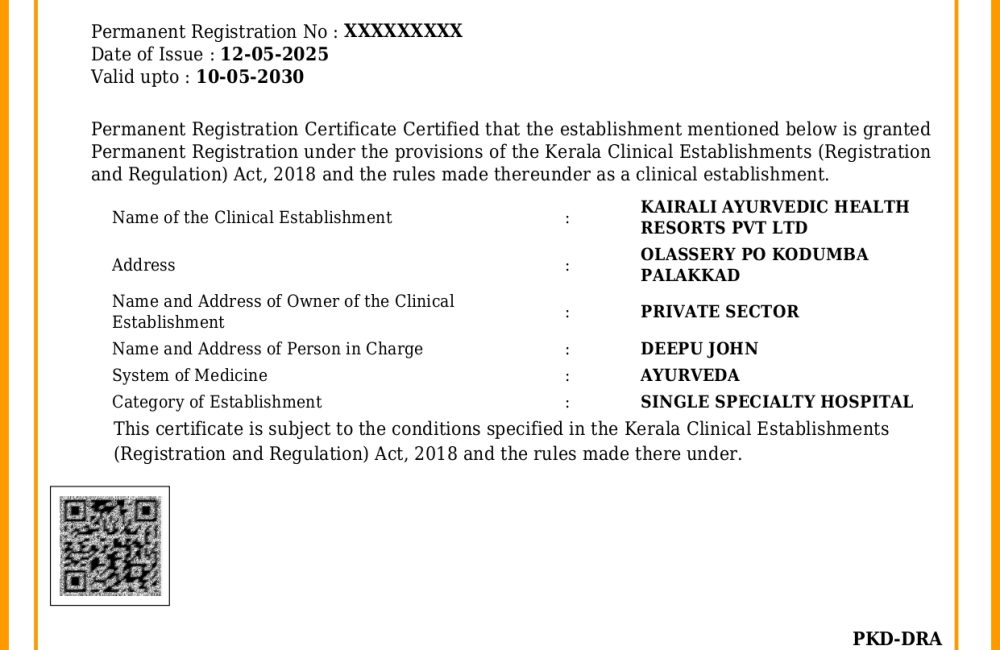

Choosing an Ayurvedic wellness centre often involves more than comparing treatments or facilities. Many people also want to know whether the institution operates within a recognised healthcare framework.
Kairali – The Ayurvedic Healing Village has received Permanent Registration under the Kerala Clinical Establishments (Registration and Regulation) Act, 2018. This registration recognises Kairali as a single-specialty Ayurvedic hospital that meets the requirements prescribed under the state’s regulatory framework.
For guests, this provides additional assurance that clinical services are delivered within an established system of registration, governance, and quality standards.
What Is the Kerala Clinical Establishments Act?
The Kerala Clinical Establishments (Registration and Regulation) Act, 2018 is a state law that regulates clinical establishments across Kerala.
The Act establishes standards relating to infrastructure, staffing, record keeping, patient care, and other operational requirements. Clinical establishments must comply with these standards to obtain and maintain registration.
The objective is to promote safe, ethical, and accountable healthcare services across registered institutions.
What Does Permanent Registration Mean?
Permanent registration indicates that a clinical establishment has met the applicable requirements prescribed under the Act.
For an Ayurvedic hospital, this means operating within a recognised regulatory framework established by the Government of Kerala.
While regulatory requirements may evolve over time, permanent registration demonstrates that the institution has satisfied the standards required for registration at the time of approval and remains subject to applicable oversight.
Why Regulatory Recognition Matters
Healthcare decisions often depend on trust.
When choosing an Ayurvedic hospital or wellness destination, visitors may wish to know that the institution follows recognised standards for clinical practice, patient care, and administration.
Government registration provides one layer of assurance by confirming that the establishment operates within the state’s regulatory system.
It does not guarantee treatment outcomes. Instead, it reflects compliance with applicable legal and operational requirements.
Ayurveda Within a Regulated Healthcare Framework
Ayurveda is one of India’s recognised systems of medicine and has long emphasised personalised healthcare.
Today, many Ayurvedic hospitals combine these traditional principles with modern regulatory requirements relating to patient safety, documentation, infrastructure, and professional practice.
This allows classical Ayurvedic care to be delivered within an organised healthcare environment.
What This Means at Kairali
At Kairali – The Ayurvedic Healing Village, physician-led care remains the foundation of every wellness programme.
Each guest begins with a consultation, during which an Ayurvedic physician assesses the individual’s health, constitution (Prakriti), lifestyle, and wellness goals before recommending an appropriate programme.
Depending on the assessment, programmes may include:
- Physician-guided Ayurvedic therapies
- Panchakarma where clinically appropriate
- Personalised dietary guidance
- Yoga and meditation
- Lifestyle recommendations
- Follow-up consultations
The emphasis is on providing individualised care rather than offering identical programmes to every guest.
A Focus on Ethical Clinical Practice
Healthcare involves more than treatments alone.
Professional practice also includes respecting patient privacy, maintaining appropriate clinical records, and following ethical standards during care.
Registered clinical establishments are expected to operate within these broader responsibilities while complying with applicable regulations.
Integrating Sustainability with Wellness
Kairali has long incorporated environmental considerations into its campus and daily operations.
The Healing Village is designed to create a peaceful setting where guests can focus on rest, healthy routines, and physician-guided wellness programmes.
Natural surroundings, thoughtfully planned spaces, and Ayurvedic lifestyle practices contribute to the overall guest experience, while remaining separate from the clinical standards required under state registration.
Personalised Care Remains Central
One of Ayurveda’s defining principles is individualisation.
Rather than applying the same treatment to everyone, Ayurvedic physicians assess each person’s constitution, present health status, and wellness objectives before recommending therapies.
This personalised approach continues throughout the stay, with regular consultations allowing the programme to be adjusted when appropriate.
Why This Matters for International Visitors
Many international guests are unfamiliar with India’s healthcare regulations.
Knowing that an Ayurvedic institution operates under a recognised state registration system can help them better understand the governance surrounding clinical services.
While registration should not be viewed as a guarantee of specific health outcomes, it demonstrates that the institution functions within an established regulatory framework.
Continuing a Commitment to Quality
Permanent registration under the Kerala Clinical Establishments Act represents an important milestone for Kairali.
It reflects compliance with the state’s regulatory requirements while supporting the continued delivery of physician-led Ayurvedic care.
For guests, it reinforces confidence that traditional Ayurvedic wellness programmes are offered within a recognised clinical setting that values professional practice, ethical care, and regulatory accountability.