

































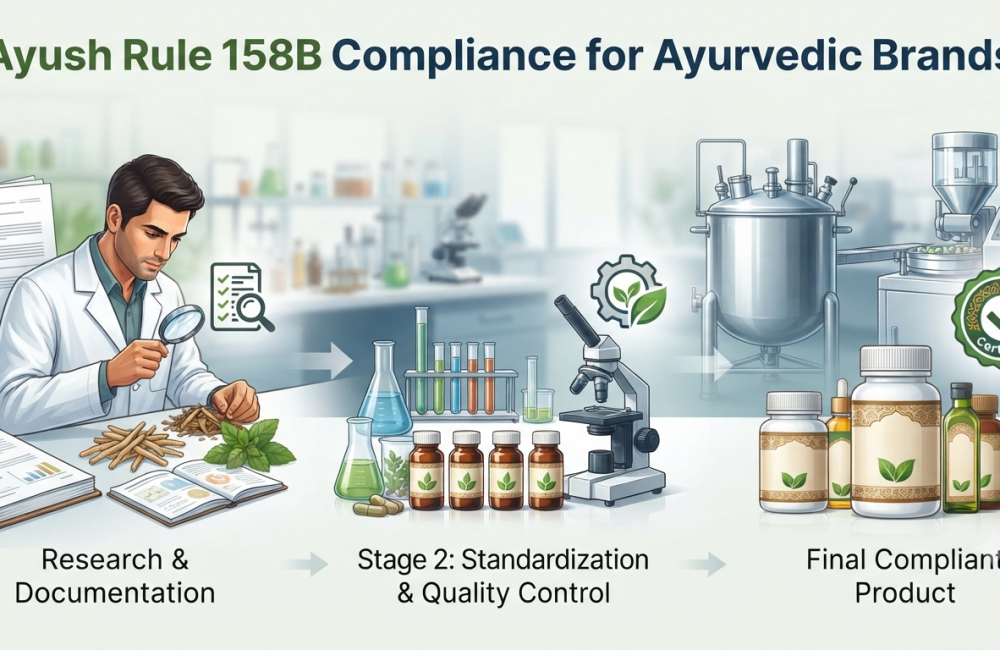

Ayurveda Regulation: Why Compliance Is Becoming a Business-Quality Issue
For Ayurvedic brands, regulation is increasingly part of a wider conversation about quality, documentation and trust. The important question is no longer simply whether a manufacturer holds the required licences. Buyers and partners also want to understand how products are documented, how claims are controlled and how consistently quality systems are applied.
That shift matters to manufacturers, distributors and other B2B partners because regulatory discipline and commercial credibility are becoming harder to separate.
Why Rule 158B deserves attention
Rule 158B of the Drugs and Cosmetics Rules sits within the regulatory framework governing Ayurvedic, Siddha and Unani medicines. For businesses working in this sector, its significance is best understood as part of a broader requirement for disciplined product classification, evidence and responsible claims.
The exact regulatory pathway can depend on the formulation, category and applicable licensing requirements. That makes broad statements about every Ayurvedic product risky. What is clear is that manufacturers need to understand precisely what they are making, how it is classified and what documentation supports it.
Classical and proprietary products require clarity
Ayurvedic portfolios can include classical formulations based on recognised texts as well as patent or proprietary medicines. The distinction affects how a product is documented and presented.
For a B2B buyer, this creates several useful due-diligence questions: What is the product category? What is the basis for its formulation? Do the label and marketing claims match the documentation available for it? Can the manufacturer provide the relevant permissions and quality information for the product being supplied?
These questions are more useful than assuming that one certificate or licence answers everything about an entire portfolio.
Documentation is part of product quality
Good documentation does not replace manufacturing quality, but it makes quality easier to examine.
For serious Ayurvedic businesses, useful documentation can include applicable licence and permission details, formulation records, manufacturing and quality specifications, testing records, and information supporting shelf life and approved communication.
The precise documents required will vary by product and market. The commercial principle is simpler: a manufacturer should know what supports the product it is selling and should be able to respond clearly to legitimate due-diligence questions.
Claims deserve the same discipline
Compliance does not stop at the factory door. Product labels, catalogues, websites, advertisements and distributor material can all shape regulatory risk.
This makes claims governance an important part of brand quality. Traditional use should not automatically be translated into an unrestricted modern marketing promise. Similarly, language used in one market may not be appropriate in another.
For export-oriented brands, disciplined communication is therefore part of responsible market preparation, not merely a final copy-editing exercise.
What B2B buyers should ask
When evaluating an Ayurvedic manufacturing or supply partner, buyers can focus on a few practical areas:
- Product identity: Is the exact formulation and category clearly documented?
- Permissions: Can the supplier provide the applicable licence or product-permission information?
- Quality records: Are specifications and relevant testing records available?
- Shelf life: Is the stated shelf life supported by the documentation required for that product?
- Claims: Do labels and sales materials remain consistent with the product’s regulatory basis?
- Export readiness: Has communication been reviewed for the requirements of the destination market?
None of these questions replaces independent regulatory due diligence. Together, however, they help distinguish a mature quality system from a purely sales-led approach.
The opportunity for established Ayurvedic brands
Stronger scrutiny can feel burdensome, particularly for businesses managing large or long-standing portfolios. It can also create an opportunity.
Brands that invest in traceability, documentation, quality systems and disciplined communication are better placed to build trust with distributors, practitioners and international partners.
For Kairali Ayurvedic Products, that is the standard worth pursuing: not treating compliance as a badge or a one-time exercise, but recognising regulatory discipline as part of how an Ayurvedic product earns long-term confidence.
Regulation will continue to evolve. The more durable principle is that heritage and accountability should strengthen one another. Ayurveda’s history may create interest; consistent quality and responsible documentation are what help turn that interest into trust.







Leave a Reply