

































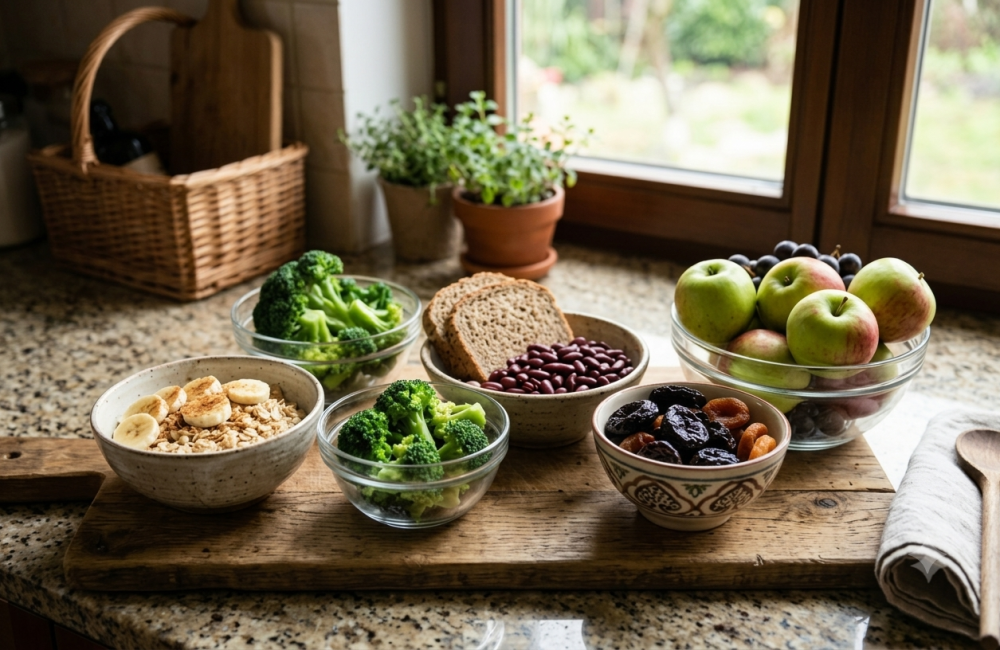

A pear. A bowl of papaya. An apple eaten with its skin. Bitter gourd. Kachri.
These are among the foods recently highlighted in a Free Press Journal article on Ayurvedic approaches to constipation. The suggestions point towards something useful: food does matter when bowel movements become difficult or irregular.
But an Ayurvedic understanding of constipation begins with a broader question.
Why has the bowel become irregular in the first place?
That distinction matters. Constipation is often discussed as though it is simply a problem of finding the right food, herb or laxative. Ayurveda looks instead at the pattern surrounding digestion and elimination: what a person eats, how regularly they eat, fluid intake, movement, daily routine and the characteristics of the bowel movement itself.
Modern medicine, from a different framework, also recognises that constipation has multiple possible causes. Low fibre intake, inadequate fluid intake, physical inactivity, changes in routine and certain medicines can all contribute.
First, what actually counts as constipation?
Constipation does not necessarily mean failing to have a bowel movement every day.
It can include having fewer than three bowel movements a week, passing hard, dry or lumpy stools, having difficulty or pain while passing stool, or feeling that the bowel has not emptied completely. Normal bowel patterns also differ from person to person.
This is an important distinction because frequency alone tells us relatively little.
Someone may pass stool regularly but experience considerable straining. Another person may naturally have less frequent bowel movements without discomfort. The quality and ease of elimination therefore matter alongside frequency.
How Ayurveda looks at constipation
In Ayurvedic theory, constipation is commonly associated with disturbance of Vāta doṣa (the functional principle associated with movement), particularly its role in the lower digestive tract.
This should not be confused with a modern biomedical diagnosis. Vāta is part of Ayurveda’s traditional explanatory framework, not an anatomical structure or a directly measurable physiological variable.
Within that framework, however, the characteristics of constipation are important.
Dryness, hardness, irregularity and difficulty in elimination are not treated merely as interchangeable symptoms. They help the practitioner understand the broader digestive pattern.
This is why reducing Ayurveda to a list of “five foods for constipation” misses part of its reasoning.
The food matters. So does the person eating it.
What about pear, apple and papaya?
There is a straightforward nutritional reason several fruits repeatedly appear in discussions about bowel regularity: fibre.
Pears and apples with their skins are recognised sources of dietary fibre. Fibre can help increase stool bulk, while adequate fluids help fibre work effectively and can make stools easier to pass.
Papaya similarly provides fibre and water and can form part of a varied diet.
That does not make any of these fruits a treatment for every case of constipation.
The more useful lesson is that diets containing adequate amounts of fruits, vegetables, pulses and whole grains generally provide more fibre than diets dominated by highly processed, low-fibre foods. For someone who currently eats little fibre, gradually improving the overall dietary pattern may be more meaningful than concentrating on a single ingredient.
Gradual is worth emphasising. Increasing fibre very quickly can be uncomfortable for some people.
And what about bitter gourd and kachri?
The Free Press Journal article also discusses bitter gourd, or karela, and kachri, a wild melon used in regional Indian cooking. It attributes specific laxative and bowel-cleansing properties to these foods and describes traditional ways of consuming them.
Here, some caution is useful.
A food can have a long history of traditional use without every health claim attached to it having the same level of modern clinical evidence. Traditional use and modern evidence answer different questions, and responsible discussion of Ayurveda should make that distinction visible.
Bitter gourd and kachri can certainly exist within a varied diet where culturally and individually appropriate. But concentrated juices or preparations should not automatically be treated as universally suitable remedies.
This is particularly relevant for people taking medicines or living with other health conditions.
The overlooked part of constipation: routine
Food receives most of the attention because it gives us something tangible to add or remove. But bowel habits are also habits.
Regular physical activity may help with constipation. Responding to the urge to pass stool rather than repeatedly delaying it can matter as well. In some cases, clinicians may recommend establishing a regular time for bowel movements.
This is one area where the Ayurvedic emphasis on dinacaryā (daily routine) becomes particularly interesting.
Ayurveda traditionally places considerable importance on regularity: sleeping, waking, eating and attending to natural urges within a relatively consistent daily rhythm. The point is not that everyone needs an identical schedule. It is that digestion does not occur independently of the rest of daily life.
Travel disrupts routine. So can irregular work hours, missed meals, inactivity and changes in eating patterns. Modern clinical guidance likewise recognises changes in daily routine, travel and repeatedly ignoring the urge for a bowel movement among factors that can contribute to constipation.
So the practical question becomes larger than, “What should I eat?”
It becomes: What changed?
Before reaching for another remedy, look at the pattern
For occasional constipation, it can be useful to examine several ordinary factors together:
- Has fibre intake fallen?
- Has fluid intake changed?
- Has physical activity decreased?
- Has travel or a change in schedule disrupted the usual routine?
- Is the urge to pass stool regularly being postponed?
- Did constipation begin after starting a medicine or supplement?
These questions do not diagnose the cause. They help reveal why simply adding one supposedly “digestive” ingredient may not address the wider pattern.
Certain medicines and supplements can contribute to constipation, including some iron supplements, antacids and prescription medicines. Medication should not be stopped or changed without discussing it with a healthcare professional.
When constipation should not be self-managed
Occasional constipation and persistent constipation are not the same thing.
If symptoms repeatedly return, do not improve with self-care or represent a significant change from normal bowel habits, medical assessment is appropriate. Blood in the stool, rectal bleeding, persistent abdominal pain, vomiting, fever, inability to pass gas or unexplained weight loss are among the signs that warrant medical attention.
This is also where the popular language around “cleansing” the bowel can become unhelpful.
Constipation can have many causes. Persistent symptoms should not automatically be interpreted as accumulated “toxins”, nor should increasingly strong laxatives, juices or herbal preparations be used simply because something is described as natural.
The more useful Ayurvedic question
The renewed interest in foods such as papaya, pear, apple, karela and kachri is not misplaced. Food is an important part of digestive health, and several of these foods can contribute fibre and fluid to the diet.
But Ayurveda has more to contribute to this conversation than another list of ingredients.
Its more interesting proposition is that elimination should be understood in context.
What is the person eating? How regularly? How much are they moving? Has their routine changed? Is the stool unusually dry or difficult to pass? Is the problem occasional, or has it become persistent?
That shift, from searching for a single remedy to observing the pattern, is a more useful place to begin.
And when that pattern does not improve, the appropriate next step is not a stronger home remedy. It is a proper clinical assessment.











Leave a Reply