






















Abhyanga is often described simply as an Ayurvedic oil massage. That description is accurate, but incomplete.
In Ayurveda, Abhyanga (abhyanga, therapeutic oil application and massage) is not defined only by relaxation or by the mechanical action of massage. The choice of oil, the way it is applied, the individual’s constitution and current condition, and the place of the therapy within a wider treatment plan all matter.
This is particularly important when distinguishing classical Ayurvedic practice from the increasingly common spa interpretation of Abhyanga.
At Kairali – The Ayurvedic Healing Village in Palakkad, Kerala, Abhyanga is used within a physician-led Ayurvedic framework rather than offered as an isolated wellness add-on. Kairali is an NABH-accredited Ayurvedic hospital-resort, and therapies are planned according to an Ayurvedic assessment and the purpose of the guest’s programme.
So what actually happens during Abhyanga, and why has oil application remained such an important part of Ayurvedic practice?
What is Abhyanga?
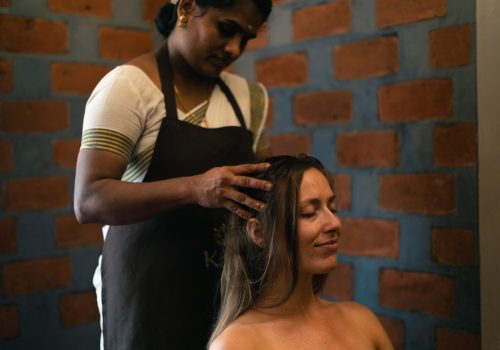
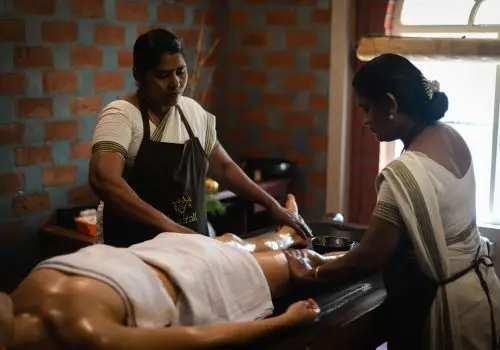
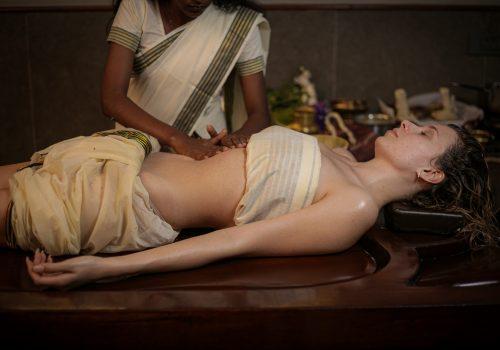
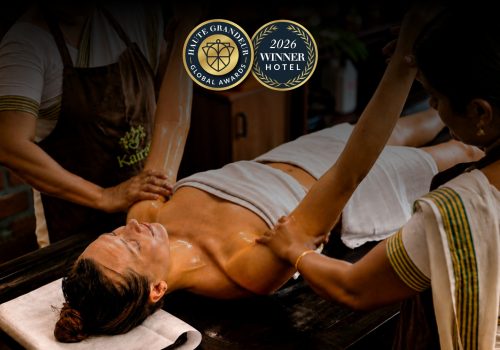
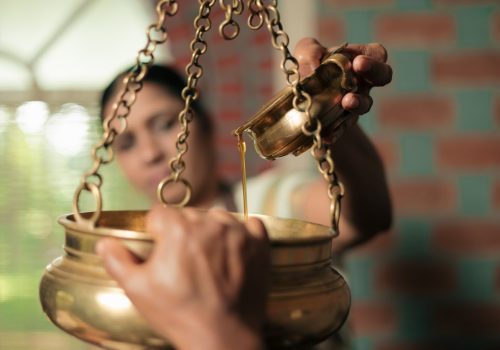
Abhyanga involves the systematic application of warm oil to the body, usually accompanied by rhythmic massage strokes.
The oils used are not necessarily the same for everyone. In Ayurvedic practice, the choice may be influenced by prakṛti (individual constitution), vikṛti (the present state of imbalance), the season, the person’s strength and the wider clinical purpose of treatment.
This individualisation is one of the most important aspects of the therapy.
Ayurveda does not treat oil simply as a lubricant for massage. Oil application, or snehana (oleation), occupies a broader therapeutic role within the system. Depending on the context, oleation may be used independently as part of a daily routine or incorporated into more structured physician-supervised treatment.
This is also why two people receiving what is broadly called “Abhyanga” may not necessarily receive an identical treatment.
Abhyanga is not the same as a conventional massage
The physical experience can certainly be relaxing, but relaxation alone does not explain the Ayurvedic use of Abhyanga.
A conventional massage may focus primarily on muscular tension, pressure points or relaxation. In Ayurvedic practice, attention also goes to questions such as:
- Which oil is appropriate for this individual?
- Is the person feeling dry, depleted, restless, heavy or overheated?
- What is their digestive and general physical state?
- What season and climate are they currently experiencing?
- Is Abhyanga being used independently or as part of a broader Ayurvedic programme?
The answers influence how the therapy is approached.
At Kairali, this begins with physician assessment rather than with the therapist choosing a standard massage from a menu.
That distinction matters. Ayurveda is highly contextual. The same intervention is not automatically appropriate in the same form for every person.
Why does Ayurveda use oil?
Oil has a particularly important place in Ayurvedic descriptions of Vāta doṣa, the functional principle associated with qualities such as movement, dryness, lightness and variability.
Classically, unctuousness and warmth are used to counter qualities such as excessive dryness and coldness. This is one reason oil application has traditionally been associated with maintaining comfort in the skin and body and with creating a sense of physical steadiness.
Different oils also have different properties within Ayurvedic practice.
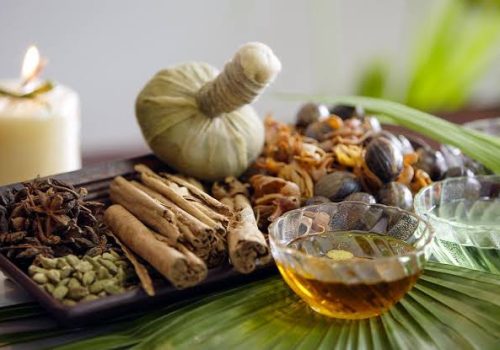
Sesame oil, for example, is widely used as a base in traditional oil preparations. Other oils and herbalised formulations may be selected depending on the individual’s constitution and treatment objectives.
The important point is that Ayurvedic oil selection is not simply about fragrance or luxury. It is part of the therapeutic reasoning behind the treatment.
What does Abhyanga feel like?
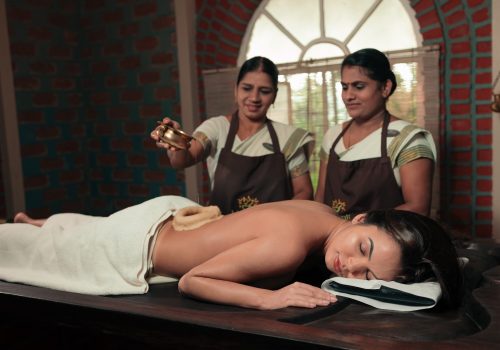
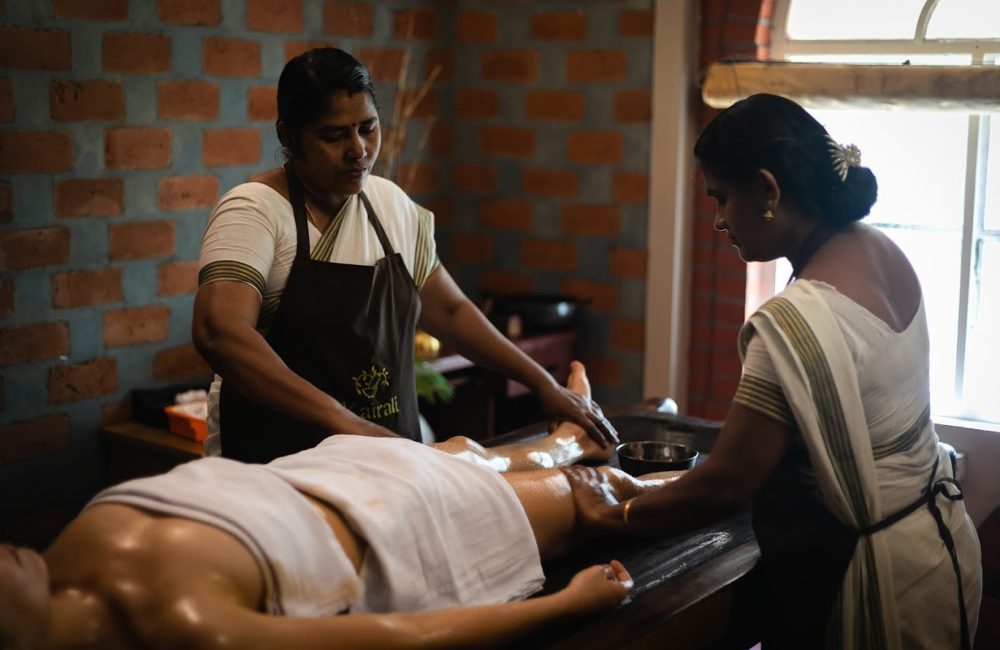
A professionally administered Abhyanga typically involves generous application of warmed oil across the body using repeated, coordinated strokes.
Rather than focusing intensely on one painful muscle or a single “knot,” the treatment generally works across the body in a more continuous pattern.
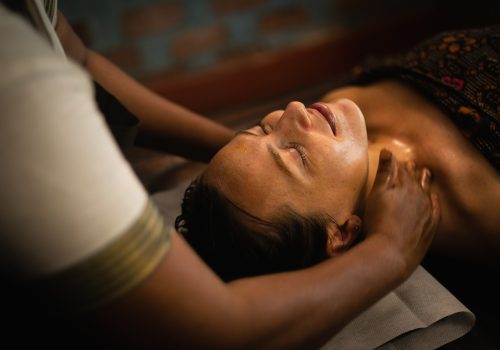
Many people experience the process as calming and physically comforting. Warm oil reduces friction over the skin, while the repetitive nature of the strokes can make the treatment feel markedly different from a vigorous sports or deep-tissue massage.
The precise technique, oil and duration can vary according to the treatment plan.
At Kairali, the therapy may also form part of a sequence of Ayurvedic procedures rather than being considered a complete treatment in itself.
What are the traditional benefits associated with Abhyanga?
This is where careful language matters.
Ayurvedic tradition attributes a wide range of uses to regular oil application, including supporting the condition of the skin, physical comfort, steadiness and general well-being.
Some of the benefits commonly discussed around Abhyanga can be understood quite practically.
Skin conditioning
Oil application helps moisturise and soften the skin by reducing moisture loss from its surface. The oil used and the individual’s skin condition both influence the experience.
That is a more precise description than claiming that Abhyanga necessarily makes the skin “youthful” or reverses ageing.
Relaxation
The combination of warmth, touch, repetitive movement and a period away from ordinary stimulation can create a strong sense of relaxation.
This is one reason Abhyanga is often associated with slower, restorative periods within an Ayurvedic programme.
Muscular comfort
Massage can temporarily ease the sensation of muscular tightness and provide a sense of physical looseness.
However, Abhyanga should not be described as a treatment for arthritis, chronic pain or other medical conditions without appropriate clinical evidence and individual assessment.
Ayurvedic balance
Within Ayurvedic theory, Abhyanga may be selected according to the qualities of the individual’s doṣic state.
This does not mean a single massage automatically “balances all three doṣas.” The oil, technique and frequency are chosen according to context.
That nuance is central to understanding the therapy.
Does Abhyanga “remove toxins”?
This is one of the most common descriptions of Ayurvedic massage, and one of the least useful when presented without explanation.
Popular wellness writing often claims that Abhyanga “pulls toxins from deep tissues” so they can be eliminated from the body. That statement should not be treated as established modern physiology.
Ayurveda uses the concept of āma, a traditional term associated with impaired digestion and metabolism within Ayurvedic theory. Āma should not simply be translated as “toxins” in the modern biochemical sense.
In structured Ayurvedic care, external oleation can form part of the preparatory process surrounding certain Panchakarma procedures. But this classical framework is different from claiming that an oil massage physically extracts unspecified toxins through the skin.
The distinction matters because Ayurveda does not become more credible when traditional concepts are given modern-sounding explanations that the evidence does not support.
How Abhyanga is approached at Kairali
At Kairali – The Ayurvedic Healing Village, the starting point is the Ayurvedic consultation.
A physician assesses the individual’s constitution, present concerns and broader treatment requirements. The therapy plan, including the selection of oils and other procedures, is then determined within that clinical framework.
The therapists administer the treatment according to the physician’s instructions.
This physician-led structure is especially relevant when Abhyanga forms part of a Panchakarma programme. Panchakarma is not simply a collection of massages. It is a structured Ayurvedic process in which therapies are selected and sequenced according to the individual.
For the reader, the useful distinction is therefore not between a “luxury” and a “basic” massage.
It is between a standardised massage and a therapy being used within an Ayurvedic assessment and treatment plan.
Is Abhyanga appropriate for everyone?
Not necessarily.
The idea that something is traditional or natural does not mean it is suitable in every circumstance.
There may be situations in which a physician modifies, postpones or avoids oil massage depending on acute illness, skin conditions, digestive state, pregnancy, physical strength or other individual factors.
This is particularly relevant when Abhyanga is being considered as part of treatment for a specific health concern rather than simply as general self-care.
A qualified Ayurvedic practitioner can determine whether the therapy is appropriate and which oil and approach make sense for the individual.
Abhyanga as part of a larger Ayurvedic idea
The enduring relevance of Abhyanga may have less to do with any single promised benefit than with the way Ayurveda thinks about care.
Ayurveda rarely separates an intervention from its context. The oil matters. The person receiving it matters. The season matters. So does digestion, strength, age and the purpose of treatment.
Abhyanga illustrates that principle particularly clearly.
It can be deeply relaxing. It can condition the skin and provide physical comfort. Within Ayurveda, it also belongs to a much larger system of individualised therapeutic reasoning.
Understanding that difference prevents Abhyanga from being reduced to either extreme: neither a miracle treatment that “removes toxins” and cures health problems, nor simply an Indian version of a spa massage.
Its place is more specific than either description suggests.
At a physician-led Ayurvedic centre such as Kairali – The Ayurvedic Healing Village, that context is what gives the treatment its meaning.
CTA:
Speak with a Kairali Ayurvedic physician to understand whether Abhyanga or a wider physician-led Ayurvedic programme is appropriate for your individual needs.
Website: www.ktahv.com
Call: +91-9555156156