



























Ayurveda relies on a far wider botanical vocabulary than its best-known ingredients suggest. Musta, Manjistha and Punarnava may receive less attention in mainstream wellness media, but each has a distinct place within traditional Ayurvedic practice.
Ashwagandha and Triphala have become familiar names far beyond India. They appear in wellness articles, supplement ranges and conversations about stress, digestion and healthy ageing.
Yet Ayurveda has never been built around a handful of universally prescribed herbs.
Its pharmacopoeia contains hundreds of botanicals, each understood through qualities such as taste, potency, post-digestive effect and its influence on the doṣas, the functional principles Ayurveda uses to describe physiological patterns. The appropriate herb depends on the person, the preparation and the clinical context.
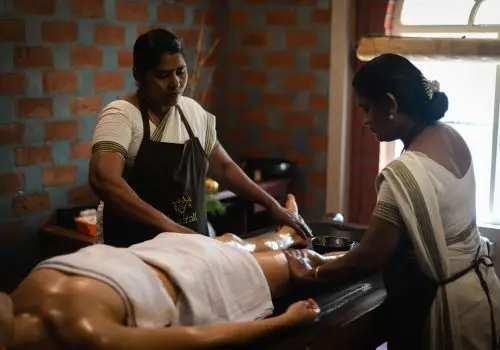
At Kairali – The Ayurvedic Healing Village in Palakkad, herbal formulations form one part of physician-led care. They may be considered alongside diet, daily routines, therapeutic procedures and yoga following an individual consultation.
Here are six herbs that deserve a closer look.
Musta (Cyperus rotundus): Traditionally Used for Digestive Balance
Musta is a perennial plant whose underground tubers are used in Ayurvedic preparations. It is traditionally associated with digestive regulation, particularly when appetite, bowel patterns or post-meal comfort have become unsettled.
Ayurvedic practitioners may consider Musta in patterns involving aggravated Pitta and Kapha. It is also traditionally discussed in relation to āma, a term used in Ayurveda for incompletely processed metabolic material.
Musta may be prepared as a powder, decoction or part of a multi-herb formulation. The choice of preparation depends on the person’s constitution, symptoms and wider treatment plan.
It should not be understood as a generic remedy for bloating or weight loss. Similar digestive symptoms may arise from very different causes and require different approaches.
Manjistha (Rubia cordifolia): A Herb Associated with Skin and Circulation
Manjistha is a climbing plant recognised by its reddish roots. In Ayurveda, it is traditionally associated with rakta dhātu, the tissue category connected with blood, and with channels involved in circulation and skin health.
This has led to its use in formulations intended to support the body’s natural processes of elimination and maintain a clear, balanced complexion.
However, descriptions such as “blood purifier” can be misleading when presented without context. This is a traditional Ayurvedic concept, not a direct biomedical claim. Persistent acne, rashes or inflammatory skin conditions require proper medical assessment rather than self-treatment with a single herb.
Within supervised Ayurvedic care, Manjistha may be used internally or included in external preparations. Its role depends on the broader pattern identified by the physician.
Punarnava (Boerhavia diffusa): Traditionally Associated with Renewal
The name Punarnava is commonly translated as “renewed again”. The plant has a long history of use in Ayurvedic formulations concerned with fluid balance, digestion and recovery from periods of physical depletion.
Punarnava is traditionally described as having a light, drying action. Practitioners may consider it when the clinical picture includes heaviness, sluggishness or fluid accumulation.
Its association with urinary function has also made it a common ingredient in formulations relating to the kidneys and urinary system. This does not mean it should be used independently for swelling, reduced urination or suspected kidney disease. Such symptoms can require prompt conventional medical investigation.
In a supervised programme, Punarnava may be selected as part of a wider formulation rather than prescribed in isolation.
Daruharidra (Berberis aristata): Bitter, Drying and Traditionally Used for the Skin
Daruharidra, sometimes translated as Indian barberry, is recognised for its yellow stem and distinctly bitter taste.
Ayurvedic texts and practice traditionally associate the plant with the skin, digestion and Pitta-Kapha patterns. It may appear in internal formulations as well as preparations intended for external application.
Its bitterness is central to how Ayurveda understands its action. Bitter substances are often used selectively when the clinical aim is to reduce heaviness, heat or excessive oiliness. They are not appropriate for everyone, particularly when dryness or depletion is already present.
Guduchi (Tinospora cordifolia): More Complex Than an “Immunity Herb”
Guduchi is frequently promoted as an immunity supplement. That description is convenient, but it is too broad to explain its traditional use.
In Ayurveda, Guduchi is classified as a rasāyana, a category of substances used to support resilience, recovery and healthy ageing. It is also traditionally used in formulations addressing heat, digestive disturbance and periods of convalescence.
The herb’s suitability depends on the individual and the formulation. “Immune boosting” is not always a desirable or medically precise goal, particularly for people with autoimmune conditions or those taking immune-modulating medication.
Guduchi should therefore be used under qualified supervision rather than treated as an everyday supplement for everyone.
Bhringaraj (Eclipta prostrata): Known for Hair, but Not Limited to It
Bhringaraj is best known through Ayurvedic hair oils. Traditionally, it is used to support the scalp and maintain healthy hair, often alongside other herbs and an appropriate oil base.
Its Ayurvedic applications are broader than cosmetic hair care. Bhringaraj also appears in formulations associated with the liver, digestion and Pitta-related patterns.
As with other Ayurvedic ingredients, the method of preparation matters. An infused oil used externally is not equivalent to a concentrated extract taken internally. The effects, safety considerations and intended purposes differ.
Why Ayurveda Rarely Relies on One Herb
The popularity of single-ingredient supplements can create the impression that each Ayurvedic herb has one fixed benefit. Traditional practice is more precise.
An Ayurvedic physician considers prakṛti (an individual’s constitutional pattern), vikṛti (the present imbalance), digestive capacity, age, season, medical history and concurrent medication. The practitioner must also decide whether a herb should be used alone or as part of a formulation, and whether it is best prepared as a powder, decoction, tablet, medicated oil or another form.
Two people reporting the same symptom may therefore receive very different recommendations.
This is why a list of herbal benefits cannot replace consultation. The botanical may be important, but the reasoning behind its selection is equally important.
The Value of Ayurveda’s Less-Familiar Botanicals
Musta, Manjistha and Punarnava are not “hidden cures”. Nor are they simply alternatives waiting to become the next Ashwagandha.
Their value lies in specificity.
Each herb has a defined traditional profile, a range of preparations and a particular place within a wider clinical assessment. Understanding that context offers a more accurate picture of Ayurvedic herbal practice than any list of fashionable ingredients.
At Kairali – The Ayurvedic Healing Village, herbal preparations are considered within physician-led programmes that may also include food, daily routine, yoga and supervised therapies. No formulation is suitable for every person, and herbal use should account for existing diagnoses, pregnancy, medication and possible interactions.
Speak with a Kairali Ayurvedic physician to understand how an individual Ayurvedic assessment informs the selection of herbs, diet and supervised therapies.
Website: www.ktahv.com
Call: +91-9555156156