



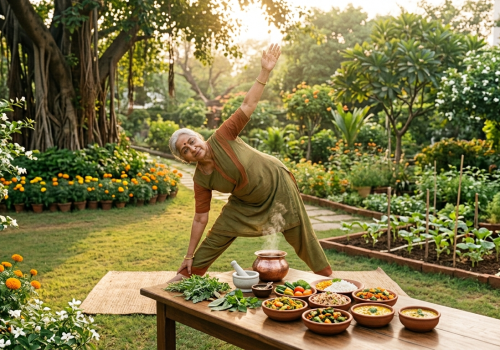




























Food is often the easiest place to encounter Ayurveda in everyday life. You do not need to begin with an unfamiliar therapy or completely reorganise your routine. The kitchen already offers a practical starting point: what we eat, how we prepare it, when we eat it and whether the meal leaves us feeling comfortable afterwards.
That is the territory Gita Ramesh explores in The Ayurvedic Wellness Cookbook.
Gita Ramesh, co-founder and Joint Managing Director of Kairali Ayurvedic Group, has spent much of her work examining the relationship between Ayurvedic principles and everyday cooking. The book brings that approach into the home through recipes designed to make Ayurvedic dietary thinking more accessible without turning food into a complicated wellness exercise. Kairali’s knowledge base identifies her specifically as an Ayurvedic chef and scholar, alongside her role as co-founder of the Group.
The central argument of the cookbook is straightforward: food intended to support wellbeing should still be enjoyable to eat.
Ayurveda in the kitchen does not have to be complicated
Ayurvedic food is sometimes presented as though it requires an entirely new pantry, strict rules or an elaborate understanding of herbs and spices.
In practice, many of its core ideas are much simpler.
Ayurveda traditionally considers food in relation to the individual, their digestive capacity, the season and the way a dish is prepared. Warmth, texture, quantity and combination can matter alongside the ingredients themselves.
This makes the kitchen an important part of Ayurvedic daily life, but not because every plate needs to become a treatment.
It is about paying closer attention to how food functions in the context of a person’s routine.
In discussing the recipes in her book, Gita Ramesh emphasises simplicity and flavour. As she puts it, “The beauty is in the simplicity of these recipes with the prerequisite that they are delicious too.”
That last point is significant.
A way of eating that feels permanently restrictive is difficult to sustain. However carefully designed a meal may be, food remains part of family life, culture, pleasure and habit. A practical approach to wellbeing has to account for that.
Why digestion matters in Ayurvedic food
One of the ideas that distinguishes Ayurvedic dietary thinking is its emphasis on digestion.
Instead of asking only whether an ingredient is conventionally considered healthy, Ayurveda also asks whether it suits the person eating it and whether it can be digested comfortably.
This is why the same meal does not necessarily suit everyone equally.
An individual’s appetite, constitution, present state and the season can all influence dietary recommendations. Cooking methods can change as well. In some situations, Ayurveda may favour warm, freshly prepared foods over meals that are heavy, cold or difficult for a particular person to digest.
This is not a reason to divide every ingredient into rigid categories of “good” and “bad.”
It is a reason to pay more attention to context.
That approach runs through Ramesh’s work: familiar food, carefully prepared, with Ayurveda providing the framework rather than overwhelming the recipe.
A cookbook designed for everyday use
The Ayurvedic Wellness Cookbook is intended to translate those principles into food people can prepare outside a retreat or Ayurvedic centre.
That matters because a health practice is of limited value if it can only be followed in exceptional circumstances.
A week at a wellness property may provide an organised routine, but everyday life looks different. People have families to cook for, working days to navigate and ingredients that depend on where they live.
A useful cookbook therefore has to work in a real kitchen.
Ramesh’s approach places recipes at the centre rather than surrounding them with complicated rules. The idea is not to make every reader an expert in Ayurvedic medicine. It is to introduce a way of thinking about meals that considers digestibility, preparation and individual needs alongside taste.
That is a more realistic entry point into Ayurveda than asking people to transform their diets overnight.
Recognition for an Ayurvedic approach to food
According to the material supplied for this article, The Ayurvedic Wellness Cookbook received recognition at the Gourmand World Cookbook Awards 2023 at Umeå Food in Sweden, in the Diet and Vegetarian categories.
The supplied feature notes that the awards consider a large international field of cookbooks and food publications. The significance for an Ayurvedic cookbook is not simply the award itself, but the context in which the book is being read.
Ayurvedic cooking is increasingly entering a wider conversation about food, not simply one about traditional medicine.
That shift makes sense.
Ideas such as eating seasonally, paying attention to digestion, cooking with familiar ingredients and making food enjoyable enough to sustain are understandable even to someone with no previous knowledge of Ayurveda.
They do not require the reader to accept every Ayurvedic concept before entering the kitchen.
They begin with a meal.
Food as a daily practice, not a wellness project
Gita Ramesh has written about Ayurvedic food and massage across several books, but the appeal of The Ayurvedic Wellness Cookbook lies in how ordinary its starting point is.
We already eat every day.
The question is whether we pay attention to what happens afterwards.
Does a meal satisfy without leaving us uncomfortably heavy? Does it fit the season? Is it something we can prepare regularly? Does it taste good enough that eating well does not feel like deprivation?
Ayurveda has a complex medical framework behind its approach to diet, and individual therapeutic dietary advice belongs with a qualified practitioner. But its everyday food principles can begin much more simply.
Cook thoughtfully.
Notice digestion.
Respect appetite.
Use the season as context.
And do not remove pleasure from the plate in the name of wellness.
That may be the most accessible lesson in Gita Ramesh’s cookbook: a considered way of eating does not have to make food less enjoyable. If anything, it asks us to pay more attention to it.
“I have written an easy-to-follow guide to maintaining a balanced diet and a healthy lifestyle. According to Ayurveda, this is what we follow in our daily lives. In Ayurveda, one does not count calories, instead, we commit to a philosophy and a way of life. Ayurveda proposes that eating be a mindful, meditative experience. By making a shift to a way of slow eating, using freshly sourced, seasonal ingredients, this cookbook shifts the focus of eating to detoxification and rejuvenation for all body types” she said.