





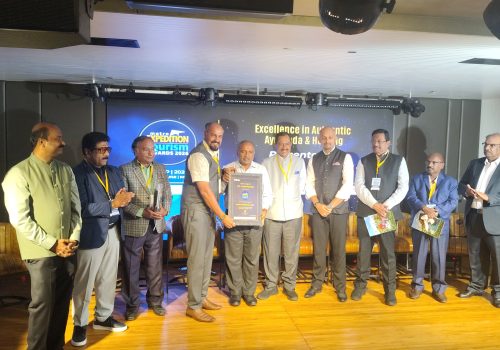



















On January 25, 2018, Aarogyalay marked its first Founder’s Day at the India International Centre in New Delhi with a discussion on a subject that remains relevant: the role of Ayurveda in conversations about stress in schools.
The event brought together Ayurvedic doctors, school leaders, teachers, students, industry representatives, media professionals and community organisations. Kairali Ayurvedic Group participated in the programme, with Dr Ruchi Vyas contributing to the discussion on practical approaches to stress awareness.
The central question was not whether stress could be removed from school life entirely. It was how children, teachers and families could recognise it earlier and respond with healthier routines.
Stress in the School Environment
Academic pressure is only one part of the problem.
Students may also face parental expectations, peer pressure, long commutes, reduced outdoor activity, disrupted sleep and constant exposure to digital devices. Teachers, meanwhile, are expected to respond to behavioural and emotional difficulties while managing their own professional demands.
Speaking at the event, Vanita Bhardwaj, then Vice Principal of Dev Samaj Modern School in Okhla, described how pressure around examinations, expectations and internet exposure could affect children’s behaviour and wellbeing.
She also discussed the wider effect on teachers, who are often required to manage these pressures within the classroom.
Her school had previously hosted a stress-management workshop conducted by Aarogyalay. At the Founder’s Day event, she announced the school’s support for the organisation’s awareness work through student-led street theatre on health and Ayurveda.
Food, Movement and Sleep
Padma Shri Vaidya Rajesh Kotecha, then Secretary of the Ministry of AYUSH, Government of India, attended as the guest of honour.
In his remarks, he identified three areas as especially important in conversations about stress among schoolchildren: āhāra (food), vyāyāma (physical activity) and nidrā (sleep).
“Ahaar, Vyayaam and Nidra are the three important factors for managing stress among school children.”
The statement reflected one of Ayurveda’s most practical contributions to the discussion. Before introducing complicated interventions, schools and families can examine the daily conditions in which children are expected to learn.
Are they sleeping consistently? Are they eating regular meals? Do they have time to move, play and spend time outdoors? Is there space for conversation when they feel overwhelmed?
These questions do not replace psychological or medical care. They help create a healthier foundation around it.
Ayurveda as Health Education
Aarogyalay was established with the stated aim of introducing health awareness through Ayurveda in schools.
Its founder, Rajeev Narang, described the organisation’s early work as both rewarding and difficult. According to figures shared by him at the event, Aarogyalay had conducted workshops in more than 100 schools and involved more than 250 Ayurvedic practitioners during its first year.
He also announced an intention to extend the programme to 500 schools in the following year.
These figures were presented by Aarogyalay at the event and describe the organisation’s position at that time.
The larger idea behind the initiative was simple: children are more likely to engage with health education when it is presented in a language and format they understand.
Kairali’s Contribution to the Discussion
Representing Kairali Ayurvedic Group, Dr Ruchi Vyas spoke about the need for realistic expectations.
“We cannot get rid of stress completely, but we can fight it with various Ayurvedic therapies and methods.”
Her presentation focused on areas that may require attention when a person is under sustained stress, including sleep, routine and the broader relationship between physical and mental wellbeing.
In a school context, this requires particular caution. Ayurvedic therapies and medicines should not be recommended to children as general remedies without proper assessment, parental involvement and qualified supervision.
For most schools, the more appropriate starting point is education: regular meals, adequate sleep, age-appropriate movement, emotional communication and timely referral when a child is struggling.
The Importance of Communication
Sunder Solanki, then Deputy Editor at India News Haryana, raised concerns about aggression and serious conflict in schools.
He argued that communication between children and adults must remain open. Whatever framework a school adopts, children need trusted people with whom they can speak honestly about pressure, fear, anger and isolation.
This is especially important because stress does not always appear as sadness. It may present as irritability, withdrawal, poor concentration, disrupted sleep, declining academic performance or sudden changes in behaviour.
Ayurveda may contribute a language for discussing routine and balance, but schools also need trained counsellors, responsive teachers and clear safeguarding procedures.
Learning Through Participation
The Founder’s Day programme did not limit itself to formal presentations.
Aarogyalay also launched the Aarogyavity Book, an activity book for children aged eight to twelve. It used puzzles, games and other exercises to introduce ideas related to Ayurveda and health.
Akanksha Narang, representing the next generation of Aarogyalay, explained the reasoning behind the format:
“The young find Ayurveda as something which is not meant for them. Their listening can be transformed only when we talk to them about Ayurveda in the language they speak in.”
The same approach informed Aarogya Explorica, a creative competition that invited students to interpret health through Ayurveda using formats of their choice.
According to information shared at the event, the competition received more than 1,000 entries, including paintings, models, presentations, poems, articles, scrapbooks and a rap song.
Fifteen winners were recognised during the Founder’s Day programme. G.D. Goenka School, Model Town, received the Maximum Participation Award, while a team from St. Xavier’s School, Nainital, received a special appreciation award for composing and recording a rap song about Ayurveda.
What Schools Can Take from the Event
The most useful lesson from the discussion is not that Ayurveda provides a simple solution to school stress.
It is that health education becomes more effective when it addresses the ordinary structure of a child’s day.
Schools can begin by examining:
- Sleep and early-morning schedules
- Time for physical activity and outdoor play
- Meal regularity
- Digital exposure
- Examination pressure
- Communication between students, teachers and parents
- Access to qualified mental-health support
Ayurvedic concepts can contribute to this conversation when they are presented responsibly, translated into practical language and kept within appropriate educational boundaries.
Catching Them Young, Without Oversimplifying
Aarogyalay describes its mission as “catching them young.” The phrase reflects its belief that health awareness should begin before unhealthy routines become deeply established.
That principle is valuable, but it must be applied carefully.
Children experiencing persistent anxiety, depression, sleep disturbance, aggression or other significant symptoms require assessment by qualified medical or mental-health professionals. Ayurveda should not be used to delay or replace that care.
Its most credible contribution in schools lies elsewhere: helping children understand the value of food, movement, rest, routine and attentive communication.
The 2018 gathering at the India International Centre placed these subjects in the same room. Educators spoke about pressure. Practitioners discussed routine. Students participated through art, performance and play.
That combination remains a useful model for school health education: practical, collaborative and grounded in the realities of children’s daily lives.